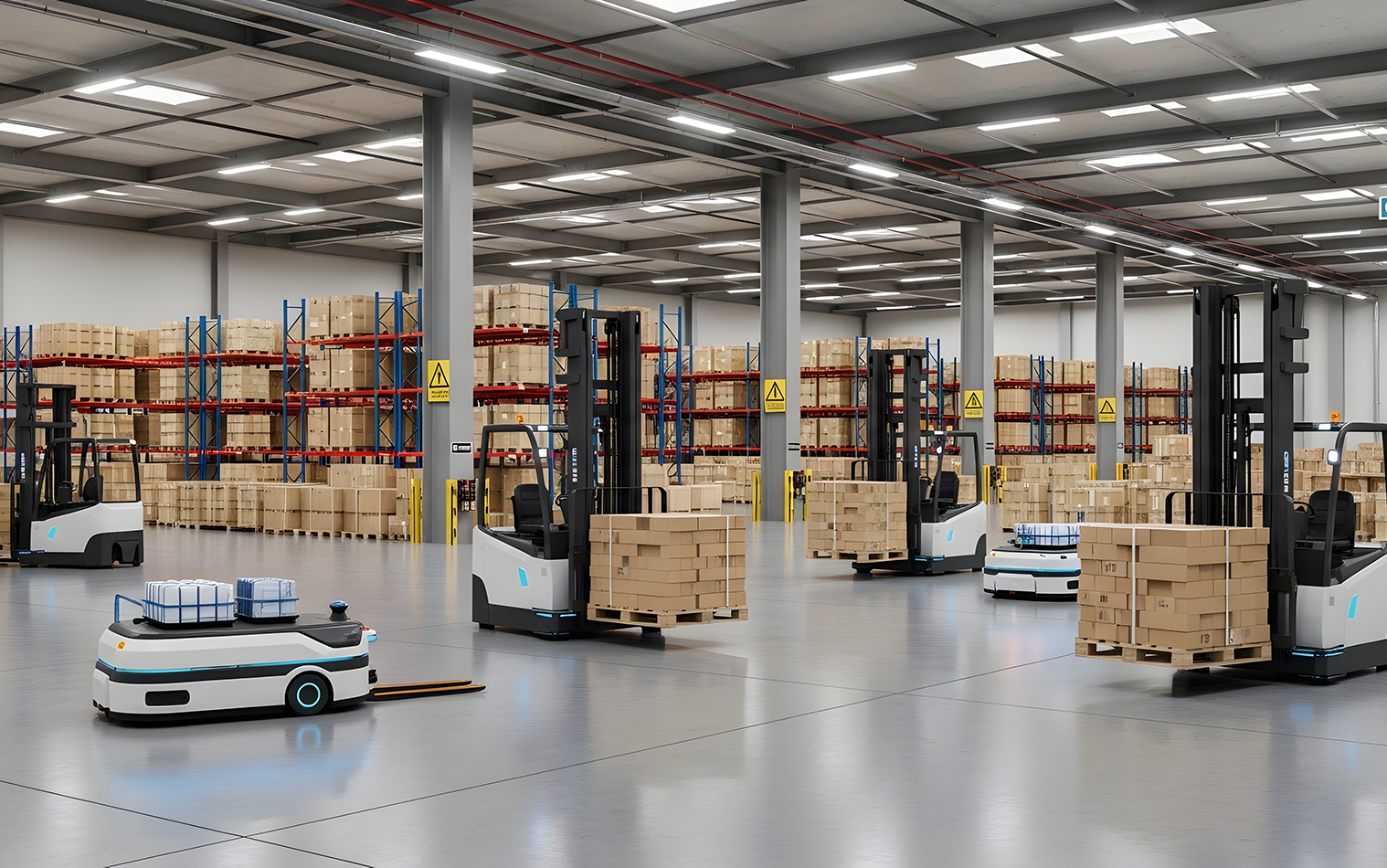
The warehouse robotics industry is approaching a moment of truth. After a decade of new companies, rapid experimentation and ambitious promises, the sector now faces a narrow window in which it must prove it can scale. The market is growing quickly and the need for automation has never been clearer, but only a small handful of companies have managed to deploy robots across multiple sites, and even fewer have succeeded across more than one warehouse application. The gap between the number of companies in the market and the number that have achieved real, repeatable success is now too large to ignore.
According to Mordor Intelligence, the warehouse robotics market will reach a value of $9.33 billion in 2025 and is expected to more than double to $21.08 billion by 2030, growing at a strong 17.7% CAGR. The demand is clearly there, but what remains uncertain is which companies will be able to meet it and how many will still be around to do so.
Prediction #1: Consolidation becomes essential for real scale
The warehouse robotics ecosystem has become fragmented. Startups have spent the past decade solving one specific automation problem at a time. This narrow focus was necessary as physical environments are unforgiving, and progress in robotic manipulation, perception and autonomy often requires years of iteration on a single workflow. The result of all this specialization is a market in which a single warehouse might rely on a different vendor for each step: depalletizing, induction, piece picking, dimensioning or scanning and yet another for mobile transport. Each system has its own software interface, maintenance needs, integration demands and quirks
Warehouse operators are tired of juggling so many vendors. They want fewer partners who can handle more of these steps. Customers say that if two or three robotics companies can handle most of their manipulation tasks reliably, they would prefer that over managing a dozen separate tools.
In 2026, the pressure to simplify the vendor landscape will become impossible to ignore. Consolidation is no longer optional; it’s a requirement for the industry’s survival. To be successful, companies will either acquire adjacent capabilities, merge with complementary vendors or organically expand into related applications in a way that reduces friction for customers. Those that continue betting on a single application, without at least a demonstrated capability outside their core application or broader vision for future growth, will find it harder to raise capital, retain customers and justify their valuations.
Prediction #2: A market shakeout begins before humanoids arrive
Humanoids are an important part of the story, but not because they’ll suddenly take over warehouse work. The reality is that humanoid robots are still early in their development curve. Most of the progress to date has come from lab environments or small pilots. The real, large-scale warehouse deployments remain years away. At the same time, humanoids have already reshaped investor expectations. They have raised enormous funding rounds and captured significant media attention, creating a sense of inevitability around their future impact.
If these companies fail to deliver commercially meaningful results in the next few years, the disappointment could spill over into the broader robotics ecosystem. The risk is that humanoid underperformance becomes a drag on investor confidence across all categories of automation, not just the humanoids specifically. This makes the next two to three years especially important for warehouse robotics.
The sector needs to prove it can scale now and demonstrate strong economics, reliable uptime and the ability to support multiple workflows within the same facility. Otherwise, when the humanoid hype cycle eventually cools, investors' patience may run out.
Prediction #3: AI-assisted workflows become a stabilizing force
The operational environment around warehouses is becoming increasingly unpredictable with tariff changes, routing shifts, port delays and geopolitical tensions impacting supply chain teams. This volatility started as a short-term disruption forcing U.S. businesses to adapt with little notice, and has now become a structural reality.
In this environment, warehouses will increasingly rely on AI-assisted systems that combine automation with human oversight. These hybrid workflows help facilities respond to SKU variability, unexpected volume spikes, packaging changes and re-routing without the need for long reprogramming cycles. To maintain throughput when conditions shift quickly, it will become common practice for facilities to rely on a model in which AI handles the stable, repetitive work and humans intervene for more complex tasks. Instead of replacing labor, warehouse robotics will continue to augment it, providing the stability and adaptability that supply chains now require as a baseline.
Prediction #4: Testing and reliability standards tighten significantly
The next major shift we’ll see in 2026 will be stronger testing, validation and reliability standards. As automation becomes central to daily operations, warehouses are demanding clearer proof that systems work as intended under real-world conditions. They want to know how robots perform with damaged boxes, irregular packaging or varied lighting. Clarity is expected on failure modes and service requirements. The days of polished demo videos serving as evidence are over.
In 2026, Robotic Foundation Model (RFM) testing, digital twins and simulation-driven evaluation will become common requirements for procurement. Automation vendors will need to show repeatable performance across messy edge cases, not just ideal ones. Along these lines, facilities will judge robots by uptime, durability and the predictability of their maintenance cycles. The metric that determines whether a vendor grows or fades out will be reliability.
Prediction #5: Robotics and STEM investment fuel U.S. competitiveness
In 2026, expect robotics deployment to align more closely with national policy goals, corporate reshoring efforts, and renewed attention to STEM workforce development.
There’s a larger national shift toward robotics becoming a critical element of U.S. industrial competitiveness. The U.S. can’t outpace global manufacturing powerhouses without a deeper investment in engineering talent and practical automation. Robotics is becoming fundamental infrastructure for reshoring production, strengthening logistics networks and stabilizing supply chains.
Warehouse robotics plays a central role in that strategy as warehouses sit at the intersection of manufacturing, transportation and retail. Automation in these environments builds a culture of robotic automation that will plant the seeds for automation across the enterprise.
The warehouse robotics industry must prove itself in 2026
The warehouse robotics industry is entering a defining year in which market growth won’t guarantee survival. Investors will demand real results, operators will require reliability and the global environment will force resilience. By late 2026, we’ll start to see the first major mergers and acquisitions signaling who’s built to last and who isn’t. The companies built to last will be those that can scale, adapt and perform in real-world conditions.