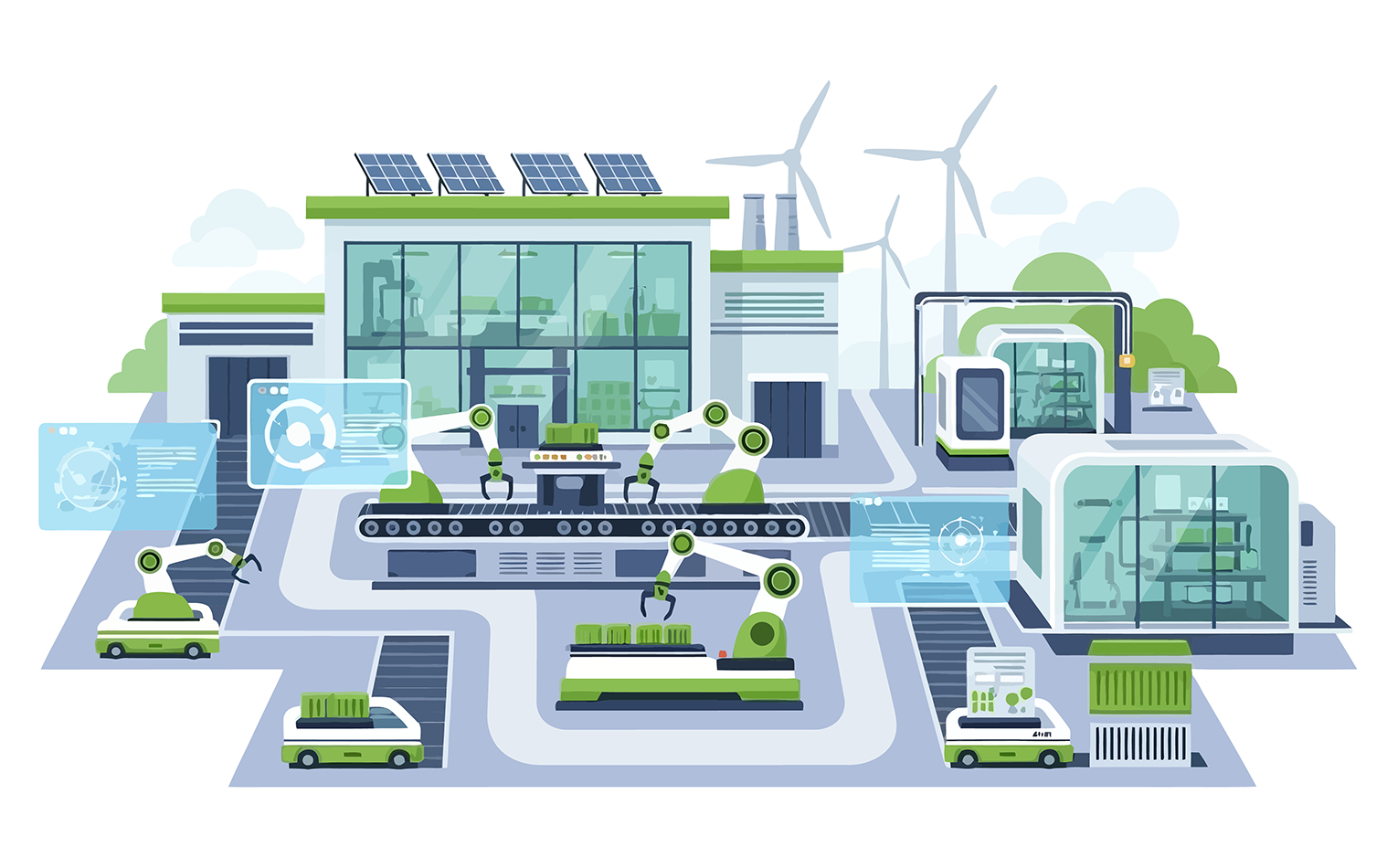
Industrial automation in clean energy is transforming how electricity is produced, stored and delivered. Its integration across diverse clean-power innovations has created systems that operate independently, adapting and responding without human intervention. This capability addresses emerging challenges in security and efficiency while advancing energy‑transition technologies.
Sensors enable live visibility and control
Sensors provide continuous, live data on energy flows and system conditions so operators can see and respond to changes instantly. Connected by the Industrial Internet of Things (IIoT), these form the foundation for monitoring and smarter decision-making across networks.
Forecasting electricity demand
Smart meters contain sensors that measure electricity usage, voltage and power quality in real time and communicate that data back to utilities. When advanced metering infrastructure (AMI) replaces traditional meters, the information helps forecast demand and enable dynamic pricing.
A multiyear study in Colombia demonstrated that hourly measurements collected from AMI sensors enabled accurate one-week-ahead demand forecasting using machine learning models — even without relying on weather inputs. The research confirmed that smart meter sensor data can support operational-grade forecasting for distribution network planning and grid security.
The granular load and voltage readings from these sensors help utilities integrate renewable energy more effectively. By showing sub-hourly consumption patterns, control systems can balance intermittent solar and wind power with demand and charge or discharge batteries. Tracking CO2 Levels in Carbon Capture and Sequestration Carbon capture and sequestration (CCS) is touted as one of the most important efforts to decarbonize hard-to-abate sectors like cement and steel. Automation optimizes the whole process.
Sensors embedded throughout capture plants and pipelines continuously measure CO2 concentration, pressure, temperature and flow rates. Automation uses this data to control the process and adjust the amount of CO2 removed from flue gas. It also helps keep compressors at the right pressure and detects leaks before they become dangerous.
Detecting irregularities inside the transformer
Distribution transformer monitors (DTMs) are installed on transformers and secondary lines to track current, voltage and temperature. These sensors detect potential overload, imbalance or overheating early. If the system recognizes something is off, it sends alerts to SCADA and responds accordingly before failures even have a chance to occur.
This automated capability minimizes damage to the equipment and reduces unplanned outages, especially in critical operations. It also protects renewable energy backfeed, which could be hazardous for utility workers if not properly controlled.
Analytics turn OT data into actionable insights
Data becomes actionable when insights are precise. Advanced analytics help sustainable power by identifying patterns that shape optimization decisions.
Highlighting inefficiencies across facilities
Through IIoT for clean‑energy infrastructure, sensor data skips the delays and limitations of human interpretation. In fact, the information becomes the instructions that machines and control systems can self-execute. For example, when sensors detect inefficiencies, controllers can adjust machine speeds, sequence operations or modify process parameters in real time without operators' intervention.
Research in smart manufacturing has shown that integrating sensors with automated control and analytics can lower electricity consumption by 18% while reducing machine downtime by 25%. It also improves overall resource use by 15% in industrial settings. Optimizing Microgrids
With digital twin analytics
Microgrids often serve as lifelines for underserved or disaster‑affected communities when the main power grid fails. However, reliability depends on the effective management of its variable sources. Emerging research shows that digital twin analytics can fully automate microgrids by creating virtual copies of physical components and operational data.
Digital twins paired with machine learning and fed live sensor readings can enable predictive maintenance and strengthen autonomous decision-making within the infrastructure. This then addresses energy security concerns and strengthens resilience in areas where smart microgrids are located.
Control architectures coordinate distributed clean energy assets
Modern control systems tie together diverse clean-power resources to allow for coordinated operations. Automation enhances these architectures to ensure efficient, reliable and responsive energy management.
Utilizing deep reinforcement learning for HESS
Because renewable sources like wind and solar are intermittent, grids sometimes generate more electricity than demand requires or storage can handle. Deep reinforcement learning (DRL) is being explored and implemented as a cutting-edge solution.
DRL optimizes power-sharing in hybrid energy storage systems (HESS), including batteries, supercapacitors and green hydrogen. These algorithms learn optimal control strategies by using sensor data — energy output, state of charge and generation — along with price signals, weather forecasts and load demand. This enables it to decide in real time how storage should charge, discharge and distribute it.
Research shows that DRL-based control can better balance power between storage and renewable sources than traditional methods, such as stochastic or particle swarm optimization.
Enabling adaptive solar tracking
Solar panels are no longer simply fixed in place, limited by shading from nearby trees or buildings and with reduced power output. Solar trackers overcome these limitations, with automated controls that adjust panel orientation based on irradiance and weather forecasts.
Even single-axis trackers can increase energy production by as much as 35%, while dual-axis trackers achieve up to 45% improvement. Dual-axis systems are especially effective in high-latitude and equatorial regions, as they adjust both azimuth and elevation angles throughout the year.
Advanced automation further leverages live weather data to protect the hardware. For instance, tracker systems can position the panels in stow mode or at least 50° ahead of hailstorms or high winds. This reduces damage risk during extreme weather and enhances overall energy resilience. Predictive Maintenance Anticipates Failures Predictive maintenance has grown alongside automation, using sensors and smart systems to track equipment health in real time.
Monitoring the condition of wind turbine gearboxes
Wind remains the largest source of renewable power in the U.S., with more than 74,000 turbines installed nationwide. While built to withstand extreme environments, these complex structures remain vulnerable to damage.
The gearbox is an example of the most critical yet failure-prone and costly components in a wind turbine. Many fail to reach their 20-year lifespan due to harsh and variable loads experienced during starting, braking or strong gusts. These stresses create subsurface microcracks that degrade bearing surfaces far earlier than expected. Additional challenges include lubrication issues from contamination or extreme temperatures, as well as misalignment of gear components.
To prevent premature failure, machine learning models analyze vibration, temperature and operational data from the gearboxes. Predictive maintenance then forecasts potential failures in advance so repairs can be scheduled during planned downtime rather than causing costly, unscheduled outages.
Smarter, stronger, greener energy with automation
Every element of the green energy ecosystem is becoming increasingly visible, controllable and optimized thanks to advances in automation. As research continues to demonstrate these capabilities, expertise in integrating autonomous systems is emerging as a key competitive advantage for operational reliability and cost efficiency.
Automation is thus the connective thread of tomorrow’s power infrastructure. Those who leverage it will enhance performance, resilience and profitability and become leaders in clean-energy operations.