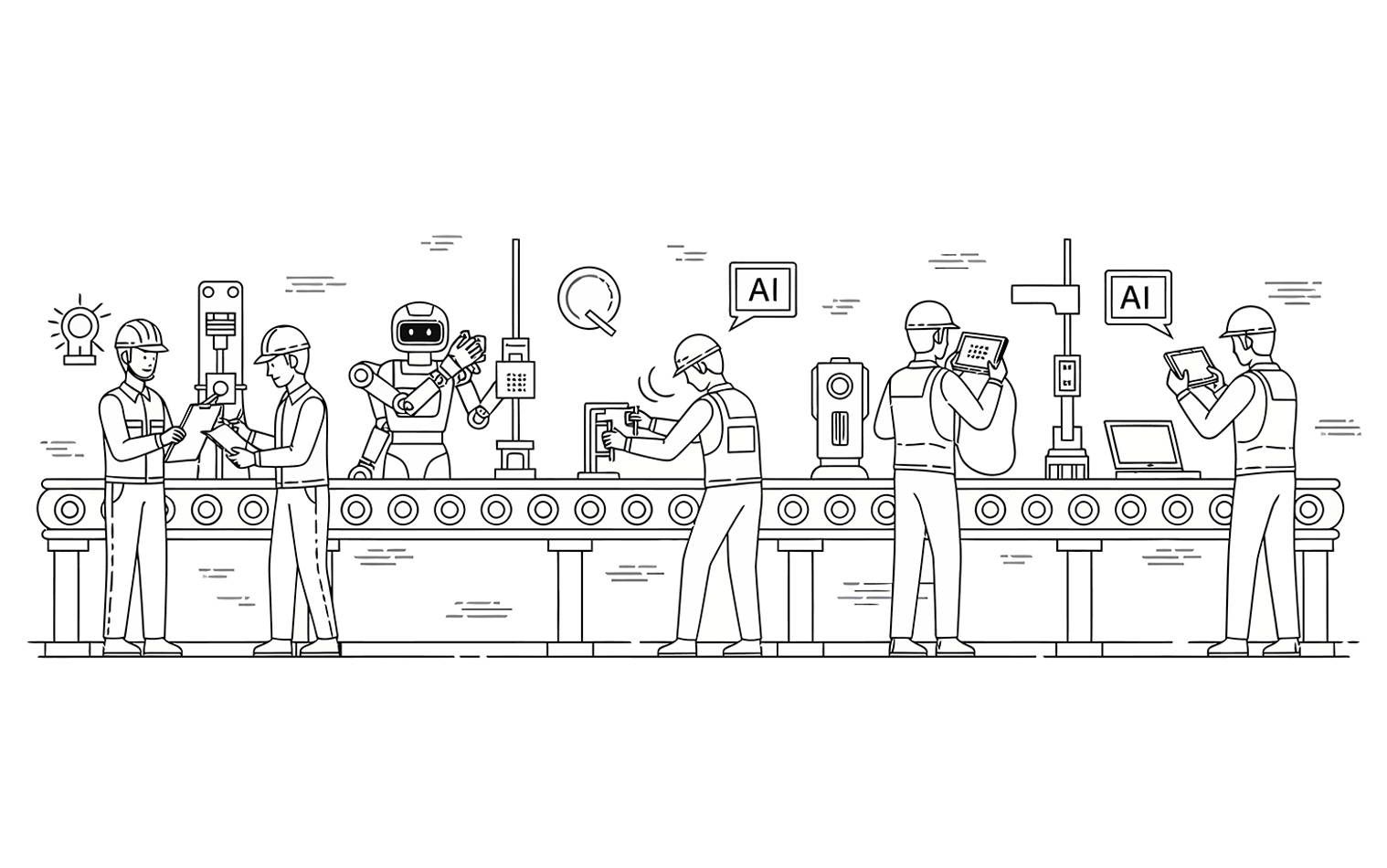
Automation has always promised a clean trade: take repetitive work away from people, increase speed, reduce variation, and free human attention for the decisions that actually require judgment. That trade becomes less clean when artificial intelligence enters the workflow. Traditional automation usually executes explicit rules. AI-enabled automation increasingly interprets language, classifies situations, summarizes evidence, recommends options, and sometimes initiates actions. The system is no longer only moving work faster. It is participating in the interpretation that determines what the work means.
That distinction matters because organizations often automate the visible task while leaving the human decision logic undocumented. The operator knows which alarm matters in this environment, which exception changes the answer, which data point is stale, which customer request is routine on paper but risky in context, and which technically permissible action should still be escalated. Those judgments may be obvious to experienced people because they are supported by years of pattern recognition. They are not automatically obvious to a model, an agent, or the workflow built around it.
The result can look deceptively successful. The process runs. The output is fluent. The response time improves. The dashboard turns green. Then the organization discovers that the same misunderstanding is being repeated at machine speed. The failure was not that automation could not execute. The failure was that the organization never transferred enough of the judgment that execution depended on.
Human-AI roles and responsibilities
The first engineering question should therefore change from “Can this task be automated?” to “What human distinctions make this task safe and correct?” That question is less glamorous than a demo, but it is closer to the real control problem.
NIST's Artificial Intelligence Risk Management Framework already points toward this issue. Its core guidance calls for organizations to define and differentiate human-AI roles and responsibilities, document the limits of system knowledge, specify application scope based on capability and context, and define processes for human oversight. The framework also recommends evaluating AI behavior under conditions similar to the deployment setting rather than assuming generic performance will transfer cleanly into a specific operational environment. Those are not bureaucratic details. They are signals that context is part of the system boundary.
NIST's discussion of human-AI interaction makes the problem even clearer: representing complex human practices in mathematical or data-driven systems can remove necessary context. Once context is removed, the system may still produce technically coherent outputs while missing the conditions that made a human judgment appropriate. In operational settings, that gap can become a reliability problem, a safety problem, a quality problem, or an accountability problem depending on what the automated decision touches.
Consider a maintenance workflow. A model may be able to summarize sensor history, classify a likely fault, and draft a recommended next action. That does not mean it possesses the same decision frame as the technician who knows that this equipment behaves differently after a recent modification, that one sensor is known to drift under heat, or that the production schedule makes a normally acceptable delay unacceptable today. None of those facts are mystical. They are operational context. If they are not represented in the evidence, constraints and escalation rules available to the system, the model has to infer around the missing pieces.
The same issue appears in incident response, quality review, procurement, customer operations, laboratory workflows, scheduling and engineering documentation. Experienced people rarely make decisions from a single fact. They weigh evidence. They distinguish normal from exceptional. They know which source is authoritative, which rule has an exception, and when uncertainty is itself the reason to stop. AI systems can assist with those activities, but assistance becomes fragile when the human weighting system remains implicit.
Managing decision debt
This is where many automation projects accumulate what can be called decision debt. Decision debt is the gap between the formal workflow and the actual reasoning required to operate it well. Organizations carry this debt long before AI arrives. It hides in veteran employees, side conversations, undocumented exceptions, local conventions and the sentence “everybody knows that.” AI does not create the debt. It exposes it, then gives the organization the ability to scale it.
Decision debt becomes especially dangerous when success metrics focus only on throughput. A workflow can reduce handling time while increasing the number of cases that require downstream correction. It can improve consistency while consistently applying the wrong interpretation. It can reduce labor at the first step while creating more review, rework, escalation, or customer friction later. If measurement stops at speed and volume, the system may appear to improve while the organization quietly pays for misunderstanding somewhere else in the process.
A useful pre-automation exercise is to separate the task into three layers: execution, interpretation and judgment. Execution is the visible action: route the ticket, summarize the record, generate the work order, draft the response, compare the options. Interpretation determines what the inputs mean in context. Judgment determines what should happen when evidence conflicts, confidence is low, consequences are asymmetric, or the situation falls outside the ordinary case. Many automation programs document the execution layer thoroughly and treat the other two as if they will somehow emerge from better prompting.
They will not. A longer prompt can add instructions, but it cannot reliably reconstruct organizational knowledge that has never been made explicit. More documents can add evidence, but they can also create a larger pile of contradictions if the system is not told which source outranks another or which version is current. Retrieval solves access. It does not automatically solve interpretation.
Building a decision structure
The control strategy should therefore include explicit transfer of decision structure. Start by identifying where experienced operators disagree with a literal reading of the procedure. Those points are valuable because they reveal hidden judgment. Ask what changes the decision, what evidence is considered trustworthy, what conditions trigger escalation, and what should never be inferred from incomplete information. Capture not only the rule but the boundary of the rule.
The source hierarchy matters too. Many organizations have policies, procedures, manuals, ticket notes, historical records, local workarounds and informal guidance that do not agree perfectly. Humans often know which source is current or authoritative because the history is socially embedded. An AI system sees documents. Unless the workflow carries versioning, ownership, recency, and authority signals, the system may treat a stale but well-written document as equal to the current operating standard. That is not a model failure in the narrow sense. It is an information-governance failure revealed by automation.
Next, make uncertainty operational. AI-enabled workflows often fail socially before they fail technically because fluent language encourages users to over-credit the system's confidence. The output looks complete, so people assume the reasoning is complete. A safer design distinguishes between a system that has enough evidence to act, one that has enough evidence to recommend, and one that should stop and request human review. Those thresholds should be designed around consequence, not convenience.
The cost of error should shape those thresholds. A low-cost reversible mistake can tolerate more automation than an action that affects safety, compliance, production continuity, financial exposure, or customer trust. The same model capability can be appropriate in one context and irresponsible in another because the consequence structure is different. Automation maturity is therefore not measured by how rarely humans are involved. It is measured by whether the human-machine configuration matches the risk of the decision being made.
Human oversight also needs more precision than placing a person at the end of the process. If the human reviewer receives the same compressed summary that created the problem, the review step can become ceremonial. Effective oversight requires access to the underlying evidence, visibility into uncertainty, and enough time and authority to challenge the automated path. Otherwise, the human is not overseeing the system. The human is approving its formatting.
Oversight also fails when escalation is culturally punished. If operators are measured only on speed, they will learn to accept automation rather than question it. If exceptions create paperwork, people will avoid declaring exceptions. If nobody owns the decision to stop the workflow, the system's recommendation becomes the default simply because it is already there. Governance design therefore has to include incentives, authority and workload, not just a box labeled “human review” on an architecture diagram.
Testing, drift and documentation
Testing should mirror the messiness of the operating environment. Clean benchmark cases are useful for basic validation, but mature testing needs stale information, conflicting sources, incomplete records, ambiguous requests, unusual operating conditions, and cases where the correct action is to defer. NIST's AI RMF emphasizes testing and evaluation in conditions similar to deployment. For industrial and operational teams, that means edge cases are not an annoyance around the test plan. They are often the test plan's most valuable material.
A practical test library should include examples collected from real corrections, escalations, near misses, and disagreements among qualified operators. Those cases reveal where the decision boundary is genuinely difficult. They also help teams distinguish between model limitations, missing context, weak source governance, and unclear organizational policy. Not every failure should be solved by changing the model. Sometimes the correct fix is to clarify the process that humans were already interpreting differently.
Organizations should also monitor interpretation drift after deployment. Workflows change, source documents are updated, terminology shifts, equipment is modified, personnel rotate, and new exceptions become normal practice. An AI-enabled process can continue producing polished outputs while its decision frame quietly becomes outdated. Monitoring should therefore include not only accuracy rates but examples of where the system's interpretation no longer matches the judgment of qualified operators.
This has a direct organizational consequence: expertise can no longer remain entirely tacit if AI is expected to participate in the work. That does not mean converting every human instinct into a rigid rule. Some judgments cannot and should not be fully automated. It means identifying which parts of the reasoning must be visible to the system and which parts must remain explicitly human. The goal is not to remove the operator from the loop. The goal is to stop pretending the loop contains judgment that was never transferred into it.
There is also a documentation implication. When a system recommendation changes an action, teams need enough traceability to reconstruct what evidence was available, which policy version applied, what the system produced, what the human accepted or rejected, and why. That record is useful for auditing, but it is equally useful for learning. Without it, the organization sees outcomes without seeing the interpretation path that produced them, which makes recurring mistakes harder to diagnose.
AI-enabled automation can be extraordinarily useful when it reduces cognitive load, accelerates evidence gathering, surfaces anomalies, drafts routine outputs, and helps people act on information faster. The risk appears when speed is mistaken for understanding. A workflow that executes the wrong interpretation consistently is not mature automation. It is a reliable delivery system for a mistake.
The practical standard should be simple: before scaling an AI-enabled workflow, identify the human distinctions the task depends on, represent the ones the system needs, preserve escalation for the ones it should not own, and test whether those distinctions survive under real operating conditions. Automating the task is the easy part. Transferring enough judgment to keep the automation faithful to the work is where the engineering begins.