AutoQuiz is edited by Joel Don, ISA's social media community manager.
This automation industry quiz question comes from the ISA Certified Automation Professional (CAP) certification program . ISA CAP certification provides a non-biased, third-party, objective assessment and confirmation of an automation professional's skills. The CAP exam is focused on direction, definition, design, development/application, deployment, documentation, and support of systems, software, and equipment used in control systems, manufacturing information systems, systems integration, and operational consulting. Click this link for more information about the CAP program.
A pressure measurement has a range of 0-100 psig, a normal operating pressure of 50 psig, and a high alarm setpoint of 60 psig. There is some noise on the measurement as shown in the figure.
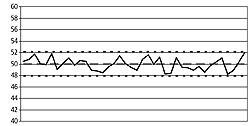
Which of the following would be the best choice for the alarm deadband setting on the high alarm?
a) 10% b) 5% c) 2% d) 1% e) none of the above
Answer A, 10% is not the best choice as it is the difference between normal operation and the high alarm condition, so the high alarm will not clear until the pressure has dropped below 50 psig.
Answer B, 5% is not the best choice as it is more than twice the signal noise and a significant part of the range between normal operation and the high alarm condition.
Answer D, 1% is not the best choice as it is less than the signal noise and will likely create a chattering alarm.
The correct answer is C
, 2%, as the noise is under 2%
Reference
: Bill R. Hollifield and Eddie Habibi, Alarm Management: A Comprehensive Guide

About the Editor
Joel Don is the community manager for ISA and is an independent content marketing, social media and public relations consultant. Prior to his work in marketing and PR, Joel served as an editor for regional newspapers and national magazines throughout the U.S. He earned a master's degree from the Medill School at Northwestern University with a focus on science, engineering and biomedical marketing communications, and a bachelor of science degree from UC San Diego .
Connect with Joel