AutoQuiz is edited by Joel Don, ISA's social media community manager.
This automation industry quiz question comes from the ISA Certified Control Systems Technician (CCST) program . Certified Control System Technicians calibrate, document, troubleshoot, and repair/replace instrumentation for systems that measure and control level, temperature, pressure, flow, and other process variables. Click this link for more information about the CCST program.
How can a transmitter's current output signal be converted to a voltage-input signal, as required by an electronic controller?
a) a resistor is placed across the input terminals of the controller b) all wiring in the loop is tied positive-to-negative c) a forward bias diode is placed between the transmitter and controller d) capacitor is placed across the output terminals of the transmitter e) none of the above
Answer B is a true statement for a current loop, but is not the way that a current signal is converted to a voltage signal that is required by the controller. This answer indicates the driving force for direction of current flow.
Answers C and D would electrically modify the behavior of the circuit, but would not convert current signals to voltage signals. A diode across the controller could be used to prevent current flow in the reverse direction, or could be used with an LED in an optical isolation circuit. A capacitor in a current loop could be used to suppress surges at the transmitter terminals.
The correct answer is A , "A resistor is placed across the input terminals of the controller." A 250Ω resistor in a 4-20mA DC current loop will produce a 1-5VDC signal, as indicated in Ohm's law: E = I · R, where E is voltage, in volts; I is current, in amps; and R is resistance, in ohms. At 4mA (0.004A), E = 250Ω x 0.004A = 1V.
At 20mA (0.020A), E = 250Ω x 0.020A = 5V.
Reference
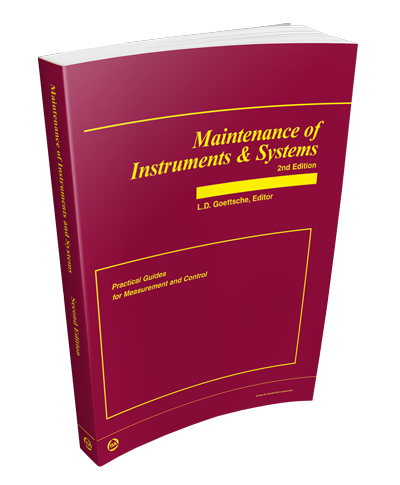
: Goettsche, L.D. (Editor), Maintenance of Instruments and Systems, 2nd Edition
About the Editor
Joel Don is the community manager for ISA and is an independent content marketing, social media and public relations consultant. Prior to his work in marketing and PR, Joel served as an editor for regional newspapers and national magazines throughout the U.S. He earned a master's degree from the Medill School at Northwestern University with a focus on science, engineering and biomedical marketing communications, and a bachelor of science degree from UC San Diego .
Connect with Joel