AutoQuiz is edited by Joel Don, ISA's social media community manager.
This automation industry quiz question comes from ISA's technical training course, Electrical Controls for the Control Systems Technician (TI23) . This class focuses on electrical controls that are frequently overlooked in a formal training program. It is geared toward any level technician who wants a thorough review of electrical process concepts to reinforce their knowledge of basic electricity and develop skills required to install and maintain electrical control devices.
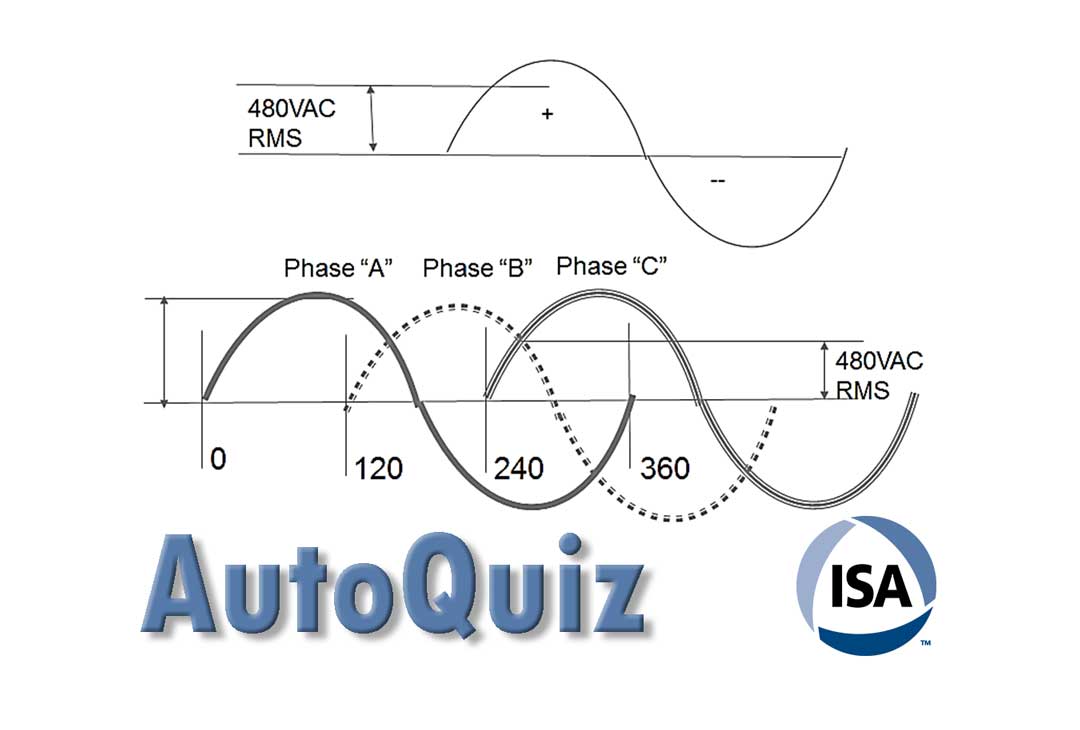
The phase difference between each phase in a three-phase system is which of the following?
a) 180 degrees b) 120 degrees c) 270 degrees d) 90 degrees e) none of the above
Here's the answer to this question from ISA's course offering, Electrical Controls for the Control Systems Technician (TI23) .
The three phases of three-phase power are electrically separated by 120 degrees. In the case of 480 volt three-phase the voltage is approximately 477 VAC across any two legs when connected in a “Y” configuration. Three-phase power provides more constant power due to a constant differential.
The correct answer is B.
About the Editor
Joel Don is the community manager for ISA and is an independent content marketing, social media and public relations consultant. Prior to his work in marketing and PR, Joel served as an editor for regional newspapers and national magazines throughout the U.S. He earned a master's degree from the Medill School at Northwestern University with a focus on science, engineering and biomedical marketing communications, and a bachelor of science degree from UC San Diego .
Connect with Joel