



AutoQuiz is edited by Joel Don, ISA's social media community manager.
Today's automation industry quiz question comes from ISA's technical training course, Control Valve Mechanics and Operations from Analog to Digital . The course takes a deep dive into the control valve’s mechanical composition, actuation and positioning accessories, including a detailed study of digital valve controllers. Training is hands-on and lab intensive, and is designed to offer a real-world, working knowledge of valve mechanical configurations, valve operations and positioner calibrations.
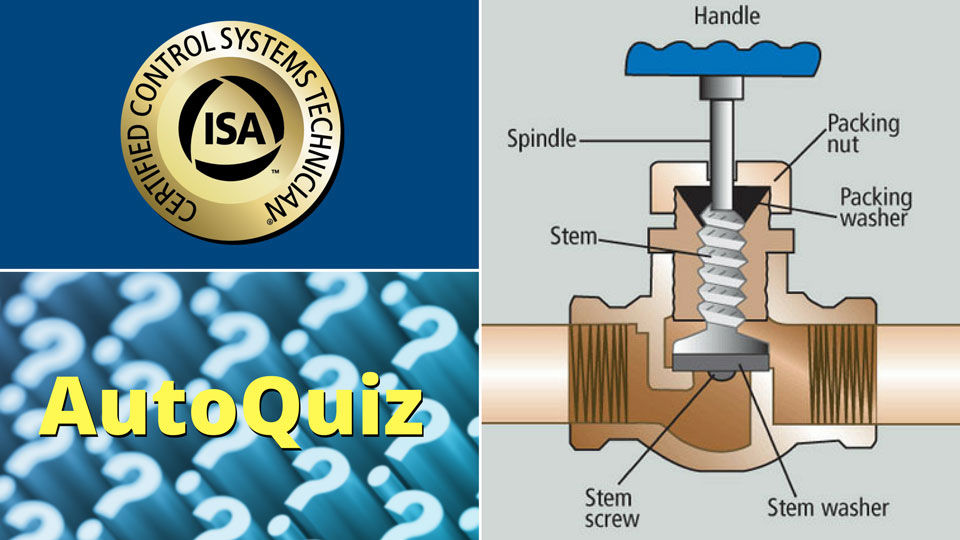
The process of grinding the plug and seat of a valve is called:
A) Characterizing B) Linearizing C) Lapping D) Calibrating E) None of the above
Although all these terms describe a process that a valve manufacturer might engage in during or after valve construction, the term lapping is a machinist's term and means to shape or fit by working two surfaces together with (or without) abrasives until a very close fit is produced. The close fit, in this case, is between the plug and the seat and would ensure that there's no fluid leakage.
The correct answer is C.
Want to learn more about control valves? Sign up for ISA’s training course, Control Valve Mechanics and Operations from Analog to Digital .
About the Editor
Joel Don is the community manager for ISA and is an independent content marketing, social media and public relations consultant. Prior to his work in marketing and PR, Joel served as an editor for regional newspapers and national magazines throughout the U.S. He earned a master's degree from the Medill School at Northwestern University with a focus on science, engineering and biomedical marketing communications, and a bachelor of science degree from UC San Diego .
Connect with Joel