Carbon capture initiatives are typically presented with a focus on new and emerging technologies, large scale capital projects and ambitious decarbonization goals. Behind each successful carbon capture, utilization and storage (CCUS) project however, there exists a much less visible, but equally important, foundation upon which those projects depend: precise chemical composition measurement of gas streams.
For the power generation, cement, steel, refining, chemical and hydrogen production sectors, CCUS represents a primary method to reduce emissions associated with processes that have been traditionally difficult or impossible to decarbonize.
Each of these sectors generates a large volume and continuous flow of CO2 gases, creating ideal conditions for capturing these gases before they enter the atmosphere. As regulatory standards continue to be implemented at a rapid pace and companies increase their commitment to addressing climate change, CCUS is rapidly evolving from a forward-looking concept to a necessity for operations.
The drivers behind this trend include both economic and strategic factors. Increasingly, governments have developed regulations on emissions, pricing mechanisms for carbon, and incentives to drive development. In the U.S., the federal 45Q tax credit is a major source of funding for each ton of CO₂ captured and stored. Other global markets also provide similar subsidy structures or trade platforms.
At the same time, many large-scale industrial processors are aligned with net-zero targets through 2030–2050 and require solutions that will enable them to continue to produce and meet their environmental goals.
While the strategic and regulatory case for CCUS is increasingly well established, its successful implementation ultimately depends on precise process monitoring and control. However, the performance, reliability, and cost-effectiveness of such technology is largely dependent upon an accurate description of the gas streams involved. As such, process gas chromatography continues to be one of the primary tools used in industrial processes for ensuring that CCUS systems are operating reliably, meeting all applicable regulatory requirements, and achieving the best possible performance.
Process gas chromatography
A process GC is an analytical tool used to continuously measure the chemical make-up of a gas stream flowing through industrial equipment. One of the most significant advantages of using gas chromatography is the ability to analyze a complex gas mixture and split it into individual components during a single measurement.
Understanding the chemical composition of a gas is important for several reasons. It is important for maintaining the quality of products, optimizing operating parameters, protecting people who are working near the process area, and compliance with regulations.
The analyzer works by sampling a small amount of gas from a pipeline or process stream and injecting it into a flow of carrier gas. This mixture then moves through a column filled with a stationary phase material. Each component interacts with the stationary phase differently, causing it to move through the column at a distinct rate. As each separated component reaches the end of the column, it enters the detector where it is identified and quantified. The detector’s signal is processed by the computer to determine the concentration of each component in the sample.
In carbon capture processes, large amounts of flue or process gases enter a capture unit. Therefore, it is imperative to be able to accurately separate and quantify the major components in the gas. However, one of the biggest obstacles in this regard is that different processing plants generate different gas mixes while operating under different pressures, temperatures and impurity levels.
For flue gas analysis from a power plant, the analyzer typically tracks CO₂, O₂, N₂, SOx. When analyzing the gas during blue hydrogen or syngas production, it would likely follow H₂, CO, CH₄, CO₂ to ensure the CO₂ removal is effective. In both industrial off-gas and chemical looping systems, there could be many additional hydrocarbons and contaminates present that need to be measured and tracked.
Because of these factors, analytical equipment needs to be versatile. However, many plants use online analyzers that detect only one compound or element, so several are needed for more complex streams.
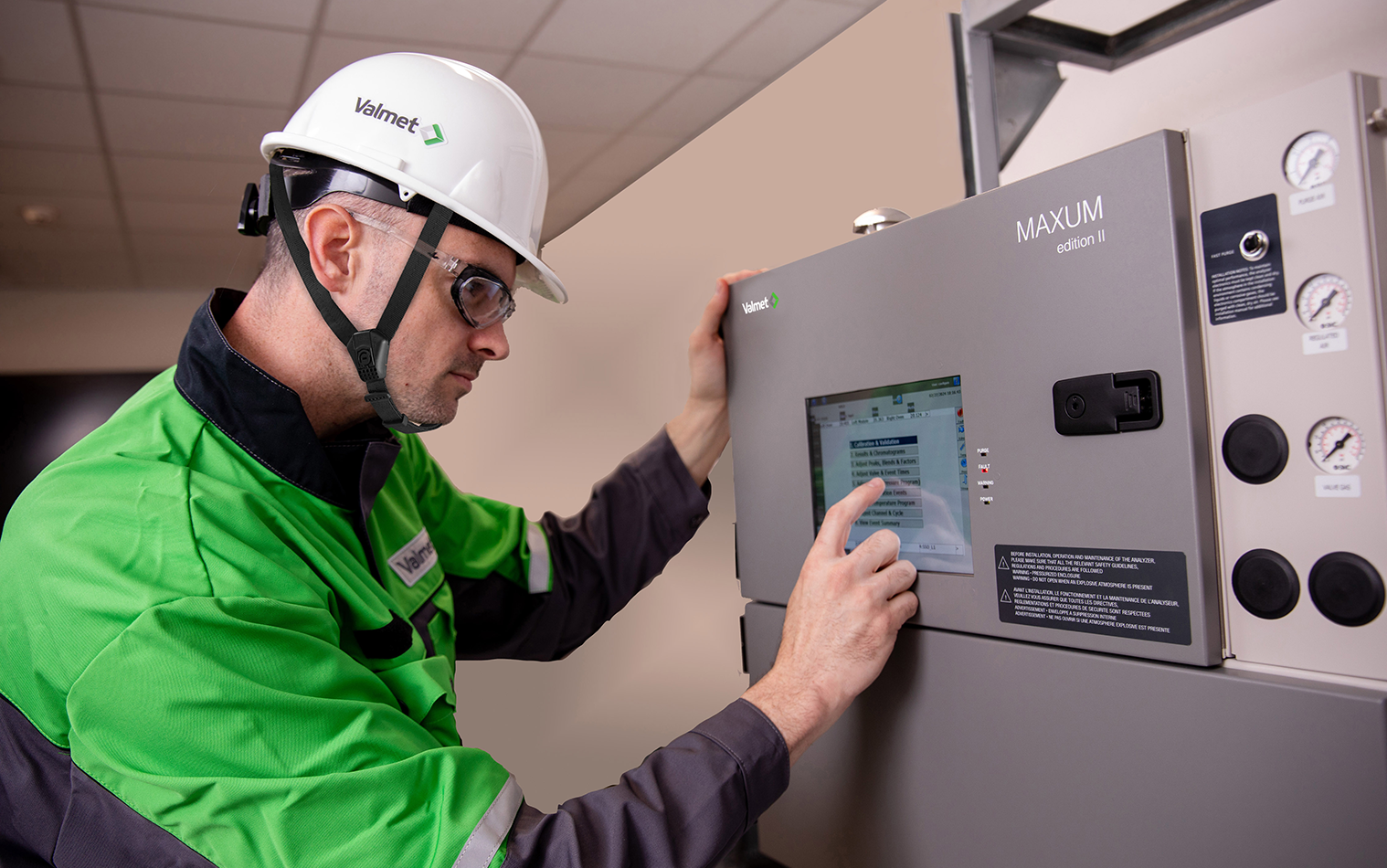
“The strength of gas chromatography lies in its ability to measure multiple components within a gas stream simultaneously, unlike individual gas analyzers that are limited to detecting a single component at a time,” said Al Kania, Business Development at Valmet, a global provider of technologies, automation, and services for process industries. Valmet’s process GC, MAXUM II, has a large installed base across process industries globally.
Accurate measurements guide decisions
Process gas chromatograph systems must deliver a level of accuracy that supports effective CCUS implementation. Reliable, high-precision measurements enable operators to accurately determine system composition, providing a dependable foundation for all downstream decisions. With detailed compositional information, operators can effectively evaluate the performance of carbon capture processes and make informed adjustments to improve absorption and stripping efficiency.
Accurately measured process parameters provide the confidence needed by operators to make educated decisions regarding the actual chemistry of the system. In addition, using accurate measurements of the chemical composition of the feedstock, operators can make knowledgeable decisions as to the effectiveness of the carbon capture process and identify opportunities to optimize the absorption and stripping processes.
The accurate identification and quantification of each component present in the gas stream is critical in managing amine degradation during CO₂ absorption, mitigating corrosion risks through effective control of corrosive conditions, operating compressors and pipelines safely at or below their design limits, and ultimately ensure that the captured CO₂ meets the specified standards of purity for transportation and storage.
Validated laboratory grade compositional data is also necessary to meet many of the reporting requirements for regulatory purposes related to carbon sequestration and to qualify for available tax incentives.
“Many reporting frameworks require validated, laboratory grade quality for process compositional data,” noted Kania. “Process GCs are the established analytical method capable of meeting these requirements.”
Guarding against analytical drift
Although advanced analyzers like gas chromatographs are sophisticated, small measurement inaccuracies can lead to higher operational expenses or cause the control system to make unnecessary adjustments to the process.
This gradual shift in accuracy, known as analytical drift, is caused by variables such as temperature, detector deterioration, contaminants, and electronic stability issues. Analytical drift may occur even when the analyzer is regularly calibrated.
“If an instrument experiences analytical drift, it may report CO₂ concentrations that are either higher or lower than actual values. This can lead the system to incorrectly adjust absorber or regeneration conditions, resulting in increased energy consumption or reduced capture efficiency,” said Kania.
Accurate gas chromatography (GC) readings play an important role in minimizing operational and safety-related risks from hydrogen sulfide (H₂S) breakthroughs and oxygen (O₂) ingress.
By maintaining their accuracy and reliability, GC instruments provide timely and reliable information on changes to the gas mixture so operators can take actions before the situation escalates.
GC design and construction
The design and construction of the process GC is also a factor in controlling drift. Industrial-grade products like the MAXUM II are designed to operate across a temperature range of -20 °C to 100 °C and should be rated for use in corrosive and potentially explosive atmospheres where hazardous gases may be present.
Kania said the MAXUM II also utilizes real-time diagnostics to predict component wear, drift, or failure before it disrupts operations.
Another factor that can affect measurement accuracy are the changes that occur in gas composition when a pilot-scale operation transitions to full-scale production. “At the pilot stage, the gas composition may appear consistent. Once the process is scaled up, small variations in temperature, reaction efficiency, or material flow can cause the gas composition to drift over time,” said Kania.
If these changes are not detected promptly, the plant may continue producing gas that falls outside the required purity specifications. This is where the advantages of real-time monitoring far outweigh periodic sampling and analysis in a laboratory. “Instead of waiting hours for laboratory results, inline analyzers allow operators to observe changes in gas composition as they occur,” said Kania.
Advancing CCUS initiatives
According to Kania, processors producing significant amounts of CO₂ are regularly approached by major energy companies which develop and operate CCSU projects, often in partnership with specialized technology providers.
Carbon capture systems come in several types and are typically installed on industrial exhaust streams to remove CO₂ before it is emitted, often as modular units that can be retrofitted onto existing plants.
For facilities like steel mills, cement plants and pulp and paper mills, the most widely deployed technology is amine-based chemical absorption systems installed on flue gas streams. In this approach the exhaust gas is passed through a large absorber tower containing a liquid solvent that chemically binds with carbon dioxide.
Most industrial-scale facilities such as steel mills, cement plants and pulp and paper plants deploy chemical absorption systems that use amine solvents to remove CO₂ from their flue gas streams. The process works by passing the flue gas through an absorber tower that has a liquid solvent in it which reacts with carbon dioxide to form a compound.
The amines react specifically with CO₂ while allowing nitrogen, oxygen and all other gases to be removed from the absorber. The CO₂ rich liquid is then heated in a regeneration column, releasing the CO₂ into a compressed gas stream. The solvent is then recirculated to the top of the absorber.
Another type of gas purification for removing CO₂ is physical absorption, also known as solvent absorption. In this method the gas being purified is contacted with a solvent that will absorb the CO2.
Various other carbon capture methods separate CO₂ by using different mechanisms to improve efficiency and purity. Given the diverse process configurations, projects often prioritize the flexibility of a single instrument platform.
“With configurable detectors, one analyzer can perform a wide range of analytical measurements across multiple points in the CCUS value chain, minimizing the need for separate instruments and reducing long-term maintenance demands,” explained Kania, adding that the MAXUM II can be configured for a range of applications, including flue gas analysis, CO₂ removal in hydrogen and syngas production, industrial off-gas treatment, CO₂ purity verification before transport, and monitoring during reinjection and at the wellhead.
A foundational tool for CCUS
Today, CCUS has evolved from an ambitious concept into an actual engineering solution to meet ambitious decarbonization goals. As processers continue to increase their CCUS investments, measuring, validating, and controlling the gas streams will become increasingly important for both operational efficiency as well as regulatory reporting requirements, verification of stored CO₂ and integrity of long-term storage.
In environments characterized by extremely high concentrations of CO₂, trace contaminants, and the need for uninterrupted operation, process gas chromatography is a foundational technology that enables the precise, continuous monitoring of complex gas streams.