Depending on what you read, which events you attend and who you speak to, you’d be forgiven for thinking that humanoid robots at scale are hiding just around the corner, a technological distraction best left in science fiction or most likely, somewhere in between.
Some industry analysts, such as ABI Research, are predicting a market worth $6.5b by 2030. Conversely, Gartner recently claimed that humanoid robots risk stalling at pilot stage, predicting that fewer than 20 companies will be live in production for supply chain and manufacturing use cases by 2028.
What is in no doubt is that we’re moving into an age of embodied, or “physical” artificial intelligence, providing the foundation for a new era of robotics in all forms, including humanoid.
Physical AI at the frontier
Physical AI models provide deep understanding of spatial relationships to industrial systems, giving them the theoretical knowledge of how to act in the real world. But as knowledge and wisdom are different things, robots need to both understand the physical environment, and be able to apply this knowledge, acting safely and effectively.
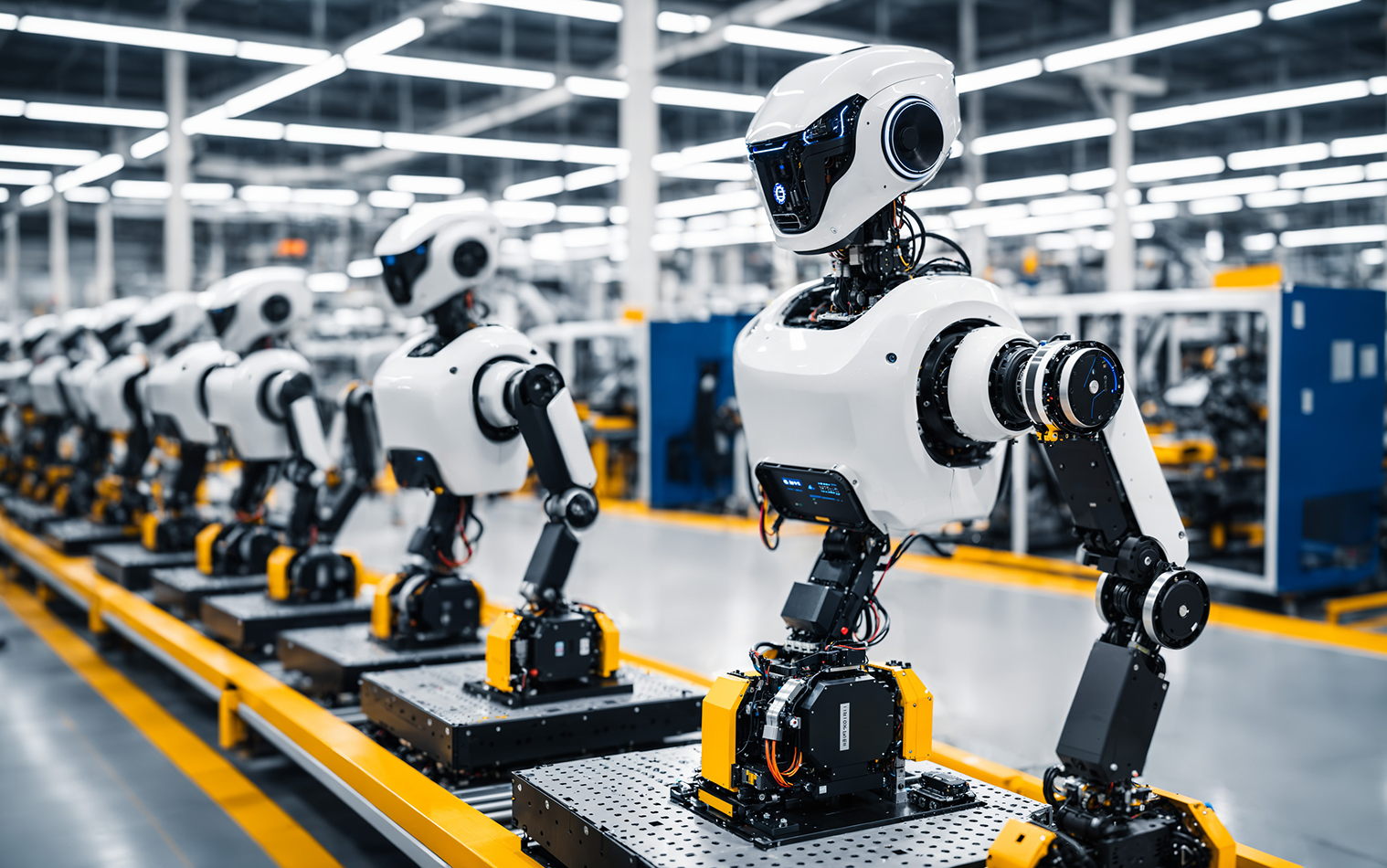
The vision for humanoid robots is one in which they sense and adapt to real-world environments in real-time, exactly as a human would. Like your average human, they combine perception, intelligence and motion, allowing them to understand their surroundings, plan their actions and act appropriately.
Underpinning these advancements in environmental understanding — and truly bringing the vision of humanoid robots to life — are advances in sensors, actuators, edge AI processing and efficient power systems.
But some may still question why we are choosing to develop robots in the human form, when many industrial robots remain designed for single, specific tasks.
Why human-like robots?
The industrial interest in humanoid robots is being driven by several key factors.
The first is an increasing workforce gap in vital manufacturing, logistics, healthcare and service sectors. Many of these industries involve physically demanding, repetitive or dangerous tasks; all ideally suit to the use of robots over humans. While existing robots are optimized for specific tasks, humanoid robots retain a high level of dexterity and flexibility. This allows them to more quickly adapt to changing conditions and undertake a variety of tasks within an industrial environment.
The second factor is compatibility with existing workplace environments. It may be stating the obvious, but humanoid robots are ideally suited to operate in spaces built for humans. This means they can be employed in existing workspaces without adaptation, navigating stairs, doorways, shelving and workstations without requiring costly facility redesigns. This dramatically lowers barriers for adoption of robotics across multiple sectors where it was previously unfeasible.
Third, is the fact that humanoid robots serve as valuable testbeds for advancing biomechanics, robotics engineering and embodied intelligence, all of which combine to deliver the full potential for physical AI. As humanoid robots approach cost parity with human labor, and hardware and sensors advances are improving their abilities to respond and react to evolving environments, we believe they are poised to join the workforce in significant numbers over the coming years.
Humanoid robots are already moving out of labs. The first meaningful applications are concentrating in logistics and manufacturing for material handling and simple assembly steps, but there are also early pilots in healthcare support, retail, and basic inspection roles.
The foundations of robot intelligence
Physical AI refers to the integration of AI with physical systems, where AI is embedded directly into physical entities that can sense, act and adapt in real-time. Unlike large language models (LLMs) that operate in data center environments, physical AI functions in tandem with a physical system interacting with the environment.
The core elements that allow technology to translate its understanding of the physical environment with the ability to act in real-time are sensors for perception, computation for interpretation, and actuators for movement.
These come together in a tightly integrated semiconductor platform that combines sensing, compute, motion control, power management, connectivity and functional safety into deterministic, real-time systems.
True 3D perception requires depth sensing, environmental mapping and object detection. For robots, this is achieved through MEMS and image sensors, global shutter CMOS sensors, and Time-of-Flight (ToF) modules. The first two are vital in addressing challenges with diverse objects and maintaining accurate spatial representations despite sensor noise and environmental complexity. These allow robots to better track motion and changes in their environment, reacting more quickly and preventing collisions and accidents.
Embedded computation is where the most drastic advancements have been in the last decade. Edge AI processing and machine learning (ML) capabilities have notably accelerated embedded robotic intelligence. New innovations enable distributed intelligence for perception, motion planning, simultaneous localization and mapping (SLAM), and motor coordination at the edge.
By reducing bandwidth and offloading low-priority tasks from the main CPU, real-time responsiveness is enhanced. And modern deep learning and reinforcement algorithms are leading to continual improvements and optimizations on the software side.
While we don’t underestimate the challenges of replicating the world’s most evolved biological and biomechanical system, in relative terms motion control is more straightforward. Humanoid robots utilize multiple motor drivers and precision motor controllers for various robot joints — shoulders, neck, elbows, wrists, knees and fingers — to replicate human physical movement.
It is the combination and integration of these components that enables robots to become intelligent, responsive, autonomous agents rather than just programmed machines. A complex and comprehensive portfolio of semiconductor solutions allows a perfect integration of the mechanical and electronic systems. This allows humanoid robots to perform complex tasks with precision, safety and intelligence in shifting environments.
Remaining challenges and the road ahead
There are still significant issues to be overcome before wide scale adoption of humanoid robots becomes a reality. Practical concerns related to deployment, software improvements, data security, cost scaling, standards and regulations all need to be defined and overcome. And of course, there’s the question of whether humans themselves will accept humanoid robots.
Innovations across AI, advanced sensors, high-performance semiconductors and next-generation mechanical systems are unlocking technology improvements at a rapid rate. As these technologies mature, humanoid robots will shift from isolated pilots to broad deployment across factories, hospitals, warehouses and more.
Robots will eventually become valued collaborators and coworkers, supporting workforces in environments that demand physicality, adaptability and efficiency.