



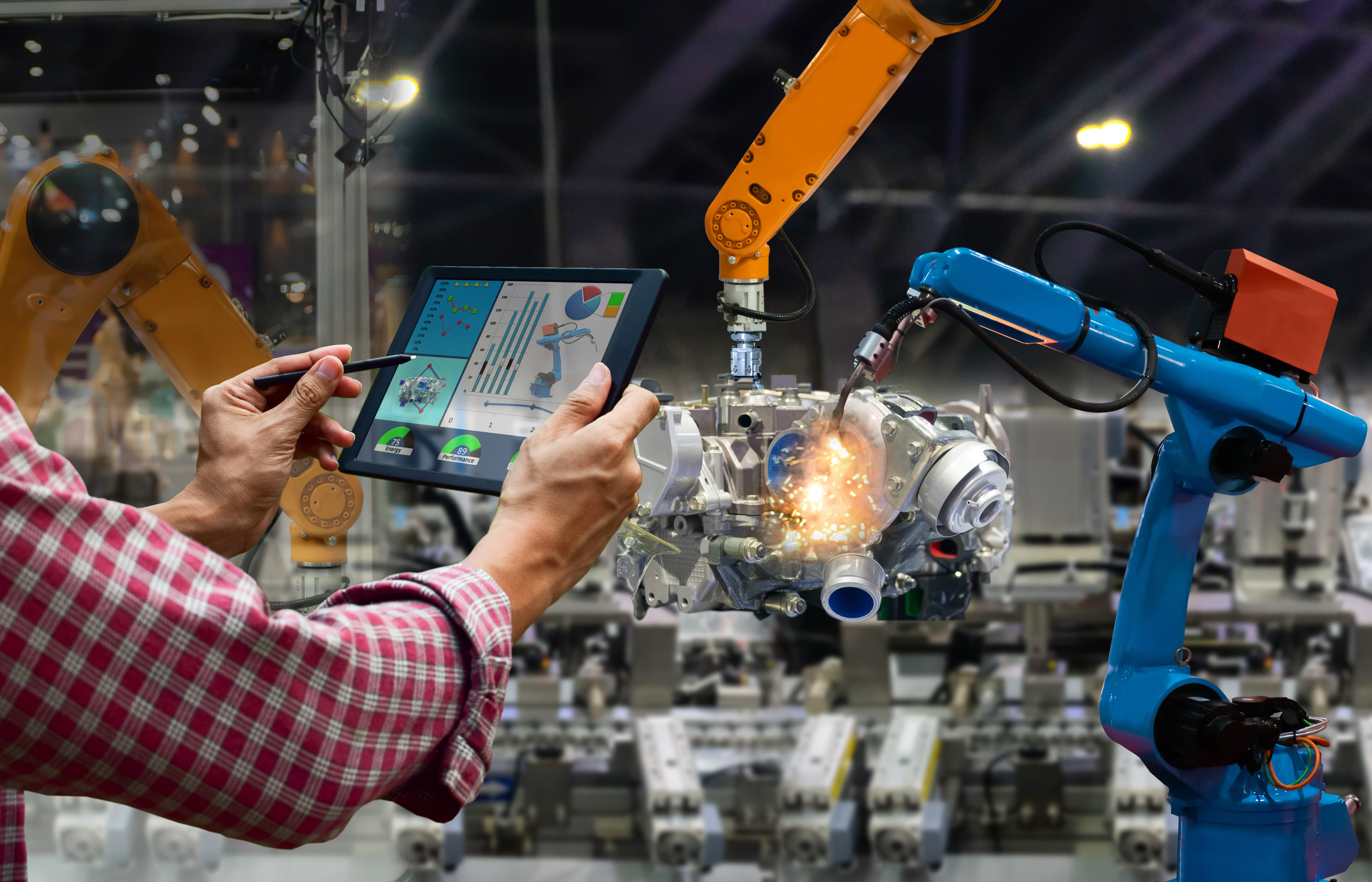
The principle idea behind the implementation of Industry 4.0 solutions is to empower manufacturing companies to
enhance collaboration among various departments
, making the right information available to the right people on a real-time basis. The goal is to facilitate appropriate decision-making at the right time, thereby increasing efficiency and productivity.
Cyber-Physical Systems
The key element in the implementation of the concepts of Industry 4.0 is the idea of
cyber-physical systems (CPS)
. The term "cyber-physical systems" was coined by Helen Gill at the National Science Foundation in the United States.
According to the NIST Special Publication 1500-201 Framework for Cyber-Physical Systems: Volume 1, Overview, cyber-physical systems are smart systems that include engineered interacting networks of physical and computational components . The publication highlights that these highly interconnected and integrated systems provide new functionalities to improve quality of life and enable technological advances in critical areas, such as personalized health care, emergency response, traffic flow management, smart manufacturing, defense and homeland security, and energy supply and use. Thus, CPS have great potential to enable innovative applications and impact multiple economic sectors in the worldwide economy.
Acatech (National Academy of Science and Engineering, Germany), in its report Cyber-Physical Systems, describes CPS as follows: cyber-physical systems are systems with embedded software (as part of devices, buildings, means of transport, transport routes, production systems, medical processes, logistic processes, coordination processes, and management processes). Cyber-physical systems:
-
Directly record physical data
using sensors and
affect physical processes
using actuators
-
Evaluate and save
recorded data
and actively or reactively interact both with the
physical and digital
world
-
Are connected
with one another and in global networks via digital communication facilities
-
Use globally available
data and services
-
Have a series of dedicated, multimodal
human-machine interfaces
The result is a wealth of far-reaching solutions and applications for all areas of our everyday life.
Manufacturing and Cyber-Physical Systems
From a manufacturing industry perspective, a cyber-physical system is an
internet-enabled physical entity
, such as a pump or compressor, embedded with computers and control components consisting of sensors and actuators. Such an entity, which is IP address-assigned, is capable of self-monitoring, generating information about its own functioning, and communicating with other associated entities or even outside. It is a self-regulating and autonomous operation.
In the years to come, as the Fourth Industrial Revolution evolves, industrial firms will begin to leverage the tenets of CPS more and more to help achieve operational excellence through productivity improvements, efficient deployment of all resources (including material and human), customer fulfillment, and the enhancement of shareholder value. Envisioning this development,Klaus Schwab, founder and executive chairman of the World Economic Forum, used the term "Fourth Industrial Revolution" to describe the trend.
The foundation for Industry 4.0 was laid during the Third Industrial Revolution, characterized by the extensive application of electronics and computers to automate industrial production processes.
The expanding use of electronics and computers
contributed to their declining prices, the miniaturization and robustness of computers, and a massive increase in computing and processing power. Digital and communication technologies began to converge. We witnessed the first stages of development of edge/cloud computing, the Industrial Internet of Things (IIoT), artificial intelligence (AI), autonomous robots, and such others. The integration of digital technologies with industrial technologies is set to transform manufacturing and help realize the vision of Industry 4.0.
The tenet of Industry 4.0 is that a manufacturing company will be able to achieve higher efficiency, productivity, and the autonomous operation of production processes by ensuring that machines/plant equipment, logistics systems, work-in-progress components, and such other elements (including people)
directly communicate with each other to achieve collaboration
. A manufacturing company that wants to align its vision with that of Industry 4.0 must take steps to
convert existing physical entities into cyber-physical systems
.
Based on its own assessment, each company has to identify machineries, equipment, or other physical systems of its industrial plant that have the potential to deliver maximum value. The company must proceed further to integrate them with cyber systems and evolve into a network of cyber-physical systems. A refinery complex, for example, may have on-site and off-site tank farms with pipelines, control valves, and pumping stations connecting them to the main plant. Regarding tank farm upkeep, the present practice typically is manual inspection and periodic maintenance, which is expensive and not efficient.
By converting these assets into CPS and supporting them with suitable analytics software, the refinery will be able to switch over to remote monitoring, and predictive maintenance can benefit.
This article is a product of the International Society of Automation (ISA) Smart Manufacturing & IIoT Division. If you are an ISA member who is interested in joining this division, please log in to your account and visit this page .