This post is an excerpt from the journal ISA Transactions. All ISA Transactions articles are free to ISA members, or can be purchased from Elsevier Press.
Abstract:
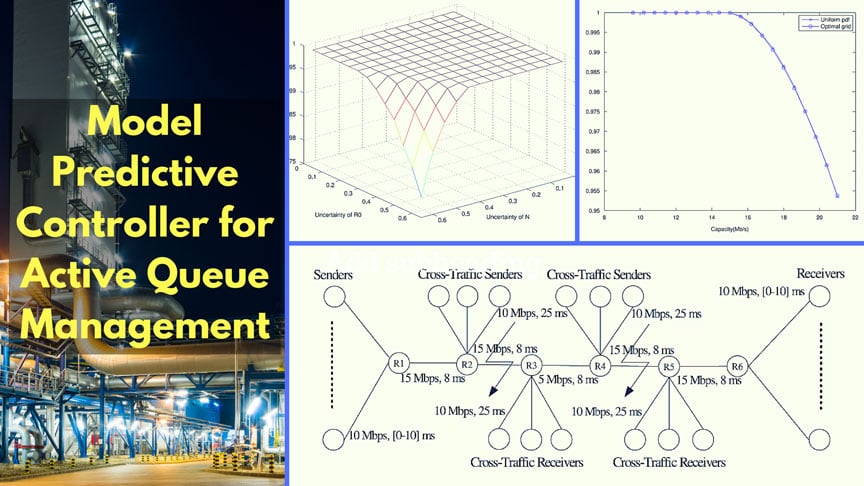
Model predictive (MP) control as a novel active queue management (AQM) algorithm in dynamic computer networks is proposed. According to the predicted future queue length in the data buffer, early packets at the router are dropped reasonably by the MPAQM controller so that the queue length reaches the desired value with minimal tracking error. The drop probability is obtained by optimizing the network performance. Further, randomized algorithms are applied to analyze the robustness of MPAQM successfully, and also to provide the stability domain of systems with uncertain network parameters. The performances of MPAQM are evaluated through a series of simulations in NS2.
The simulation results show that the MPAQM algorithm outperforms RED, PI, and REM algorithms in terms of stability, disturbance rejection, and robustness.
Free Bonus! To read the full version of this ISA Transactions article, click here.
Join ISA and get free access to all ISA Transactions articles as well as a wealth of other technical content, plus discounts on events, webinars, training & education courses, and professional certification.
Click here to join ... learn, advance, succeed!
2006 Elsevier Science Ltd. All rights reserved.