This post is an excerpt from the journal ISA Transactions. All ISA Transactions articles are free to ISA members, or can be purchased from Elsevier Press.
Abstract:
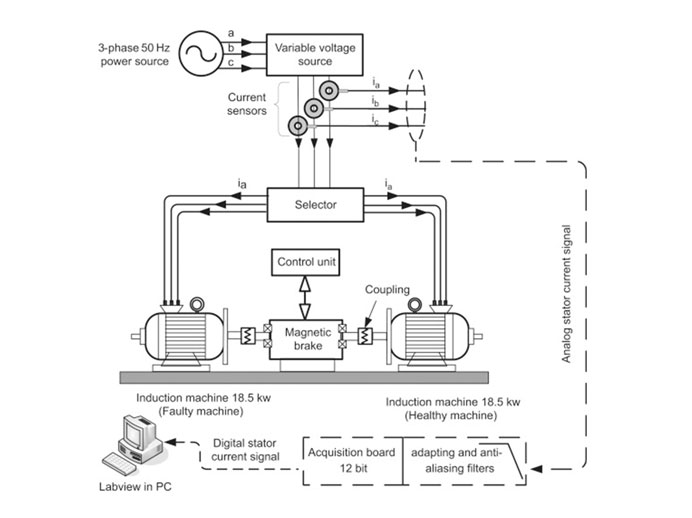
Detection and identification of induction machine faults through the stator current signal using higher order spectra analysis is presented. This technique is known as motor current signature analysis (MCSA). This paper proposes two higher order spectra techniques, namely the power spectrum and the 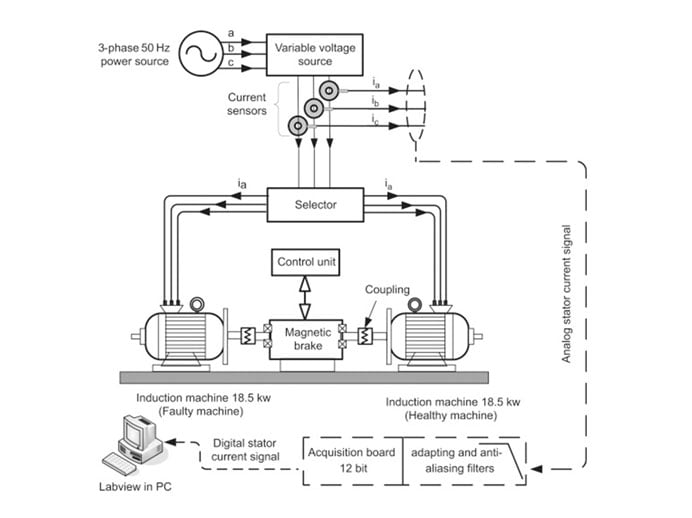 slices of bi-spectrum used for the analysis of induction machine stator current leading to the detection of electrical failures within the rotor cage. The method has been tested by using both healthy and broken rotor bars cases for an 18.5 kW-220 V/380 V-50 Hz-2 pair of poles induction motor under different load conditions.
Experimental signals have been analyzed highlighting that bi-spectrum results show their superiority in the accurate detection of rotor broken bars. Even when the induction machine is rotating at a low level of shaft load (no-load condition), the rotor fault detection is efficient. We will also demonstrate through the analysis and experimental verification, that our proposed proposed-method has better detection performance in terms of receiver operation characteristics (ROC) curves and precision-recall graph.
Free Bonus! To read the full version of this ISA Transactions article, click here.
Join ISA and get free access to all ISA Transactions articles as well as a wealth of other technical content, plus discounts on events, webinars, training & education courses, and professional certification.
Click here to join ... learn, advance, succeed!
2006 Elsevier Science Ltd. All rights reserved.