
Clark Dressen, Dow Corporation global director, described extending the reach of systems with the application of private 5G networks at the 27th Annual ARC Industry Forum. Dressen for many years has been involved in implementing and growing networking throughout the company’s manufacturing plants. He emphasized a big part of digitalization is targeted at the way we work is getting reliable, timely and actionable information in the hands of stakeholders including process operators, maintenance technicians, environmental health and safety people, and supply chain people. These people must go to many areas in production plants and outdoor areas out of the reach of Wi-Fi, and public cellular signals.
Expanding data connectivity
Dow plants are industrial chemical process plants that include many heavy assets, such as rotating equipment and steel infrastructure plus outdoor equipment and tanks. For example, Dow’s Freeport site is 5,000 acres spread out with no Wi-Fi or public cellular available. Because of lack of pervasive digital communications, many operators are still walking around with sheaves of paper to record procedures, recording information and inspection results. This requires them to transfer information from paper into computer systems, which is time-consuming and prone to errors. Private cellular is enabling achievement of digitalization goals to take advantage of many things including analytics, machine learning and digital guided procedures with pervasive communications throughout operations.
Network transformation
Clark Dressen described network transformation using private LTE cellular. They started with a proof-of-concept relation that validated the value of private cellular in less than a year. The private cellular approach provides data connectivity in places that in the past was not practical and is empowering people including operators, maintenance, production management, and logistics when they’re in the field. He emphasized this is the foundation for a wide range of applications to drive positive outcomes that matter, including operational excellence and cost reduction; improved productivity and skill of people; and cognitive-driven business models. 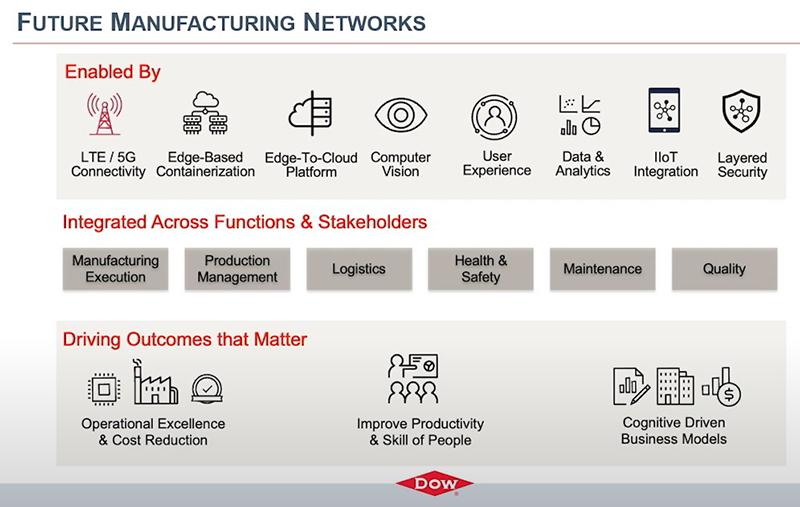
Private LTE cellular network
He described the implementation; the solution was installing a CBRS (Citizens Broadband Radio Service) private cellular LTE type service to cover this plant of 5,000 acres of open space with no public services available. They considered industrial Wi-Fi, but it is very slow, difficult to deploy to deploy at scale, and expensive to maintain with hundreds of Class I Div 2 wireless access points. Using Nokia Private Cellular LTE hazardous rated devices, the network was deployed in less than one year across the entire site, “at a price point that was magnitudes less than other technologies. We got services out to the fingertips of users much quicker than we ever expected."
LTE |
WiFi |
|
|
In 2015, the FCC adopted rules for sharing commercial use of the 3550-3700 Mhz band (3.5 GHz band) frequencies. The commission established the Citizens Broadband Radio Service (CBRS) and created a three-tiered access and authorization framework to accommodate shared federal and nonfederal use of the band. CBRS is only available in the United States but other countries have similar shared spectrum and can support private cellular. CBRS overcomes limitations of Wi-Fi and provides an efficient option for large industrial sites, in terms of coverage, capacity and cost benefit to deploy and maintain.
The system architecture collaborating with Kyndryl Inc. and Nokia was created to cover a large area cost effectively. 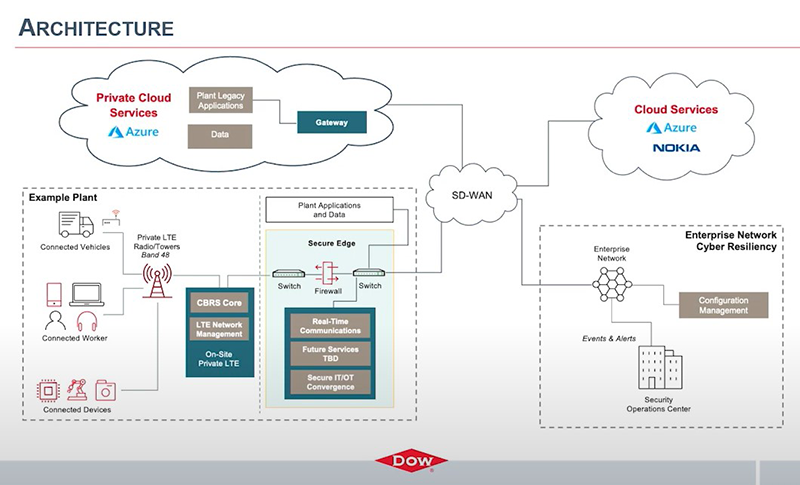
IT and manufacturing integration
Clark Dressen emphasized the Dow is committed to digital with IT and manufacturing collaborating developing solutions, getting funding from the board of directors, setting priorities and driving manufacturing digital transformation. He reference the 2020 ARC joint keynote presentation by Dow Corporation’s Melanie Kalmar , the Corporate VP, Chief Information Officer & Chief Digital Officer and Peter Holicki, the Senior Vice President of Operations for Manufacturing and Engineering, which described the company’s digitalization journey. They described their joint vision of how IT & OT, working together with the shared goal to become the leading material science company pursuing digital innovation that generates growth for the company.