



Industrial organizations face an increasingly difficult challenge: how to modernize their operations, improve connectivity and increase visibility into industrial processes while still protecting critical systems from cyber threats. Legacy industrial automation and control systems (IACS) environments were originally designed for reliability and operational continuity, not cybersecurity. As a result, many facilities operate with legacy technologies, flat network architectures, unmanaged remote access and systems never intended to connect to anything beyond the plant floor. In such environments, cybersecurity can no longer be treated as an isolated IT issue. This is why adopting ISA/IEC 62443 has become so important for asset owners, system integrators and product suppliers alike.
ISA/IEC 62443 provides a comprehensive cybersecurity framework developed specifically for industrial automation and control systems. Unlike traditional IT security approaches, the standard recognizes that industrial environments must maintain safety, uptime, reliability and operational continuity while defending against cyber threats. This distinction is critical. In operational technology (OT) environments, a cybersecurity incident can disrupt production, reduce visibility or control, damage equipment or create safety and environmental consequences.
From Fortinet’s perspective, ISA/IEC 62443 shifts cybersecurity discussions away from simply identifying vulnerabilities and toward managing operational risk. ISA/IEC 62443 promotes a lifecycle-based security that continuously evaluates risk, aligns mitigations to operational priorities and improves cybersecurity maturity over time.
This is especially important for asset owners responsible for continuous operations. A manufacturing plant, utility, refinery or critical infrastructure operator cannot simply shut systems down to immediately implement every security recommendation. ISA/IEC 62443 acknowledges these operational realities and provides a structured, phased approach that allows organizations to strengthen security while maintaining production and reliability. A core principle of ISA/IEC 62443 is the use of security zones and conduits. Rather than treating the entire IACS environment as a single flat network, the standard encourages organizations to divide systems into logical zones based on operational function, risk and required protection levels. Conduits are then used to securely manage communications between those zones.
The following image highlights the concept of zones and conduits (originally published on Automation.com), also known as network segmentation.
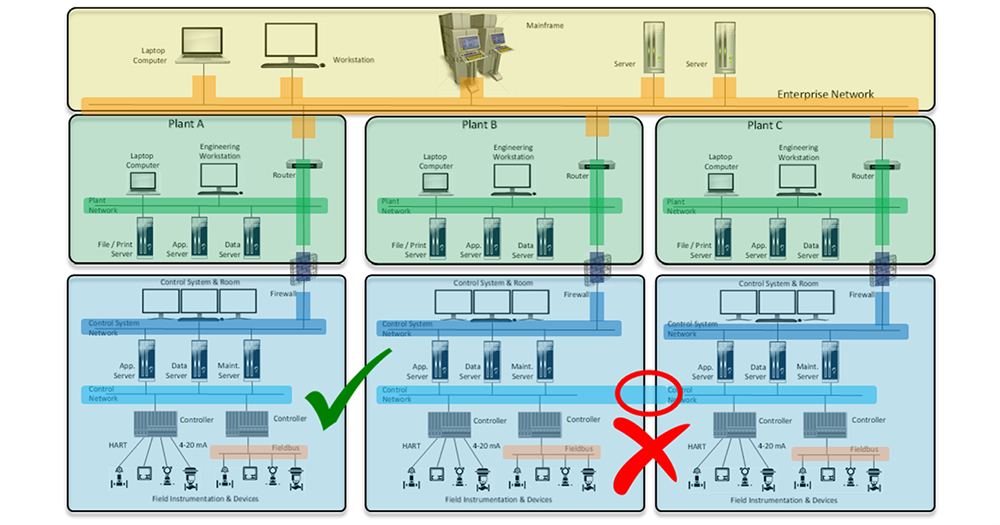
- A zone can have sub-zones.
- A conduit cannot have sub-conduits.
- A zone can have more than one conduit.
- Cyber assets within a zone use one or more conduits to communicate.
- A conduit cannot traverse more than one zone.
- A conduit can be used to connect two or more zones.
This segmentation strategy is important because cyber threats in OT environments often spread laterally once an attacker gains access. By isolating operational areas and controlling communications pathways, organizations can limit the impact of an incident and better protect critical systems.
The standard also introduces security levels (SLs), ranging from SL 0 through SL 4, allowing organizations to align security controls with the sophistication and capabilities of threats.
ISA/IEC 62443 protection levels
Asset Owner, System Integrator and Product Supplier
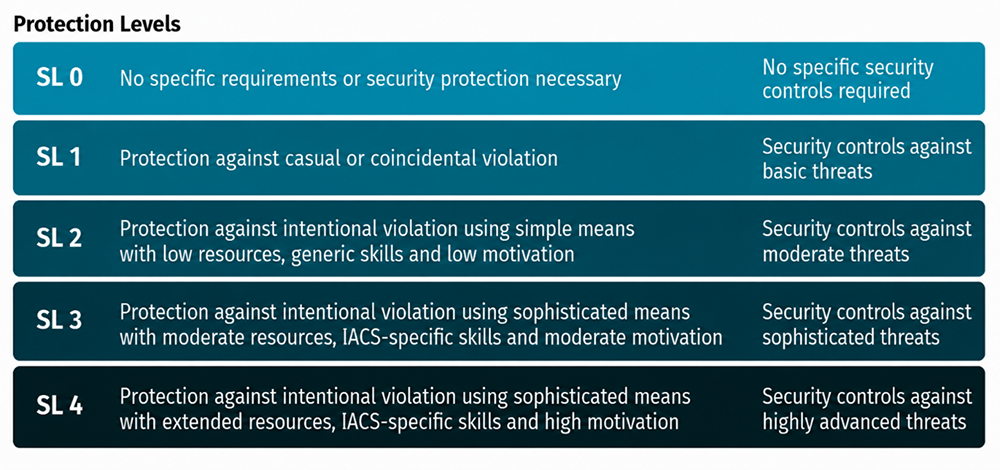 These levels represent increasing resistance against cyber threats. Lower levels provide protection against accidental or casual violations, while higher levels are intended to withstand sophisticated attacks conducted by skilled and motivated adversaries. Organizations establish a Security Level Target (SL-T) for each zone based on risk assessments and then implement controls necessary to achieve that target.
To support the achievement of these SLs, ISA/IEC 62443-3-3 defines seven Foundational Requirements (FRs). The following tables show high-level mapping of FRs to operational controls.
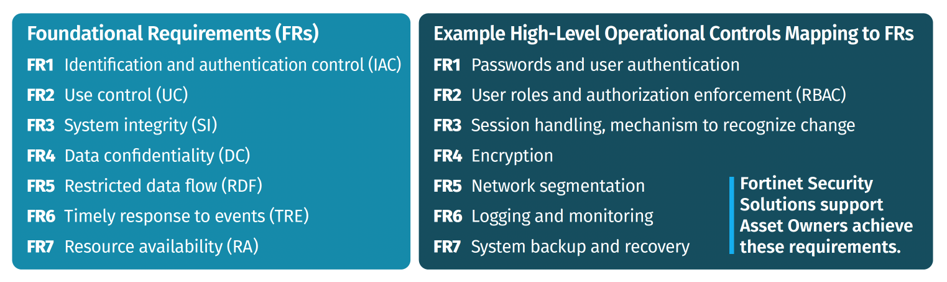 These controls should work together as part of a cohesive defensive strategy rather than being deployed in isolation.
This risk-based approach is important because it helps organizations apply cybersecurity investments strategically rather than implementing expensive, one-size-fits-all controls across the entire environment.
ISA/IEC 62443 provides a common framework and shared cybersecurity expectations across the industrial ecosystem for system integrators and product suppliers. As industrial environments become more interconnected through remote access, cloud connectivity, wireless infrastructure and Industrial Internet of Things (IIoT) technologies, asset owners are realizing the importance of having vendors and integrators demonstrate how their systems align with recognized OT cybersecurity practices.
Importantly, ISA/IEC 62443 recognizes that industrial cybersecurity maturity evolves over time. Many organizations operate brownfield environments containing decades-old technologies that cannot realistically be replaced overnight. Rather than forcing immediate wholesale redesigns, the standard supports incremental improvements through phased implementation and continuous monitoring. This practical approach is important because it allows organizations to improve security in a measurable and sustainable manner while working within operational and financial constraints.
As technology, business requirements and threat landscapes evolve, organizations must continuously reassess whether their assigned security levels remain appropriate. Ultimately, adopting ISA/IEC 62443 provides industrial organizations with a structured, operationally realistic roadmap for improving cybersecurity resilience.
- For asset owners, it helps align cybersecurity with operational risk and uptime requirements.
- For system integrators, it provides guidance for designing and deploying more secure architectures.
- For product suppliers, it establishes a common framework for building technologies that support modern OT security expectations.
As incidents of cyber threats targeting industrial environments continue to increase, organizations need more than isolated security tools or vulnerability checklists. They need a cohesive strategy that aligns cybersecurity with operational objectives. Fortinet believes ISA/IEC 62443 provides that foundation, helping industrial organizations move from reactive security efforts toward proactive, risk-based operational resilience.
ISA/IEC 62443 provides a practical framework for aligning cybersecurity investments with operational risk, enabling organizations to build security programs that are measurable, sustainable and adaptable to changing threats. By using risk-based security levels, well-defined zones and conduits, continuous monitoring and lifecycle management practices, organizations can strengthen the resilience of their IACS environments while maintaining the safety, reliability and availability that today’s industrial operations depend on.
The opinions and views expressed are solely those of the authors and do not necessarily reflect any official policy, position or views of the International Society of Automation (ISA), Automation.com or the ISA Global Cybersecurity Alliance (ISAGCA).