This post is an excerpt from the journal ISA Transactions. All ISA Transactions articles are free to ISA members, or can be purchased from Elsevier Press.
Abstract:
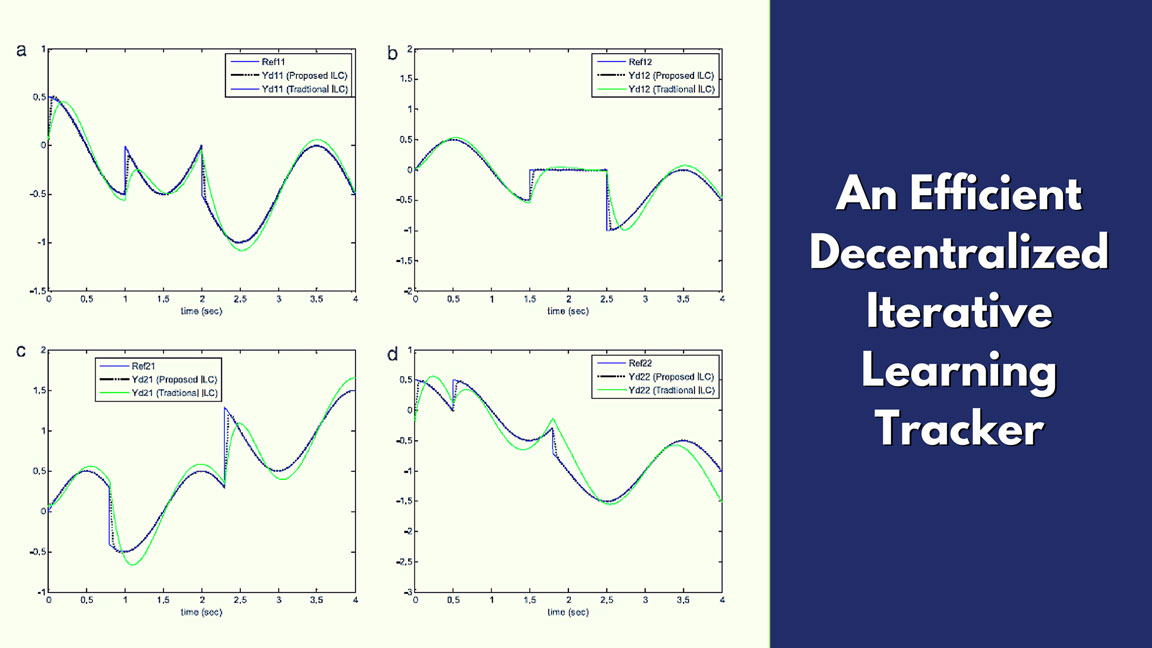
In this paper, an efficient decentralized iterative learning tracker is proposed to improve the dynamic performance of the unknown controllable and observable sampled-data interconnected large-scale state-delay system, which consists of NN multi-input multi-output (MIMO) subsystems, with the closed-loop decoupling property. The off-line observer/Kalman filter identification (OKID) method is used to obtain the decentralized linear models for subsystems in the interconnected large-scale system. In order to get over the effect of modeling error on the identified linear model of each subsystem, an improved observer with the high-gain property based on the digital redesign approach is developed to replace the observer identified by OKID.
Then, the iterative learning control (ILC) scheme is integrated with the high-gain tracker design for the decentralized models. To significantly reduce the iterative learning epochs, a digital-redesign linear quadratic digital tracker with the high-gain property is proposed as the initial control input of ILC. The high-gain property controllers can suppress uncertain errors such as modeling errors, nonlinear perturbations, and external disturbances (Guo et al., 2000) [18] . Thus, the system output can quickly and accurately track the desired reference in one short time interval after all drastically-changing points of the specified reference input with the closed-loop decoupling property.
Free Bonus! To read the full version of this ISA Transactions article, click here.
Join ISA and get free access to all ISA Transactions articles as well as a wealth of other technical content, plus discounts on events, webinars, training & education courses, and professional certification.
Click here to join ... learn, advance, succeed!
2006 Elsevier Science Ltd. All rights reserved.