


For decades, manual inspection has served as the final checkpoint for product quality across consumer goods manufacturing. Whether verifying package labels, inspecting seals, confirming product presence, reading codes, or checking assembly accuracy, human operators have played a critical role in maintaining standards before products reach consumers.
Today, however, manufacturers face a growing challenge. Labor shortages, increasing production demands, and stricter quality requirements are making it more difficult to rely on manual inspection processes alone. At the same time, advances in industrial vision technology and artificial intelligence are providing manufacturers with a practical path toward greater automation, consistency, and efficiency.
Modern machine vision systems are helping organizations reduce repetitive manual tasks, improve inspection accuracy, and enable employees to focus on higher-value activities. As these technologies become easier to deploy and use, automated inspection is becoming accessible to a broader range of manufacturers than ever before.
The Limitations of Manual Inspection
Manual inspections bring flexibility and experience to production environments, but they have inherent limitations.
As production speeds increase, maintaining consistent inspection quality becomes increasingly difficult. Fatigue, distractions, varying lighting conditions, and repetitive tasks can all impact reliability. Even highly trained operators may interpret defects differently over time or across shifts.
Consumer goods manufacturers face additional complexity because product variation continues to increase. Shorter production runs, customized packaging, promotional labeling, and frequent changeovers require inspection processes that can adapt quickly.
At the same time, many manufacturers continue to struggle with workforce availability. Positions involving repetitive inspection tasks can be difficult to fill and retain, creating operational challenges and increasing costs.
Automated vision systems address these issues by delivering consistent, repeatable inspections that do not vary from shift to shift. Rather than replacing skilled workers entirely, these technologies often allow manufacturers to redeploy employees into more strategic roles while maintaining high standards.
Expanding the Scope of Automated Inspection
Industrial vision technology has evolved far beyond simple presence detection.
Today's systems can inspect products, packaging, labels, and assemblies with speed and precision, enabling manufacturers to automate a wide variety of quality checks.
Common applications in consumer goods manufacturing include:
- Product presence and completeness verification
- Label inspection and validation
- 1D and 2D barcode reading
- Packaging integrity inspection
- Cap and closure verification
- Seal inspection
- Print quality verification
- Object position and orientation checks
- Assembly verification
- Color and pattern recognition
- Defect detection
Vision systems can inspect every product moving through a production line rather than relying on random sampling. This approach increases quality assurance coverage while reducing the potential for defective products to reach customers.
For manufacturers operating high-speed lines, automated inspection also provides valuable production data that can be used to identify recurring issues, improve process control, and reduce waste.

The Rise of AI in Machine Vision
Traditional machine vision systems have long been effective at performing rule-based inspections. However, some inspection tasks are difficult to define using conventional programming techniques.
Variations in product appearance, packaging materials, lighting conditions, and natural manufacturing variability can create challenges for traditional systems.
Artificial intelligence helps overcome these limitations.
AI-based inspection tools can learn from examples rather than relying solely on predefined rules. By training models using images of acceptable and defective products, manufacturers can automate inspections that previously required human judgment.
This capability is particularly valuable for identifying subtle defects, cosmetic inconsistencies, or complex visual patterns that are difficult to describe using conventional parameters.
As AI continues to mature, manufacturers can address a wider range of inspection tasks while maintaining high throughput and consistent quality.
Ease of Use Accelerates Adoption
Historically, implementing machine vision required specialized expertise in programming, optics, and image processing. This often made it only attainable for large organizations with dedicated engineering resources to implement. Today's vision platforms are designed with usability in mind.
Modern systems feature graphical user interfaces, guided setup tools, preconfigured inspection functions, and built-in AI capabilities that simplify deployment. Engineers and technicians can often configure inspection jobs without needing advanced coding skills.
This ease of use has significantly lowered barriers to adoption, enabling manufacturers of various sizes to implement vision technology more quickly.
Faster deployment brings additional benefits. Production teams can adapt inspections to changing products, new packaging designs, or customer requirements without lengthy reprogramming efforts.
The result is greater flexibility and a faster return on investment.
Vision Sensors Bring Inspection Closer to the Production Line
One of the most significant developments in recent years has been the growth of compact vision sensors that combine image acquisition, processing, and communication capabilities in a single device.
Rather than requiring complex multi-component systems, these smart sensors can often be integrated directly into production equipment with minimal infrastructure.
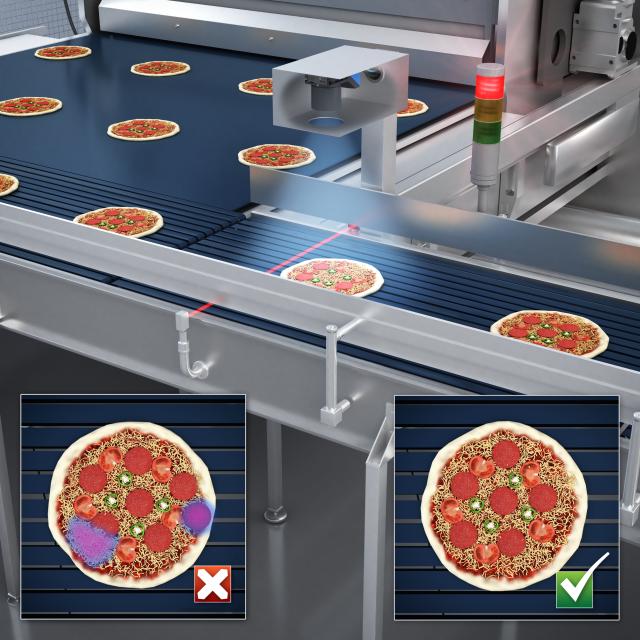
Vision sensors, such as the SICK Inspector family, demonstrate how inspection technology has become more accessible and scalable for manufacturers. These systems can perform a wide range of inspections, including object detection, quality verification, positioning, measurement, code reading, and AI-supported defect detection.
Their compact form factor and simplified configuration make them suitable for deployment throughout production and packaging operations.
By placing intelligent inspection capabilities closer to manufacturing processes, organizations can identify quality issues earlier, reducing scrap, rework, and downtime.

Supporting the Workforce Through Automation
Automation is often discussed in terms of replacing labor, but the more practical benefit in many consumer goods facilities is workforce optimization.
Many manufacturers do not have enough personnel to fill open positions. Automated inspection allows organizations to supplement existing teams rather than depend entirely on manual processes.
Employees who previously spent hours performing repetitive visual inspections can be reassigned to process improvement initiatives, equipment operation, maintenance, troubleshooting, or quality analysis. These responsibilities often provide greater value to the organization while creating more engaging work for employees.
In this way, vision technology can help manufacturers address labor shortages while strengthening operational performance.
Building the Smart Factory Through Inspection Data
Automated inspection systems generate more than pass/fail decisions. They also create valuable production data.
Quality trends, defect patterns, process deviations, and production metrics can be collected and analyzed to support continuous improvement initiatives. When integrated into broader automation architectures, vision systems become important contributors to smart manufacturing strategies.
Manufacturers gain greater visibility into production performance, enabling faster corrective action and more informed decision-making.
As data-driven manufacturing continues to evolve, machine vision is becoming an increasingly important source of actionable operational intelligence.
Looking Ahead
The consumer goods industry continues to balance growing quality expectations with ongoing workforce challenges. As production environments become more complex, manual inspection alone is no longer sufficient to meet the demands of modern manufacturing.
Advances in machine vision and AI are enabling manufacturers to automate inspection processes with greater accuracy, flexibility, and ease of implementation than ever before. From verifying labels and packaging integrity to detecting subtle defects and collecting valuable production data, intelligent vision systems are transforming how quality assurance is performed.
By reducing repetitive manual tasks and providing consistent, reliable inspection capabilities, vision technology helps manufacturers improve quality outcomes while making better use of limited labor resources. As adoption continues to grow, automated vision systems will play an increasingly important role in building more efficient, resilient, and data-driven consumer goods operations.


