AutoQuiz is edited by Joel Don, ISA's social media community manager.
Today's automation industry quiz question comes from the ISA Certified Automation Professional certification program . ISA CAP certification provides a non-biased, third-party, objective assessment and confirmation of an automation professional's skills. The CAP exam is focused on direction, definition, design, development/application, deployment, documentation, and support of systems, software, and equipment used in control systems, manufacturing information systems, systems integration, and operational consulting. Click this link for information about the CAP program. The following question comes from the CAP study guide, Performance Domain III, System Design: Design, specify, and procure the hardware/software used in the system.
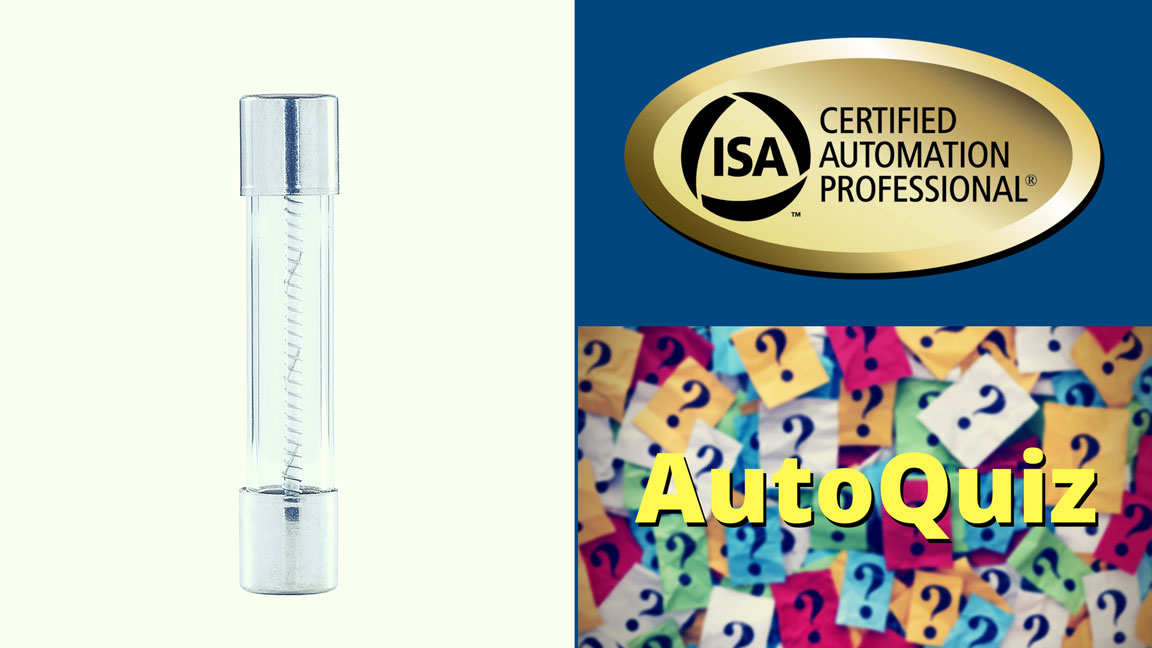
Which fuse has the quickest response to over currents?
a) single element b) dual element c) time delay d) dual-element time delay e) none of the above
In electronics and electrical engineering, a fuse is a type of over current protection device. Its essential component is a metal wire or strip that melts when too much current flows.
When the metal strip melts, it opens the circuit of which it is a part, and so protects the circuit from excessive current.
Fuses are fast-blow, slow-blow, or time-delay according to the time they take to respond to an over current condition. The selection of the characteristic depends on the protected equipment.
Semiconductor devices may need a fast or ultrafast fuse for protection since semiconductors may have little capacity to withstand even a momentary overload.
Fuses applied on motor circuits may have a time-delay characteristic, since the surge of current required at motor start soon decreases and is harmless to wiring and the motor.
Single element fuses have a very high speed of response to over currents. They provide excellent short-circuit component protection.
Dual-element and time-delay fuses serve in circuits subject to temporary motor overloads and surge currents. Dual-element and time-delay fuses contain two series elements-a short-circuit element and an overload element.
The correct answer is A , the single-element fuse.
Reference
: Bussmann Cooper Industries, SPD Electrical Production Handbook .