
Go into the instrumentation cabinets of almost any process plant built before the 2000s and you'll find the same thing: miles of twisted-pair cable, terminal blocks worn shiny from decades of maintenance visits, and temperature transmitters quietly turning RTD and thermocouple readings into a plain 4-20mA current loop. None of it looks impressive. Most of it still works exactly as it did thirty or forty years ago.
So, the question isn't really whether that old infrastructure still does its job. It's whether it can keep up with what plants are now being asked to do with their data.
The gap nobody budgeted for
Modern control philosophy runs on data, not just the process value itself, but the health, diagnostics and configuration history behind it. Predictive maintenance programs, energy optimization projects, Industry 4.0 pilots: all of them assume a level of instrument-level visibility that a bare current loop was never built to provide. A 4-20mA signal tells the BPCS or PLC what the temperature is right now. That's it. Nothing about sensor drift, nothing about wiring faults, nothing about when the device was last calibrated.
That leaves plant operators in an awkward spot. The instrumentation layer is usually the oldest part of the control system, and yet it's exactly the layer that every digitalization strategy leans on for trustworthy source data. Tearing it out and starting over sounds clean on paper. In a running plant, it rarely is; the capital outlay, the shutdown time, the disruption to processes that can't simply be paused, all push full replacement to the bottom of the list rather than the top.
Why rip-and-replace isn't the default
It's easy to frame this as a straight choice: keep the analogue wiring as is or swap it all out for fieldbus or wireless. Most European plants don't treat it that way, and continuous-process operators for chemicals, refining, pulp and paper have particularly good reasons not to.
Analogue loops are still useful. They're simple, they're robust, maintenance crews understand them without training, and they don't introduce the cybersecurity questions that come with adding network-connected devices to a control environment. A lot of safety loops are validated in their current analogue form, and revalidating a fully digital replacement is its own lengthy, expensive project.
The route more plants take is to squeeze more out of what’s already installed. Most temperature transmitters put in over the last twenty years already support HART, which adds digital communication to the existing 4-20mA signal using the same field wiring, without disrupting the analog loop. The current signal keeps doing exactly what it always did. HART just tags along, carrying additional process variables, diagnostic, maintenance, and configuration data the control system has never seen.
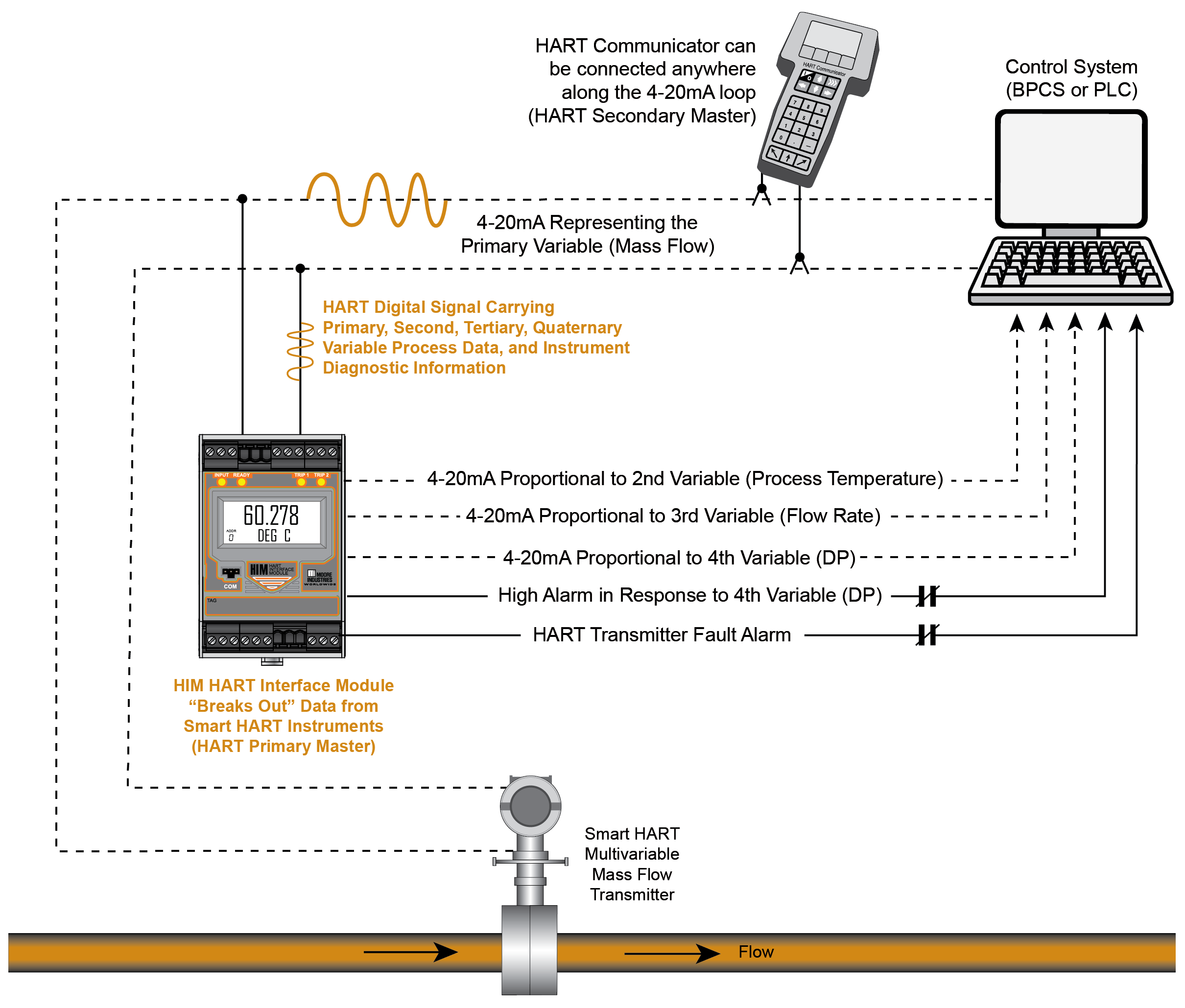 Figure 1. The Moore Industries HIM converts HART digital data to 4-20mA values proportional to a multivariable transmitter’s primary, second, third or fourth variables. Its alarm trip outputs warn of unwanted high/low process conditions or of instrument diagnostic problems.
The data that's been sitting there unused
This is where a surprising amount of plant data goes to waste. HART-capable transmitters typically hold several measurements and diagnostic parameters beyond the single value that reaches the control room over the loop: flowmeter health, differential pressure, process temperature, electronics temperature, volumetric flow, and a totalizer value. In plenty of plants, none of it has ever been looked at, simply because the I/O card was only ever wired to read the analogue signal and nothing else.
Getting at that data doesn't mean rewiring anything. HART multiplexers and interface modules tap into the existing loop and pull the digital signal off it without interrupting the process, feeding it to asset management software, a historian, or a condition-monitoring platform running alongside the existing control system. For engineering teams trying to show progress on digitalization without a capital project behind them, this tends to be the easiest place to start. The transmitters are already capable; they've just never been asked.
Where it stops working
This isn't a substitute for real modernization, and it's worth saying plainly where it falls short. HART's data rate is slow, and it was never meant for the high-speed, deterministic communication some advanced control or safety applications now need. Retrofitted diagnostics are also only as good as the device sitting in the field: an older transmitter without HART gives you nothing to extract, and some early "HART-compatible" devices only support a thin slice of what the protocol can do.
There's a people problem too, and it's the one that catches plants out more often than the technical limits. Pulling HART data off a loop is straightforward engineering. Doing something useful with it is not. Sites that buy the interface hardware without also sorting out the asset management software, the alarm rationalization, and someone whose job it is to actually look at the data end up with a system quietly generating information nobody reads. The wiring problem gets solved. The organizational one doesn't.
There's also a cost dimension worth being blunt about. Interface hardware and the software to make sense of what it produces aren't free, and it competes for budget against every other project on a plant's list. The case for it usually must be made loop by loop, not as an abstract digitalization initiative pointing to a specific unit with a history of unexplained trips, or a process area where energy costs make even a small improvement in temperature accuracy worth chasing. Abstract arguments about "unlocking data" rarely survive a capital approval meeting. A concrete maintenance or efficiency problem usually does.
A staged path, not a single decision
For engineers weighing this up, it's rarely one decision made once. More a series of small ones that fit around normal maintenance and turnaround schedules anyway. Working out which transmitters already support HART, and how much of it, costs nothing beyond an inventory check. From there, interface hardware gets added a loop at a time, prioritizing whatever measurements matter most for reliability or energy performance rather than trying to cover the whole plant in one go.
Fieldbus or a full digital rebuild is still the right call in some cases with new builds, major revamps, anywhere the analogue wiring has genuinely reached the end of its life. But for the enormous installed base of working 4-20mA loops still out there across European industry, the more common route is evolutionary: leave the analogue backbone alone and use the digital layer that's already sitting inside the loop to close the visibility gap.
Most plants already have more capability than their control system currently uses. Before signing off on a big replacement program, it's worth finding out exactly how much of that is sitting idle and what it would actually take to switch it on.