



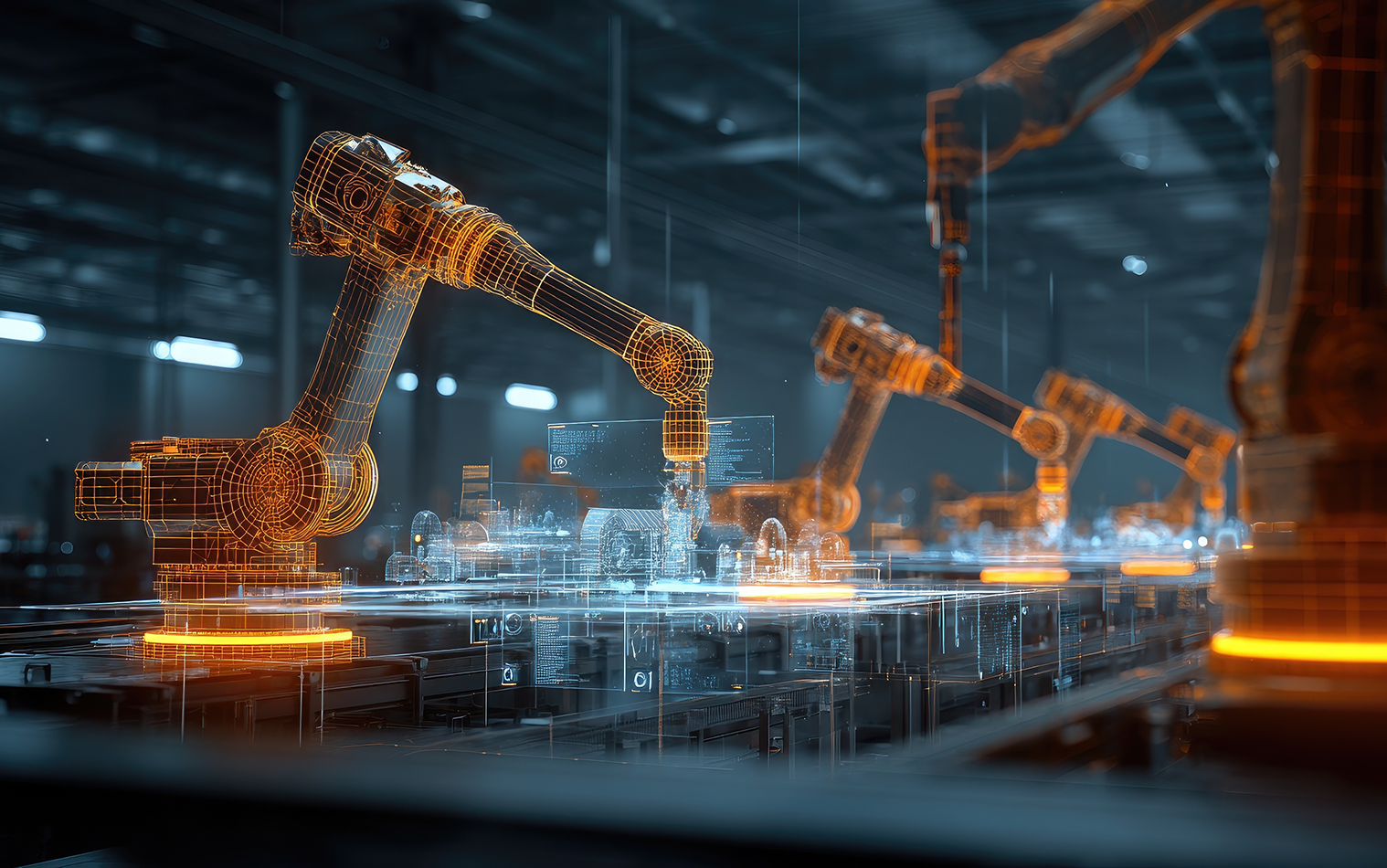
In May 2025, Siemens introduced AI agents for industrial automation with a sentence that deserves more scrutiny than it got. "By automating automation itself," said Rainer Brehm, CEO of Factory Automation, "we envision productivity increases of up to 50% for our customers."
Automating automation itself. Every controls engineer should read that phrase twice, because it describes something categorically different from what this industry has spent seventy years building, and the difference is where both the productivity and the risk live.
What changed
Traditional automation is deterministic. An engineer designs a control loop, validates it, commissions it and the logic does the same thing on Tuesday that it did on Monday. Hyperautomation, in Gartner's original framing, is different in kind: an approach that "rapidly identifies, vets and automates as many processes as possible" by stacking RPA, AI and machine learning, process mining and low-code platforms. The target of the automation is no longer a task. It's the discovery and automation of processes themselves.
On the plant floor, that stops being abstract. Generative AI now writes control logic: Siemens' Industrial Copilot, used by more than 100 companies and rolling out globally at thyssenkrupp Automation Engineering, generates code inside TIA Portal that, by Siemens' own figure, needs only 20% human adaptation. Rockwell ships a copilot in FactoryTalk Design Studio. Process-mining tools watch how work actually flows and propose the next automation candidate. Agents are beginning to orchestrate other agents.
Adoption is real, if uneven. The World Economic Forum's Global Lighthouse Network, its registry of the world's most advanced factories, now counts 238 sites, including one automaker that reports automating 90% of its R&D workflows. Rockwell's latest State of Smart Manufacturing survey of 1,560 manufacturers, vendor research but the largest of its kind, finds 34% of operations already AI-augmented, with respondents expecting to pass half by 2030.
The property nobody prices
Here's what the ROI decks don't model. In 1984, the sociologist Charles Perrow published Normal Accidents, a study of why complex systems fail. His conclusion: when a system combines interactive complexity (components affecting each other in unplanned ways) with tight coupling (no slack between cause and effect), serious accidents stop being anomalies and become a structural property of the system. Not because operators are careless. Because nobody can foresee the interactions.
Hyperautomation increases both dimensions at once, deliberately. Every copilot-generated code block, every closed-loop optimizer, every agent triggering another agent adds interactions no single engineer designed, while the whole point of the exercise is to remove the human pauses that once served as slack. A plant that automates its automation is building, on purpose, exactly the kind of system Perrow warned about.
And the industry's own data says we're not keeping up with the legibility problem. Fortinet's 2026 OT security survey of 700-plus practitioners found only 14% of organizations have full visibility into their OT environments. Rockwell's survey found manufacturers making effective use of just 43% of the data they collect. We are stacking decision-making layers on top of systems we already can't fully see.
Someone is studying your plant. It may not be you
The uncomfortable corollary comes from the threat data. In the same year that OT intrusions jumped from 47% to 71% of surveyed organizations (Fortinet, vendor data), Dragos tracked ransomware attacks on industrial organizations up 64%, with manufacturing absorbing over two-thirds of the victims. The line worth pinning to the wall comes from Dragos CEO Robert M. Lee: adversaries are "mapping how control systems work, understanding where commands originate, how they propagate, and where physical effects can be induced."
Read that against the visibility numbers above. Attackers are building system-level understanding of hyperautomated plants at the exact moment those plants are becoming harder for their own engineers to understand. The same Dragos data contains the counter-signal: organizations with comprehensive OT visibility contained incidents with a dwell time of 5 days, against 42 days for everyone else. Legibility is a security control.
The skills gap moves up a level
The standard answer is that AI copilots solve the workforce problem, and there's something to it: Deloitte and The Manufacturing Institute project US manufacturing could need 3.8 million new workers by 2033, with 1.9 million roles potentially going unfilled. A copilot that lets one engineer do the work of three looks like salvation.
But look at what the copilot actually changes. That 20%-adaptation figure means every generated block still needs a human who can tell which 20% is wrong, and plants run for thirty years. The maintenance engineer of 2040 will be debugging ladder logic written by a model that was deprecated in 2028, orchestrated by agents nobody at the site configured. Hyperautomation doesn't eliminate the skills gap; it moves it up an abstraction level, trading a shortage of people who can write control logic for a shortage of people who can audit control logic they didn't write. Deloitte's smart manufacturing survey already finds human capital the lowest-maturity dimension of the whole transformation, which suggests the trade is being made without the second population in place.
Keeping the system legible
None of this argues for refusing the technology. The productivity gains at the lighthouse sites are real, and the competitive logic is brutal. It argues for pricing in a discipline the ROI models currently get for free. Four practices matter most, in order.
Treat generated code as code. Version control, review and validation for every AI-produced block, held to the same standard as human logic, with the generating prompt archived alongside. The 20% that needs adapting is findable only by someone who looks.
Buy visibility before you buy autonomy. The 5-day-versus-42-day dwell-time gap is the strongest ROI number in this article, and it belongs to monitoring, not to any copilot.
Keep humans in the loop as circuit breakers, not as courtesy. Tesla ran this experiment publicly in 2018, when Elon Musk concluded that "excessive automation at Tesla was a mistake... Humans are underrated." The lesson generalizes: the human pause is often the only loosely-coupled element left in the system.
And ask the Perrow question in every design review: when this new layer interacts with everything already installed, who on this site can trace the interaction end to end? If the answer is nobody, that's not automatically a reason to stop. It is a reason to know you've crossed into a different risk regime, one the safety literature has been describing since 1984.
The factories that win the hyperautomation decade won't be the ones that automated the most. They'll be the ones that stayed comprehensible while they did it.