This blog post was authored by Mark Weisner, technical specialist at ISA.
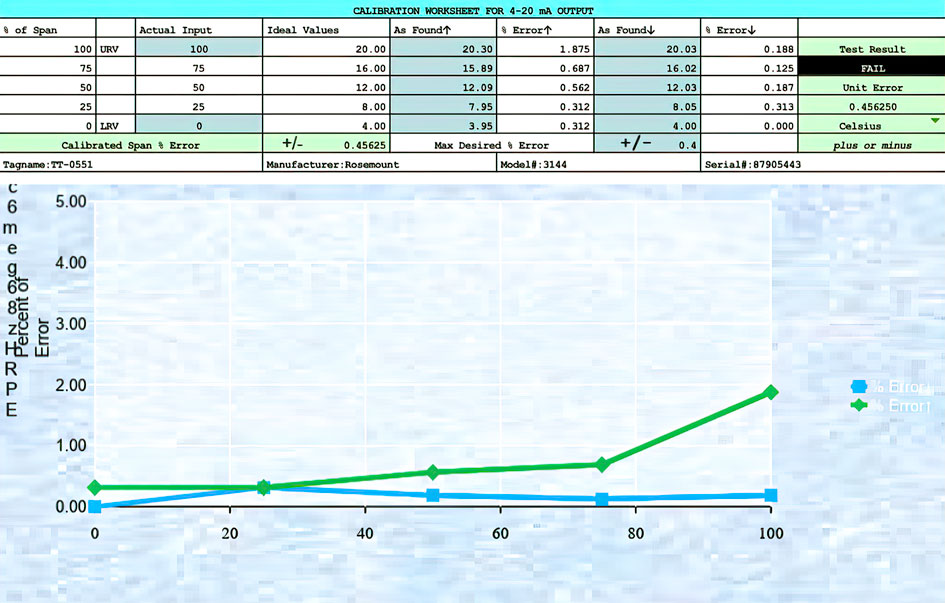
The spreadsheet we did for the Applying Motor Controls and Drives course shows the voltage and hertz relationship. We then used the chart wizard and selected a scatter point type of chart. I then started thinking about the calibration sheet we do in other ISA courses and thought it would be fun to see if I could put in the formulas to calculate error and automatically plot them on a chart. The workbook that I designed has a sheet for 4-20 mA,1-5 Vdc, and 3-15 psi output results. Now you just have to put in your URV and LRV to get your test points,enter your as founds, and errors will be automatically calculated.
Also if you put in the desired maximum error, it will tell you whether test passed or failed. To get a nice looking report, complete other information in cells and print.
Click this link to download the Microsoft Excel file.
One of the formulas I used for finding the difference between two numbers expressed as a percent is as follows:
=100-(MIN(D2,C2)/MAX(D2,C2))*100
I believe with a little more work and some feedback from automation professionals, this will be a great tool for both technicians and engineers. What kind of features would you add? Please feel free to express your opinions or ideas for what can be improved!
Blog Posts
How Often Do Measurements Need to Be Calibrated? Just in Time, or Just Too Late? A Kaizen Approach to Calibration How to Improve Industrial Productivity with Loop Calibration Temperature Calibration: Using a Dry Block to Calculate Total Uncertainty How Can Advanced Calibration Strategies Improve Control Performance? How to Calibrate a Pressure Transmitter
Webinar Recordings
Uncertainty in Calibration Calibration Uncertainty and Why Technicians Need to Understand It How to Avoid the Most Common Mistakes in Field Calibration Learn Advanced Techniques in Field Calibration How to Build an Industrial Calibration System Business Case How to Use Calibration Tools for Accurate Process Temperature Measurement How Does Low Flow Affect Differential Pressure Flowmeter Calibration? Three Common Pitfalls of Pressure Calibration
Free Downloads
ISA Industrial Calibration Worksheets Measurement Uncertainty Analysis Excel template plus book excerpt Calibration Handbook of Measuring Instruments book excerpt In-Depth Guide to Calibration for the Process Industries eBook Calibration Uncertainty for Non-Mathematicians white paper
About the Author
Mark Weisner is a technical specialist at ISA.
Connect with Mark