



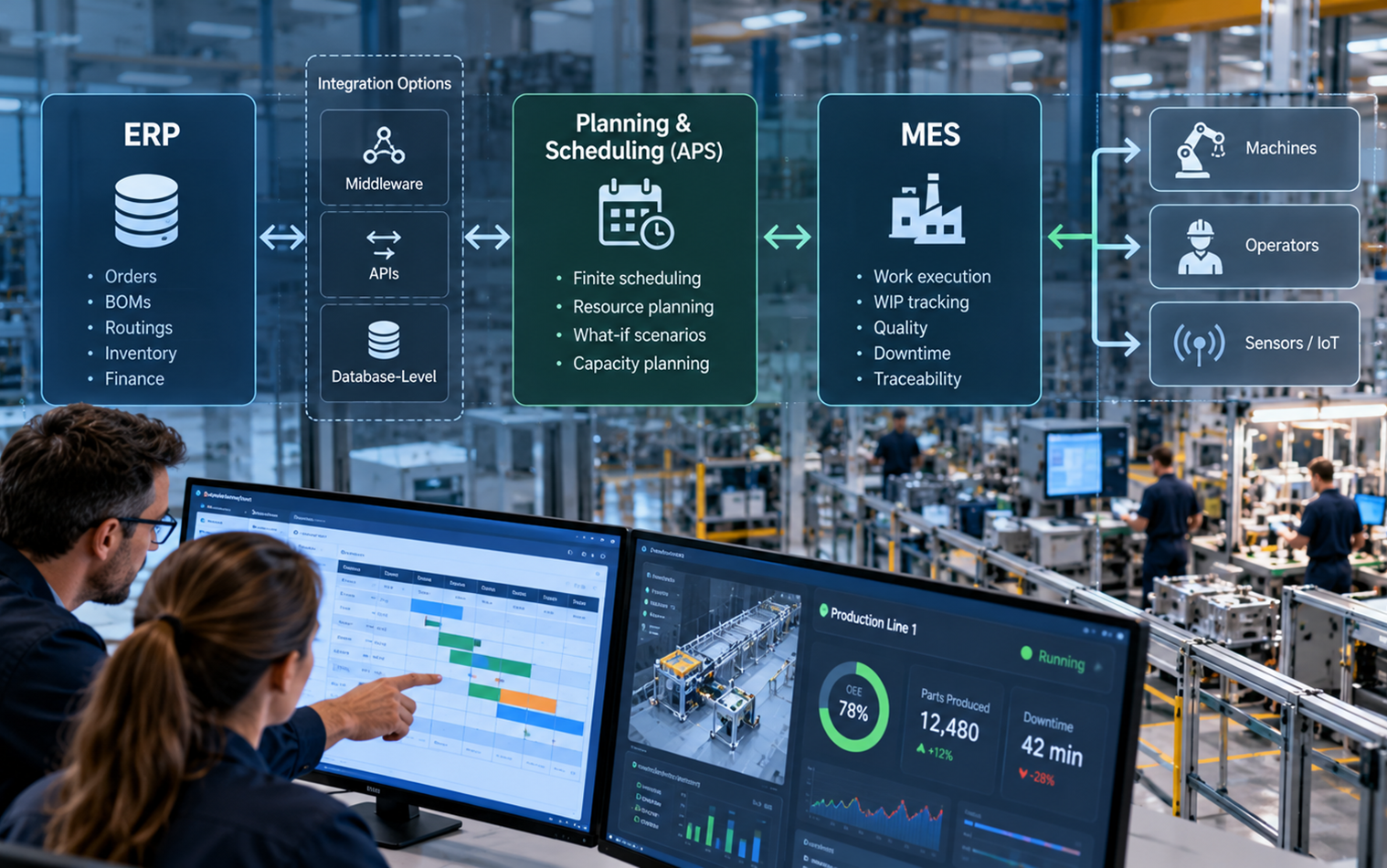
There are three common ways to integrate a manufacturing execution system (MES) with enterprise resource planning (ERP): middleware or a service bus, point-to-point API connections, and database-level integration.
Each puts the integration dependency somewhere different. Middleware puts it on an integration layer, point-to-point puts it on the pair of systems, and database-level integration puts it on internal table structures. A fourth decision comes before any of them and is often skipped: whether planning and scheduling need their own interface to execution at all.
If planning and execution share a data model, there is one fewer integration boundary to design, test, and maintain. ISA-95 gives engineers a shared way to describe what crosses between business systems and the plant floor, which helps keep integration independent of any one product's internals. Treated as a scope document, though, the standard can turn a focused project into a long modeling exercise.
What are the options for integrating an MES with ERP?
The options for integrating an MES with ERP are middleware, point-to-point APIs, and database-level integration, plus the architectural choice of running planning and execution on one data model.
With middleware, the MES and ERP exchange messages through an integration layer instead of calling each other. An ERP upgrade changes the mapping in that middle layer and leaves the MES alone. The price is one more system to license and keep running, which is easier to justify with five connected systems than with two.
With point-to-point APIs, the MES and ERP call each other directly. There is nothing new to operate, so a single interface can go live quickly. The cost arrives later because every system or site added must have its own interface, with its own testing and upgrade planning.
With database-level integration, one system reads from and writes to the other's tables. It needs no interface layer, but it relies on internal tables that neither vendor treats as a public interface, so a schema change in a new release can break it.
Choosing a pattern that fits typically depends on the number of systems and sites that must be connected.
What does ISA-95 give an integration team?
ISA-95 gives an integration team a common reference for the information that crosses between ERP and the MES, so each system maps to published definitions instead of to the other product.
The International Society of Automation's published materials on ISA-95 place business planning and logistics at Level 4, manufacturing operations management at Level 3, and process, sensing, and control at Levels 0 to 2. ERP sits at Level 4, and the MES is at Level 3. The ISA-95 framework also defines models for the information exchanged between enterprise and manufacturing operations, including production schedules, production performance, material, equipment, and personnel.
The payoff comes later in the life of the system. An interface built against those shared definitions needs less rework after an ERP upgrade, or when a second plant comes online, than one mapped field by field between two specific products.
It is also possible to over-apply the standard. Treating every object model as a day-one scope delays the first working interface and produces mappings nobody tests. Start with the flows the plant needs first, typically the production schedule going down and production performance coming back up. Material, equipment, and personnel models can follow when a real use case appears.
Where should planning sit before choosing a pattern?
Settle where planning sits before choosing the integration pattern because that decision sets how many interfaces the plant has to maintain.
In one common stack, ERP connects to a planning and scheduling system; the planning system connects to the MES; and the MES often connects to a separate record-keeping system. That can mean three separate interfaces, each needing its own mapping and its own retesting at every upgrade. A change on the shop floor has to cross the planning-to-execution interface before it can reach the schedule.
The alternative is to run planning and execution on one data model. The planning-to-execution interface then goes away, and the only boundary left to integrate is the one to ERP. Eyelit Technologies, where the author works, builds its planning and execution products this way. Eyelit MES and Eyelit APS run a continuous feedback loop: real-time WIP, downtime, and shop-floor changes pass from the MES to APS, and updated schedules return to the MES. Eyelit MES integrates with ERP, order entry, and PLM through one point of integration rather than a separate integration per system.
Choosing this route means committing to one vendor. When planning and execution share a data model, they come from the same supplier and replacing one later means revisiting both. A plant that expects to change its scheduling tool independently of its MES has good reason to keep the two separate and join them through middleware. The shared-model approach suits plants whose main problem is keeping the schedule in step with what is happening on the floor.
What should be mapped before any interface is built?
Before any interface is built, agree on how each object that crosses the boundary is represented on each side and which system owns it.
- Production orders: ERP owns creation, quantities, and due dates, and the MES owns order status from release to completion.
- Production schedule: Decide which system holds the detailed sequence. If ERP holds only due dates, write that down so the MES team does not expect a sequence from it.
- Material: Bills of material and routings come down from ERP, while actual consumption, scrap, and lot or serial genealogy go up from the MES.
- Equipment: Name the master system for equipment identifiers and equipment states.
- Personnel: Decide where labor time and operator qualifications are recorded, and whether ERP needs labor time for costing.
- Production performance: Agree on which actuals go upward, such as quantities, times, and yield, and how often they are sent.
If both systems treat a field as their own, give it a named owner before go-live.
Pattern choice still matters, but it comes second. Decide where planning sits, map the flows the plant needs first to the ISA-95 definitions, and then pick the pattern that fits the number of systems left to connect.