-

 ISA provides technical resources and standards to help industrial automation professionals advance their careers and the field. We enable automation professionals worldwide to solve problems and enhance their skills by bringing people together to create new technologies and share best practices with future automation professionals.
-
ISA Resources
-
Upcoming Events
-
Industry Insights
-
Consortia
-




Author Profile

John Gerry
8 Results Found
-
News
Derivative Action - The Good, Bad, and Ugly
The reason to use derivative (or D) is that you can use more Proportional and especially more Integral action. The result can be a much faster reacting control loop. -
 News
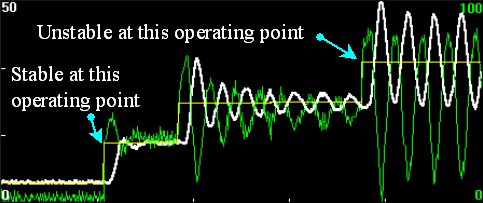
NewsPID Tuning Tips - How to Linearize Your Process
A non-linear process will have different response across the operating range. It will be sluggish at one end of the range and comparatively faster or even oscillatory at the other. -
 Feature
How to Control a Process With Long Dead Time
A process with a large dead time presents a special challenge for a controller - any controller. Find out how to get the best control of large dead time processes. -
News
Ziegler-Nichols Tuning Rules And Limitations
The standard reference for PID tuning seems to be the Ziegler-Nichols tuning rules developed in 1942 on a pneumatic controller. -
 News
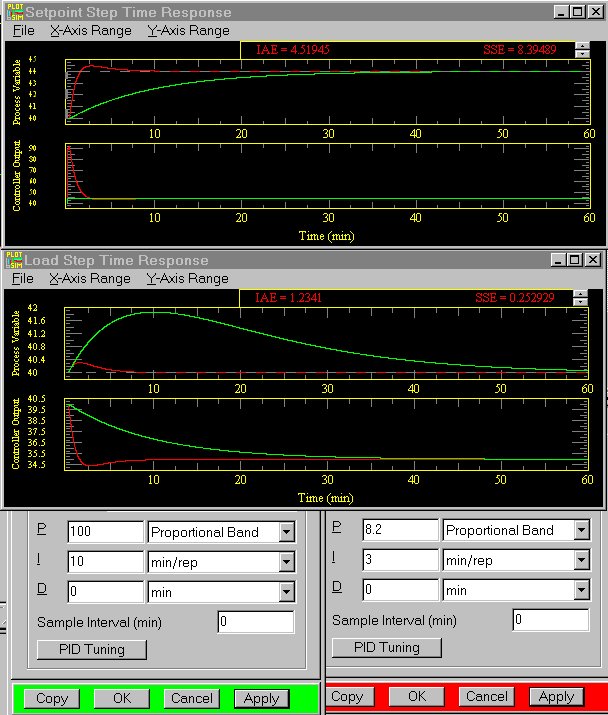
NewsShould You be Using Lambda Tuning?
A tuning method based on achieving smooth set point response is becoming more popular. The method guarantees stability, robustness and no overshoot. Shouldn't you be using it? -
 News
NewsChoosing the Best Control Loop Filter
Choosing the proper filter can have an impact in your company's bottom line. -
 News
NewsThe Best Sample Interval For Process Control
ExperTune’s Loop Tuner/Analyzer, automatically checks your loop’s sample interval and tells you if it needs to be changed. -
 News
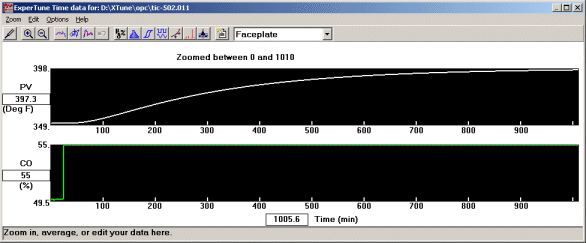
NewsThe Fast Way to Tune Slow Loops
To tune a control loop, analysis software must process some loop data. You must test or bump the loop somehow. For example a setpoint change in automatic or a controller output change in manual mode.