




Private 5G networks have come a long way from their origins in the 2010s as a relatively niche segment of the cellular industry. Today, advancements in spectrum availability, enterprise digital transformation, and the increasing demand for secure, high-performance connectivity among operational technology (OT) and information technology (IT) systems are powering industrial interest in private 5G technology. Market research estimates that standalone private 5G networks—a $3.5 billion market today—are on the cusp of becoming a mainstream technology.
The motivation for adopting industrial private 5G networks is driven by the need for enhanced security, superior performance, larger outdoor coverage footprint, and the ability to tailor the network to meet the specific needs of industrial applications.
Industrial private 5G networks offer enhanced security features compared to traditional public networks. The ability to control and manage the network internally ensures that sensitive data remains within the organization, which reduces the risk of external threats and data breaches. This is particularly crucial in industries where the integrity and confidentiality of data is paramount.
Public mobile network operators (MNOs) offer 5G connectivity solutions for industrial applications, but adoption for OT network use remains limited. These networks often rely on public infrastructure, which may not be optimized for industrial applications. Also, the shared nature of public networks can lead to congestion and poor performance during peak use times. Also, using an MNO-based OT network, enterprise data will not stay within the industry premises.
Wi-Fi, another public network option, can be suitable for certain applications but lacks the robustness and security features required for large-scale industrial deployments. Wi-Fi networks are also more susceptible to interference and have limited coverage range, which makes them less than ideal for extensive industrial environments such as oil and gas and petrochemical industries.
Characteristics of industrial private 5G networks
Industrial private 5G networks address these challenges by providing a dedicated, high-performance network that can be customized to meet the specific requirements of OT/IT integration. The ability to prioritize OT/IT traffic, ensure end-to-end encryption, and maintain high levels of reliability make the industrial private 5G network an attractive option for industries looking to enhance their digital infrastructure.
Among other defining characteristics of industrial private 5G technology are signal range and support for network complexity. How private 5G networks stack up against other wireless technologies will be discussed later in this article.
Signal range. Industrial private 5G can cover vast industrial areas with remarkably few access points. For example, a large refinery of 1.2 million square meters can be covered with only 10 private 5G access points.
The range of private 5G signals is affected by power levels, antenna height and physical obstacles. Private 5G operates at power levels specifically designed for industrial coverage. Both the access point and the user’s device—tablet, sensor, or gateway—require sufficient power to maintain two-way communication. This power is regulated by spectrum policies and typically provides robust coverage across large areas. Increasing the height of an antenna generally allows its signal to travel greater distances. For short distances (around 500 meters), antennas should be at least 2 meters above obstacles. Longer distances (around a kilometer) require antennas to be about 3 meters above obstacles. Mounting antennas at 10 to 20 meters high on existing structures such as pipe rack gantries or process units yields optimal coverage.
Physical obstacles also affect the coverage range of industrial private 5G signals. In industrial settings such as refineries or factories, metal equipment, storage tanks and pipe racks are the primary coverage challenges. Private 5G’s signal characteristics allow it to propagate effectively within these dense metal environments—not necessarily passing straight through solid metal, but finding paths around, between and reflecting off structures to navigate through the industrial maze. This provides coverage in areas that were previously difficult to connect wirelessly.
Level of complexity. No plant network is truly simple. But private 5G can cover vast, complex facilities with relatively few access points. For example, 10 access points can cover a 13 million sq. ft. refinery. That’s about 270 football fields, not including end zones, players’ areas and luxury boxes. Also, a 150,000 sq. ft. maintenance shop—an indoor facility with heavy machinery—requires only four private 5G access points.
It has been said that private 5G is “as easy as Wi-Fi,” but this isn’t a fair comparison. Wi-Fi rarely gets deployed in hazardous areas where Class 1/Div 2 requirements add layers of complexity. In addition, enterprise Wi-Fi can be quite complex, especially when it comes to radio frequency design, because engineers must account for power levels, channel widths (20/40/80/160 MHz) and interference from neighboring access points.
Seamless roaming is another facet of complexity. It requires tuning numerous parameters such as minimum received signal strength indicator (RSSI) thresholds, band steering, load balancing and fast roaming protocols (802.11r/k/v). Each vendor implements these differently, and getting them wrong has real consequences. The result is poor roaming, which means dropped connections and frustrated operators who can’t rely on their tools when moving through the plant.
Industrial private 5G is complex compared to WirelessHART; however, once the plant network has been designed and the integration with security policies and plant control systems is complete, the operation is very straightforward. Adding devices and applying security policies to private 5G networks are simple matters—much easier than with Wi-Fi.
Celona simplifies private 5G deployment
Without a doubt, radio frequency design is a complex matter in an industrial setting that requires special tools, and oversimplifying deployment realities doesn’t help anyone. But the value proposition of industrial private 5G is clear when specific use cases are considered. Celona has examples [is a link to case histories available?]: reliable coverage for Class 1/Div 1 devices in hazardous zones for gas detection, enabling condition monitoring during the installation of large gas compressors in a new LNG plant, or safety-focused “man down” alerting, to name a few.
Celona provides comprehensive radio frequency design services and deployment guidance. That means customers aren’t required to become experts in radio propagation theory or Shannon’s theorems. Celona’s team handles the technical complexity while customers focus on their operational objectives.
Celona also delivers enterprise-friendly network management through its single-pane-of-glass Orchestrator platform, which makes industrial private 5G accessible to existing IT and OT teams without requiring specialized cellular expertise. Network administrators can manage policies, monitor performance, and troubleshoot issues using familiar concepts and workflows similar to other enterprise network management systems. While industrial private 5G technology is inherently sophisticated, Celona has abstracted away the complexity, thereby allowing plant personnel to focus on operational outcomes rather than radio engineering details.
Private 5G vs. public cellular and Wi-Fi
The benefits of industrial private 5G technology are best understood by comparing it with public mobile cellular, Wi-Fi, WirelessHART and ISA100 Wireless technologies. Where such networks might coexist in an industrial facility are shown in Figure 1.
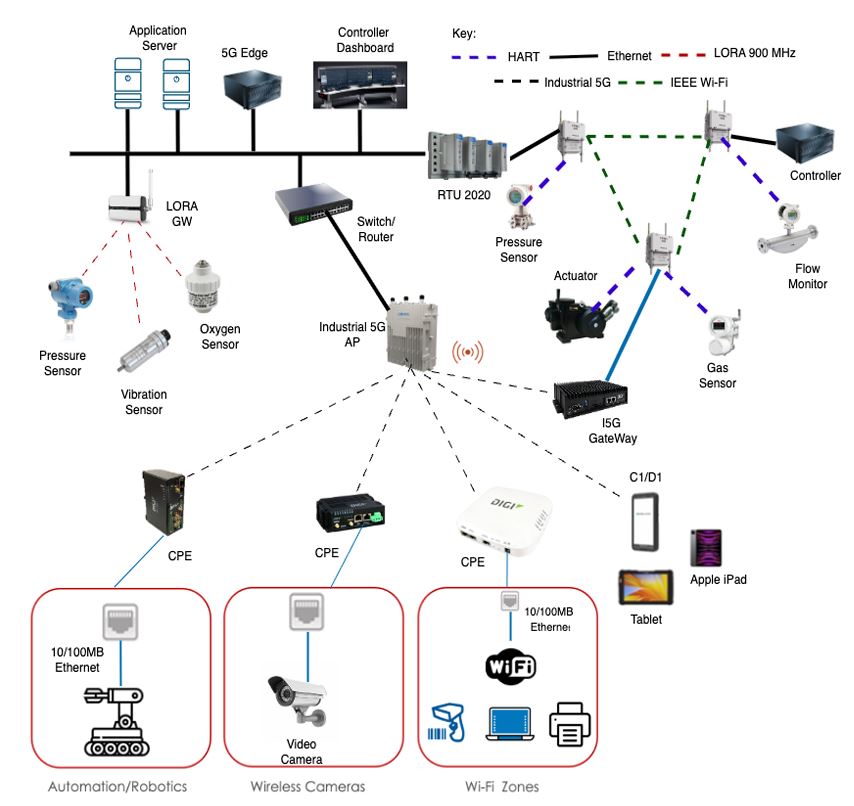 Figure 1: A sample IT/OT connectivity architecture showing wired, LoRa, WirelessHART, and industrial private 5G applications.
Public mobile cellular is an option for some plants since they already have coverage from the mobile operators. However, extending this network introduces a set of constraints. Industrial private 5G technology has advantages over public cellular in terms of control, security, and cost. Compared to public cellular, industrial private 5G has full enterprise control over Quality of Service (QoS), security policies, and network performance—especially in the ability to enhance coverage in important areas. In terms of security, industrial private 5G data stays within premises, versus traversing third-party infrastructures. It offers a predictable capex model versus consumption-based charges with overages inherent with public cellular. In addition, public cellular is often used as a backup connection for remote communications, so it’s not always a simple comparison.
Compared to Wi-Fi, industrial private 5G’s higher transmit power, lower noise floor, and a protocol designed for much higher performance in a dedicated spectrum provide much more reliable connections. Multiple devices competing for the same channel causes collisions and retransmissions; the Wi-Fi collision avoidance mechanism inherently accepts packet loss as normal operation. There is also no guaranteed QoS in standard Wi-Fi. Regarding coverage, industrial private 5G eight to 10 times fewer access points are needed compared to Wi-Fi. It also consistently provides less than 25 ms deterministic latency versus Wi-Fi’s variable latency due to contention-based access.
Seamless handovers are controlled by the industrial private 5G infrastructure versus device-driven disconnection/reconnection in Wi-Fi. This is critical with devices (and their owners) that are traveling more than one or two meters per second (walking speed).
Private 5G vs. ISA100 Wireless and WirelessHART
Industrial private 5G is quite different from technologies used for sensor applications like ISA100 and WirelessHART. Both excel at providing short bursts of information every few minutes or hours. But the amount of information is quite limited compared to the hundreds of megabits per second (Mbps) of data provided by industrial private 5G networks.
Another performance characteristic is coexistence. industrial private 5G is specifically designed for extensive coexistence. Regarding spectrum management, the Citizens Broadband Radio Service (CBRS) spectrum (3.5 to 3.7 GHz) for deployments in the U.S. is managed by a Spectrum Access System (SAS) to prevent interference.
Celona’s Self-Organizing Networks (SON) provide automated channel management and interference mitigation, which greatly eases deployment in a dense urban (or industrial) environment. In addition, radio frequencies can be successfully isolated from existing frequencies used in plant settings.
Industrial private 5G networks come with extensive integration capabilities. They seamlessly integrate with existing Wi-Fi infrastructure—not as a replacement, but as a complement. They also integrate with existing ISA100 and WirelessHART systems. Since these operate in the Wi-Fi band, there is no overlap with industrial private 5G.
Multi-technology systems that blend industrial private 5G with Wi-Fi, Internet of Things (IoT) networks, and wired connectivity are supported. Industrial private 5G also provides backhaul functionality for industrial gateways supporting condition monitoring systems, LoRaWAN sensors, and other applications.
MicroSlicing enables high-performance
“Slicing” a 5G network architecture into smaller pieces can tailor the network to the needs of specific applications, devices or users and deliver higher performance. It does this by enabling the multiplexing of virtualized and independent logical networks on the same physical network infrastructure.
MicroSlicing is Celona’s implementation of slicing for industrial private 5G networks. This proprietary technique is similar to traditional 5G network slicing, but it allows more granular and fine-tuned slices (Figure 2). In sectors such as refineries, manufacturing, energy, warehousing and logistics, a one-size-fits-all approach is insufficient. MicroSlicing enables each machine, application or function to receive the exact network service it requires. MicroSlicing can be compared to having a dedicated lane on a highway that can only be accessed with a specific transponder at a specific speed. In this lane, travel can be accomplished at 60 mph while vehicles in other lanes crawl through traffic in an attempt to reach their destination. Each slice has guaranteed performance characteristics (bandwidth, latency, reliability) and quality of service (QoS) is delivered on a per-device, per-application basis through artificial intelligence (AI) and policy settings.
MicroSlicing could support OT systems with an ultra-low latency slice for supervisory control and data acquisition (SCADA) and real-time control systems. IT applications could have a separate slice for Microsoft Teams and/or enterprise applications with different QoS. Other industrial uses include:
- Safety systems using a dedicated high-reliability slice for emergency communications.
- Video surveillance using a high-bandwidth slice for high-definition security cameras.
- A low-bandwidth, high-device-density slice monitoring industrial IoT sensors.
Celona’s MicroSlicing ensures guaranteed QoS for plant-critical applications in both uplink and downlink directions by providing the deterministic performance required for industrial operations. The technology intelligently segments network traffic by keeping critical operational data separate from non-critical communications to prevent interference and maintain security.
This QoS management extends across both the wireless air interface and the physical network infrastructure, which ensures end-to-end performance. All policies are configured centrally through the Celona Orchestrator. This eliminates the need for complex device-level configurations and allows IT/OT teams to manage the entire network from a single interface.
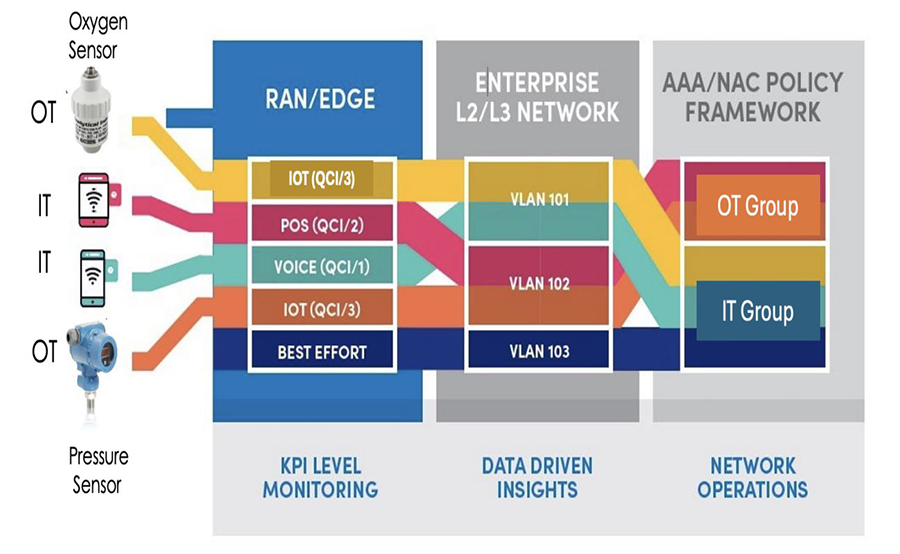 Figure 2: MicroSlicing allows granular and fine-tuned network slices tailored to the needs of specific applications, devices, or users.
Industrial private 5G security
To ensure security, Celona implements multiple security layers and is known for having a set of security features that make it very straightforward to integrate into an OT environment through its Aerloc architecture, which includes identity and authentication, network security, segmentation and isolation, and security ecosystem integration. Identity and authentication functionality uses SIM/eSIM-based authentication, which is more secure than Wi-Fi’s pre-shared keys; International Mobile Equipment Identity (IMEI) locking for physical SIMs to prevent unauthorized access; and device fingerprinting and identity verification. Network security functionality enables full enterprise control over routing and security policies, integration with existing AAA (RADIUS) and NAC systems (Aruba ClearPass, Cisco ISE), and support for zero-trust architecture. The external network domain ensures devices get IP addresses from enterprise DHCP with full firewall visibility. Segmentation and isolation functionality is ensured by physical air gapping between IT and OT traffic using separate VLANs and physical ports, policy-based segmentation at the Celona Edge, and integration with enterprise firewalls including Palo Alto for granular policies. Security ecosystem integration has APIs for integration with SASE and IoT security platforms, MDM integration (JAMF, VMware Workspace ONE, Microsoft Intune), and dynamic remediation and security orchestration capabilities.
Looking ahead
The need for enhanced security, superior performance, larger outdoor coverage footprint, and the ability to tailor the network to meet the specific needs of industrial applications is driving the adoption of industrial private 5G networks. Celona’s industrial private 5G technology provides a dedicated, high-performance network that can be customized to meet the specific requirements of industrial applications and OT/IT integration. The ability to prioritize OT/IT traffic, ensure end-to-end encryption, and maintain high levels of reliability makes the industrial private 5G network an attractive option for industries looking to enhance their digital infrastructure.