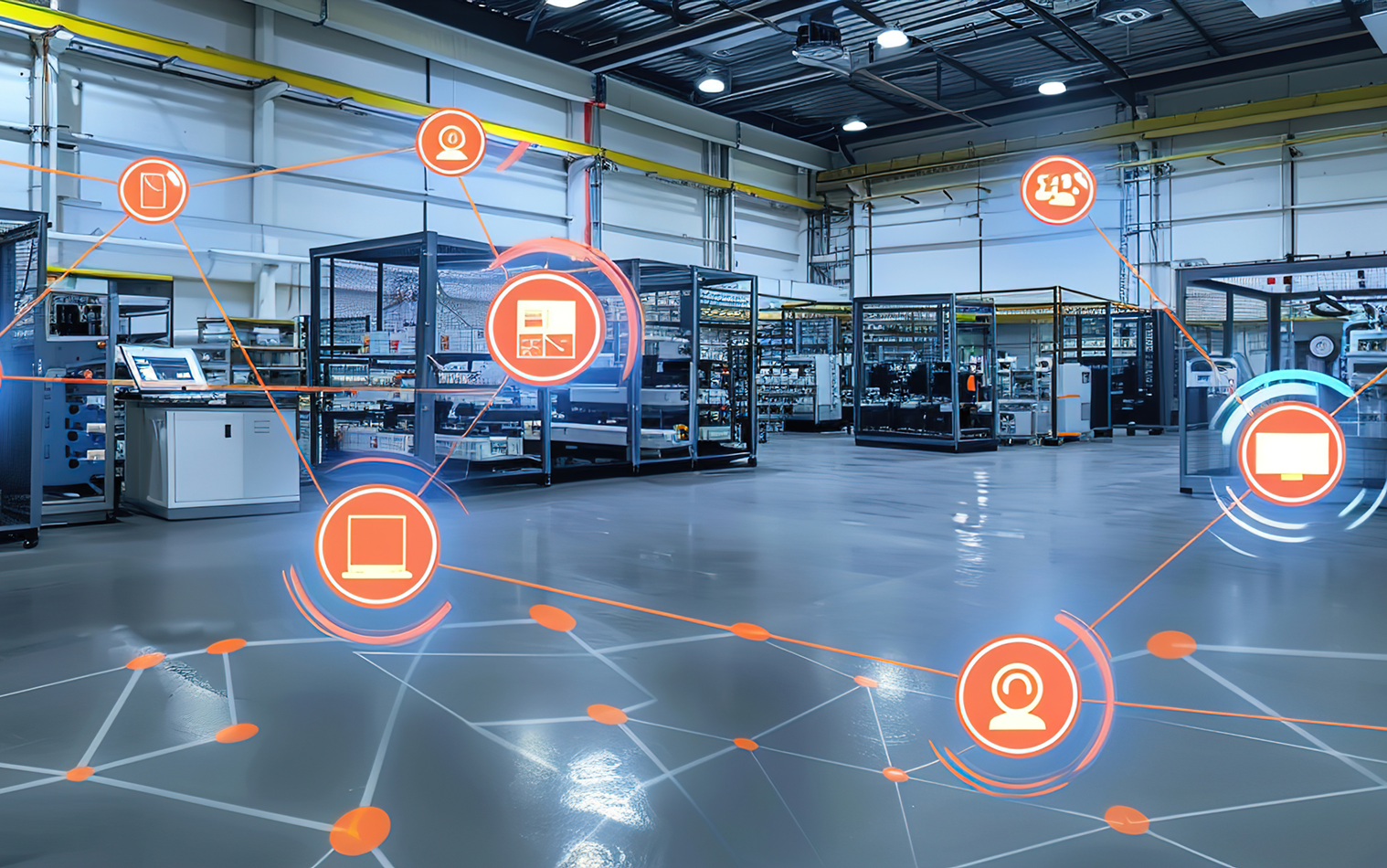
In today’s industrial landscape, one critical component in the achievement of manufacturing excellence is something surprisingly small: the connectors and sensors that keep factory floors communicating, coordinated and continuously productive. While they rarely earn the spotlight, these components are critical as factories digitize, automate and lean more heavily on data-driven decision making.
Rugged by necessity: What industrial connectors do
Industrial connectors are engineered to thrive where conditions are unforgiving. On the factory floor, connectors must resist:
- Constant vibration and impact
- Harsh temperatures and thermal cycling
- Oils, coolants, chemicals, moisture and dust
- Electrical noise, radio-frequency interference and shock
- Physical strain, bending and frequent reconnections
A single compromised connector — whether through a corroded pin or a hidden internal short — can bring a machine to a stop. And because many failures are invisible, troubleshooting often takes hours of tracing signals through miles of cable runs. This turns even a small component into a high-risk failure point with potentially significant operational and financial consequences.
These design demands have pushed connector technology toward more resilient materials, integrated sealing methods and more precise manufacturing — especially as connectors must now support increasingly complex sensor networks.
The sensor explosion: More data means more connections
Sensors have become the nervous system of modern manufacturing. They deliver the real-time intelligence required for:
- Automation and robotics
- Predictive maintenance
- Equipment monitoring
- Digital twins and smart factories
- Industrial cyber-physical systems
But as the number of sensors increases, so does the volume of electrical and communication connections needed to power and integrate them. Automation is growing at roughly 9-10% annually, robotics at close to 20% and AI-enabling hardware close to 30%. Every new sensor or computing node on the factory floor drives a nonlinear increase in connectors. The expansion isn’t one-for-one — it’s exponential.
Why it matters: The reliability imperative
This surge in electronics intensifies reliability demands. With more devices transmitting more data across more pathways, connector performance becomes essential to maintaining uptime and enabling modern digital manufacturing. Even a few minutes of unplanned downtime can disrupt production targets, labor efficiency and downstream supply chains.
Factories are turning to electronic integration — particularly sensor-enabled monitoring — to stabilize operations and improve predictability. Yet as equipment becomes more dynamic, connectors endure more mating cycles, repositioning and cable movement. This increases the risk of wear, seal failure and misalignment if connectors rely on legacy, discrete sealing components.
Industry needs connectors built for continuous use, harsh environments and high reliability. That’s where multi-component molding becomes key.
Multi-component molding creates connector reliability
Traditional connectors often rely on discrete O-Rings or manual assembly of plastic and rubber components. While functional, these seals can shift, wear or detach over repeated connection cycles, compromising integrity.
Multi-component molding (also known as overmolding) integrates plastic and elastomer elements into a single, tightly bonded structure. This approach delivers:
- More robust sealing that doesn’t shift or fall out of place
- Higher insertion-cycle life
- Better performance in environments with chemicals, moisture and thermal stress
- Reduced assembly errors and variation
- Greater design freedom for complex geometries and hybrid materials
High-performance plastics like polyether ether ketone (PEEK) provide thermal stability and electrical insulation, while elastomers such as liquid silicone rubber (LSR) create durable, high precision sealing elements. Together, they produce connectors that withstand rigorous industrial conditions and the growing demands of smart factory ecosystems.
Not all connector manufacturers can support multi-component design. Many large connector producers optimize for extremely high-volume, single-product manufacturing and struggle to adapt to the smaller runs — 50,000 to 200,000 units — that industrial applications require. This creates a strong market need for manufacturing partners who specialize in flexible, precision multi-component molding. Partners like Trelleborg Sealing Solutions offer in-house capabilities, from thermoplastic production to overmolding and inspection. Their expertise in high-complexity geometries and niche materials positions them as a leader in solving demanding connector challenges.
Why this matters for manufacturers and their supply chains
The convergence of automation, data integration and reliability expectations positions connectors — and the advanced molding processes behind them — at the center of industrial innovation. As factories add more sensors, controls and digital capabilities, the supporting infrastructure must evolve.
Industrial OEMs increasingly need:
- More reliable connectors that can survive repeated cycles
- Higher sealing performance
- Materials that resist harsh chemicals, heat and vibration
- Flexible manufacturing partners like Trelleborg that can handle medium-volume, high-precision runs
- Multi-component molded solutions that simplify assemblies and reduce failure points
Conclusion: Small components, massive impact
Connectors and sensors may be physically small, but they sit at the heart of some of the biggest transformations happening in industry today. As manufacturers race toward smarter, more connected and more automated operations, the reliability of each connection becomes critical.
The narrative is simple but powerful. Increasing the number of sensors leads to more electronics, which results in more connectors, greater complexity and a heightened demand for high-reliability, multi-component solutions.
This is why innovation in connector design — and the expertise required to produce integrated, high performance components — matters now more than ever. And it’s why suppliers who excel in multi-component molding stand uniquely positioned to support the future of industrial electronics.