This post is an excerpt from the journal ISA Transactions. All ISA Transactions articles are free to ISA members, or can be purchased from Elsevier Press.
Abstract:
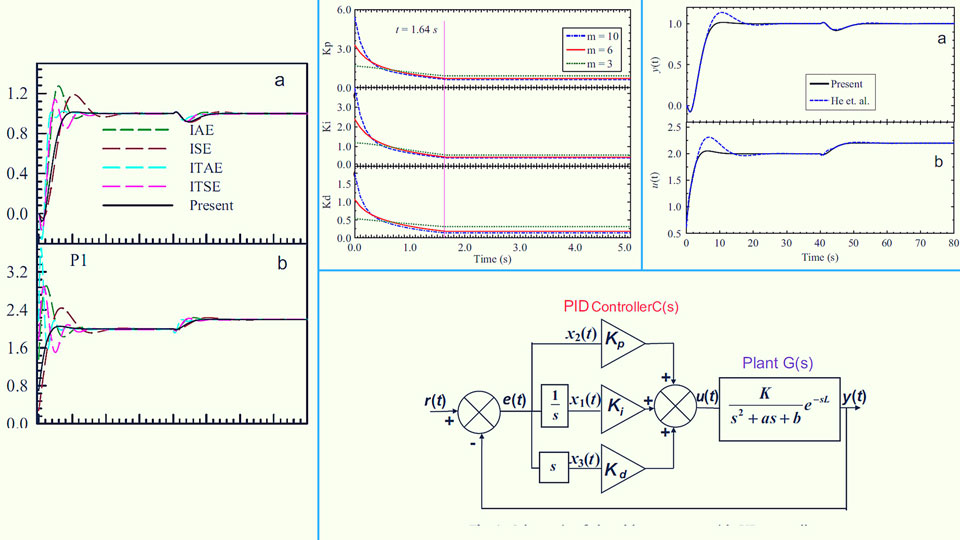
An improved tuning methodology of PID controller for standard second order plus time delay systems (SOPTD) is developed using the approach of Linear Quadratic Regulator (LQR) and pole placement technique to obtain the desired performance measures. The pole placement method together with LQR is ingeniously used for SOPTD systems where the time delay part is handled in the controller output equation instead of characteristic equation. The effectiveness of the proposed methodology has been demonstrated via simulation of stable open loop oscillatory, over damped, critical damped and unstable open loop systems. Results show improved closed loop time response over the existing LQR based PI/PID tuning methods with less control effort.
The effect of non-dominant pole on the stability and robustness of the controller has also been discussed.
Free Bonus! To read the full version of this ISA Transactions article, click here.
Join ISA and get free access to all ISA Transactions articles as well as a wealth of other technical content, plus discounts on events, webinars, training & education courses, and professional certification.
Click here to join ... learn, advance, succeed!
2006-2017 Elsevier Science Ltd. All rights reserved.