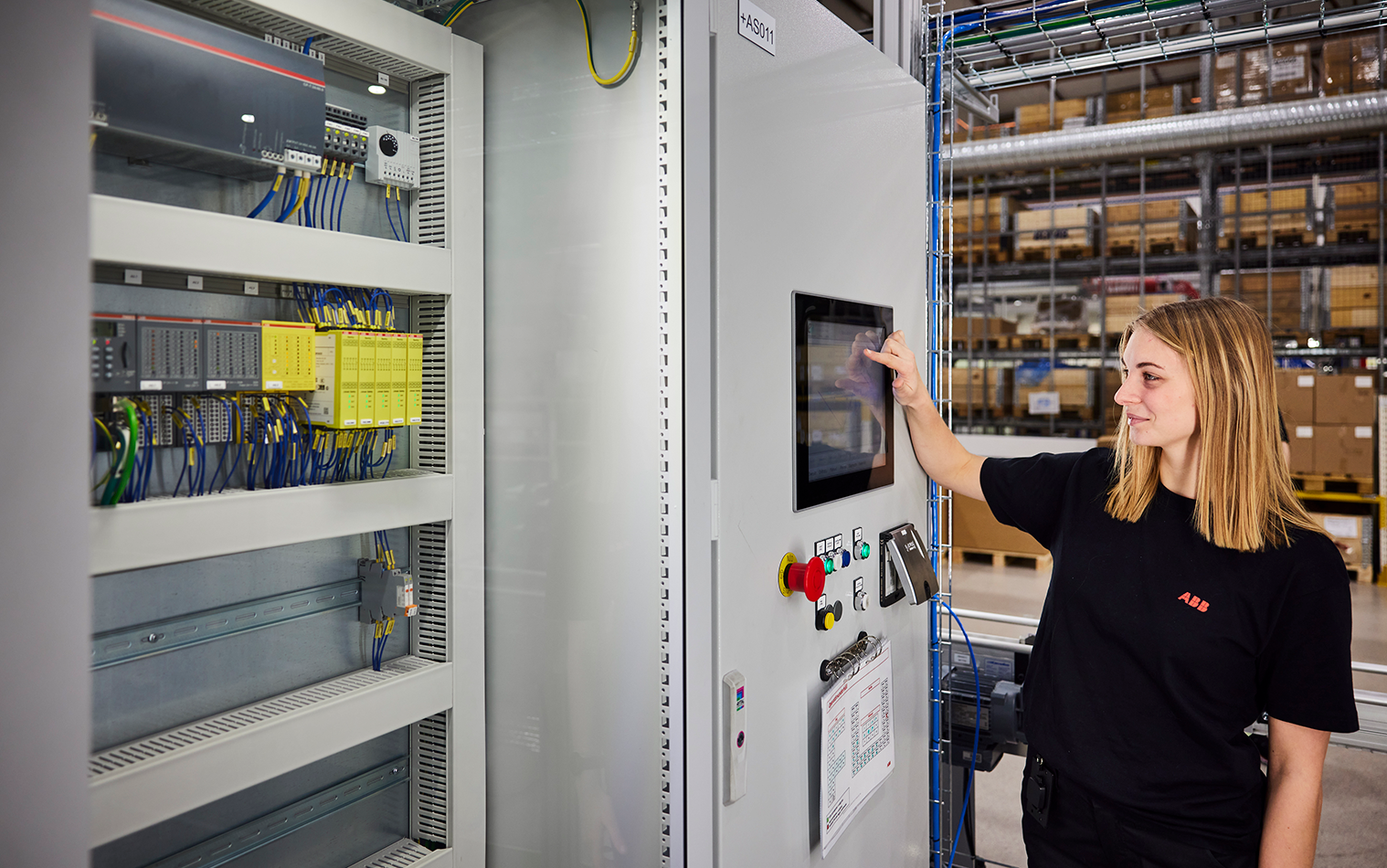
One thing that’s quietly changed in industrial automation over the last decade is the way people physically interact with machines. Tactile human-machine intuition is in many ways an obsolete skill. Operators who once knew the buttons and dials of a control panel like the backs of their hands now often run whole sites from a central system, or even from their laptop at home.
That’s all the more reason why a panel, when it’s needed, has to work seamlessly. If an operator rushes over in an emergency scenario, there’s no time to fiddle with confusing screens or cryptic alarm shutdowns when the health of crucial machinery is at stake.
A good human-machine interface (HMI) shouldn’t just look good; it should offer speed and situational awareness. With high staff turnover, hybrid working and tightening cybersecurity rules, panel usability and safety is a frontline operational issue. This is what makes intuitive control and interface design so vital now.
At ABB Machines, we say this from experience. We’ve been supplying large synchronous motors, generators and condensers for decades, along with the excitation systems that keep them under tight control. Those systems rely on reliable HMIs, and for many years our CP600 control panel, part of the AC500 PLC platform, has done that job dependably. But the way people use panels has changed — and expectations have changed too.
Then and now
Which invention was the “first” HMI technology is the subject of some debate. Was it the typewriter in the 1860s? The telegraph of the 1830s and 40s? Charles Babbage’s steam-powered mechanical computer, the “Difference Engine” in 1822? Or something much earlier?
Regardless of when it started, the evolution hasn’t stopped. Electrification, computerization and touchscreen functionality are just some of the most recent developments that have set new norms for HMIs. And the HMI market is still growing. Global market revenue was USD 5.2 billion in 2023, and by 2032 it’s expected to reach USD 10.7 billion.
Despite this, the phenomenon of fewer operators interacting with physical local panels persists. This not the fault of the technology itself, but due to recent innovations in other kinds of multi-asset, digital bridging technologies like Supervisory Control and Data Acquisition (SCADA). Condition monitoring via sensors, augmented reality and digital twins — the mass of data generated by and about industrial equipment have effectively become a hyperreal version of the real thing.
Something old, something new
At ABB, we’ve seen this change happen with our own technology. The early “classic” CP600 panels were workhorses: solid, scalable and built for engineers who understood exactly what every button did. For commissioning teams and service engineers, that worked fine. But for many plant operators who might only touch the HMI occasionally, the experience wasn’t exactly smooth. Sometimes the local panel would sit unused for weeks, as most operations were handled remotely. When something did need hands-on attention, navigation could be clunky.
That’s the reality that set off our redesign effort. We wanted to make the HMI experience simpler, more flexible and more aligned with today’s expectations, without sacrificing the robustness that industrial environments demand.
Our approach was to put users first. We held structured interviews with internal commissioning engineers and customers, and worked closely with the ABB User Experience (UX) group, which partners across our colleagues in Motion, Robotics and Electrification to create consistent UI standards. To turn design ideas into reality, we brought in an external agency and moved quickly to interactive prototypes created with design software Figma. We filmed operators using those prototypes in simulated environments so we could see where they hesitated, what drew their eyes, what confused them.
Translating the design into CP600’s native environment was no small job. The panel runs on a widget-based system through Panel Builder, and it doesn’t take Figma files directly. To preserve the design intent, our engineers even wrote custom widgets in JavaScript. It was a lot of work, but it meant we could stay true to the design language while still using the industrial-grade backbone our customers rely on.
A modern UX that actually makes work easier
The result is an interface that feels modern but still behaves like an industrial tool. Navigation is clearer: there’s now a distinct visual hierarchy between the buttons you use to change screens and those that trigger machine functions. That small change alone cuts down accidental activations and makes the layout easier to follow.
The new trend viewer allows users to filter specific data points, so you can isolate and view a single parameter in real time or from historical logs. Diagnosis becomes faster and trend analysis just makes more sense. Another key update is the alarm list, which now scrolls full alarm messages instead of abbreviations that used to cut off half the explanation. Operators can see exactly what’s going on without needing to pick up the phone.
Other practical improvements include secure upload and download of configuration files, and the ability to take screenshots straight from the panel for support. In upcoming updates, operators will even be able to open the PDF manual directly on-screen. It’s a small thing, but one that cuts down maintenance time when you’re on-site and in a hurry.
Importantly, these improvements don’t rely on operators using the panel every day. In many facilities most operations are remote, yet commissioning, maintenance and troubleshooting still need local access. The CP600 now makes those rare but crucial on-site moments faster and more confident.
Building security and compliance in
Cybersecurity has moved from background concern to boardroom priority. Increasingly, industrial equipment is connected to larger systems or the cloud for monitoring and optimization, which means more potential entry points for cyber threats. And regulators have noticed.
The upcoming EU Machinery Regulation, due in 2027, will add explicit cybersecurity obligations for machines placed on the European market. It won’t be enough to simply bolt on a firewall; the entire control system, from PLC to panel, will need to be demonstrably secure by design.
The entire CP600 HMI portfolio provides high level of cybersecurity, and it features encrypted project files to prevent unauthorized access or manipulation. Secure authentication, protected data exchange and clearer user management all contribute to safer operation. For machine builders and operators, that means not only better protection against attacks, but also easier proof of compliance when the new regulations come in.
Cybersecurity doesn’t have to make life harder for users. It should do the opposite: a well-designed HMI helps enforce good security practices by guiding people through the right procedures, reducing the temptation to look for risky shortcuts.
Evolving with the way people actually work
Most machine operations will always happen remotely, but local panels remain the trusted fallback when things get tough. That’s why usability matters. The new CP600 panels have nice graphics, sure — but fundamentally they’re about helping any operator, even one who hasn’t touched the panel for months, feel comfortable immediately.
For existing customers, upgrade kits make it easy to bring older panels up to this new standard, extending the life of the equipment and giving a familiar machine an entirely new feel.
For us, that’s the point: combining performance and simplicity. The technology under the hood keeps evolving, but it’s the human interface that determines how confidently and safely a machine can be run. An HMI that’s clear, secure and genuinely intuitive is one less unknown between the operator and the output.