The future of industrial artificial intelligence (AI) looks bright. Initial studies and pilot projects point to significant efficiency gains and cost savings made possible by connecting production systems to AI engines. However, there is at least one serious challenge. How do we keep those production systems and their data completely secure? After all, most AI tools are cloud-based. What's needed is a secure, real-time connection from the plant to the AI system running in the cloud.
The recommended approach for industrial data security is complete network segmentation. The OT (operations) system should be fully isolated from the Internet and cloud systems. This is best done using a DMZ (demilitarized zone), keeping the production network behind closed firewalls. Governments and industry leaders worldwide agree on this basic industrial cybersecurity practice, and the NIS2 Directive and NIST CSF 2.0 require it.
Protocol challenges
Getting data from production to a cloud-based AI system through a DMZ requires two steps: plant-to-DMZ, and DMZ-to-cloud. However, OPC-UA and MQTT were not designed for this type of pathway. Although often used in Industrial IoT and Industry 4.0 systems, they were conceived in the early 2000s, long before people were thinking of moving industrial data to the cloud. The OPC UA protocol by itself is simply too complex to reproduce well in a daisy chain across multiple servers.
Information will be lost in the first hop. The synchronous multi-hop interactions needed to pass data across a DMZ would be fragile and result in high latencies. MQTT, on the other hand, can be daisy-chained but it requires each node in the chain to be individually configured and aware that it is part of the chain. The quality of service (QoS) guarantees in MQTT cannot propagate through the chain, making data at the ends of the chain unreliable. MQTT is thus best used as the last step only, to move data from the DMZ to the cloud.
What about combining OPC UA and MQTT? Getting data securely from the plant to the DMZ is a challenge. Using OPC UA for that step has a serious pitfall—as it requires opening a firewall on the production network. Any OPC UA client on the DMZ would need to connect through the firewall to the OPC UA server in the plant. Opening a firewall into the plant for this connection is too high a risk, and most security administrators will not allow it.
Tunnel/mirror technology
Since neither OPC-UA nor MQTT alone or together are sufficient for passing data through a DMZ, another approach is needed—one that integrates well with both protocols. Secure tunnel/mirror software with a unified namespace provides a solution. It can make the connections at both ends and pass the data along the daisy-chained connections necessary for DMZ support. 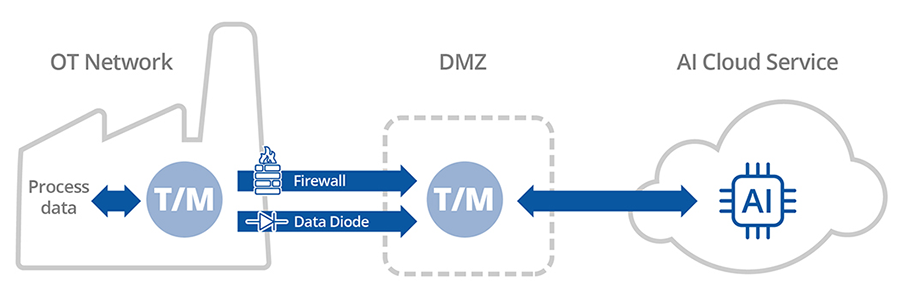 Tunneling or mirroring connections typically use two software components. The first component makes the necessary connections at the production level to collect data from various industry protocols into a single unified namespace.
It then tunnels the data to the second component running on the DMZ. The second component converts the data to MQTT and sends it from the DMZ to the AI service in the cloud. The mirroring capability of the tunnel/mirror software keeps the data consistent between the original data source, the DMZ, and the AI system.
Firewalls and data diodes
As mentioned previously, all inbound firewall ports on the production system must be kept closed at all times. The tunnel/mirror system must be able to make outbound-only connections from the production network to the DMZ. In addition, some high-security, critical infrastructure applications require a hardware data diode to ensure that not a single data packet can be sent back from the DMZ to the industrial network. A tunnel/mirror system would need to support that level of secure architecture for those applications. Other AI implementations may call for bidirectional data flow to enable hands-off supervisory control or similar data inputs back into the production system.
The tunnel/mirror technology should be flexible enough to support that if needed. In any case, there should be no access to data beyond what the AI system uses. Plant engineering staff should have full control over which data should be made available. Summing up, to optimize production systems many companies today are turning to industrial AI. The challenge they face is how to access the data they need without compromising security.
This is difficult, but not impossible. You can have a zero-attack-surface OT network and still provide data to cloud-based AI systems. The security is provided by a DMZ. Accessing production data through a DMZ can be done with well-designed tunnel/mirror software. This piece was originally published in AUTOMATION 2024: 9th Annual Industrial Automation & Control Trends Report.