AutoQuiz is edited by Joel Don, ISA's community manager.
Today's automation industry quiz question comes from the ISA Certified Control Systems Technician (CCST) program . Certified Control System Technicians calibrate, document, troubleshoot, and repair/replace instrumentation for systems that measure and control level, temperature, pressure, flow, and other process variables. Click this link for more information about the CCST program. This question comes from the Level I study guide, Domain 3, Troubleshooting. Level I represents a professional who has a five-year total of education, training, and/or experience.
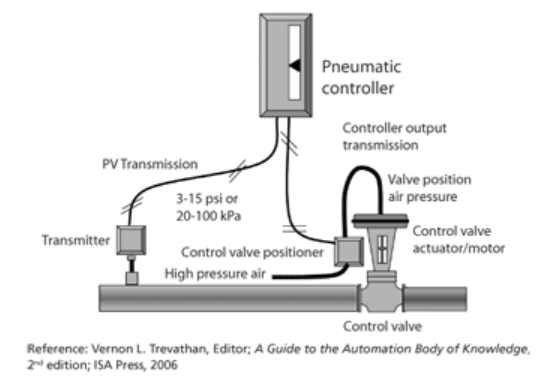
a) 3-15 psig b) 5-20 psig c) 1-10 psig d) 4-02 psig e) none of the above
Industry recognized early on that for the sake of ease and safety it would be better for an operator to monitor and control processes in a more convenient and protected place. The need for transmitting the process variable to that place settled on pneumatic transmission.
They used 3-15 pounds per square inch gauge (psig) as the range. The value of using three rather than zero is to detect failure of the instrument air supply. The measurement of 15 psig is for 100%, because it is well below nominal pressures for the air supply for diagnostic purposes.
Thousands of pneumatic instruments, controllers, and control valves remain in use even today, well into the digital signal transmission age.
The correct answer is A, 3-15 psig.