
What is the ROI of sustainable IBP (Integrated Business Planning)? Discover how integrating sustainability with virtual twins cuts carbon by 25% while improving operational resilience by 30%.
What if your business could increase order fulfillment rates by 20%, boost customer satisfaction and help the planet; all at the same time?
Executive summary:
- Sustainable supply chain planning integrates environmental, social and economic objectives into operational decision-making.
- Organizations embedding sustainability into Integrated Business Planning improve efficiency and risk management.
- Advanced planning capabilities enable measurable improvements in carbon reduction and resilience.
- Companies typically achieve 15–25% carbon reduction and 25–30% improved operational resilience.
- Virtual twin technologies allow simulation of sustainable strategies before real-world deployment.
What is sustainable supply chain planning?
Sustainable supply chain planning is the process of managing environmental, social and economic impacts throughout the supply chain to ensure responsible business practices. It involves evaluating and improving every step in a company’s value chain, from sourcing raw materials to manufacturing and distribution.
Integrating sustainability into strategic planning translates into long-term economic advantages. Companies that adopt sustainability can mitigate risks related to regulatory compliance and resource scarcity, while sustainable operational practices lead to cost savings through improved resource efficiency and waste reduction.
Sustainable supply chain planning embeds these principles directly into operational and optimization processes, ensuring environmental impact is considered alongside cost, service levels and performance objectives.
Key components of supply chain sustainability
There are many areas in which companies can develop sustainability initiatives. Supply chain planning can drive targeted transformation of operational processes.
As an overall strategy, companies can significantly impact sustainability by incorporating initiatives directly into their Integrated Business Planning process. Alignment and collaboration between financial, operational and strategic goals ensures consistent prioritization of sustainability objectives throughout the supply chain.
Core components include:
- Resource efficiency: Reducing the consumption of raw materials and energy throughout the supply chain.
- Sustainable sourcing: Procuring materials from suppliers who adhere to environmental and social standards.
- Carbon footprint management monitoring and reducing greenhouse gas emissions generated by manufacturing, transportation and logistics.
- Waste reduction: Minimizing waste generated during production and distribution.
- Logistics planning: Optimizing transportation and distribution to reduce environmental impact and improve efficiency.
Capabilities of supply chain planning software in supporting sustainability initiatives
Innovation in planning and optimization technology has introduced new capabilities that transform how companies manage and plan their supply chains.
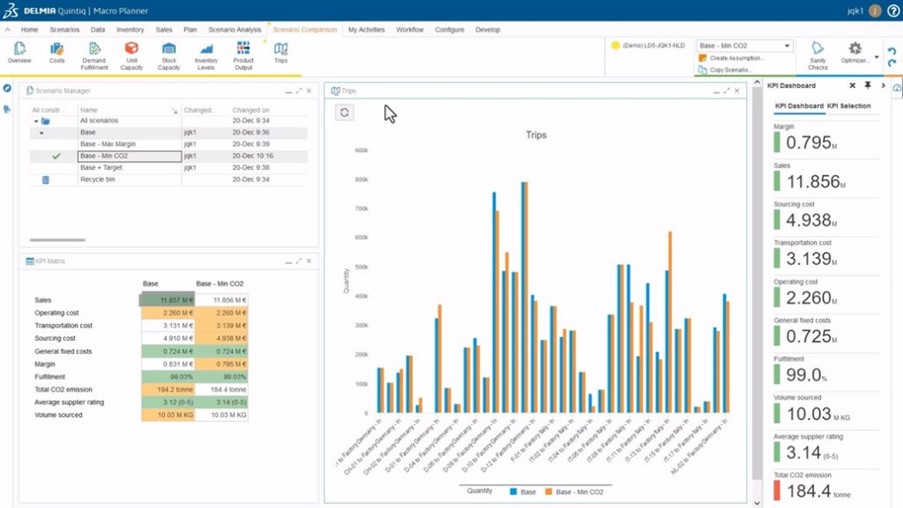 1. Real-time data analytics
Provides real-time visibility into supply chain operations, enabling informed decision-making. Example: Real-time production analytics detect waste or inefficiency early, allowing planners to re-optimize sourcing, production and logistics fast enough to cut scrap, transport and emissions.
2. Predictive analytics
Uses historical and real-time data to forecast demand, improving inventory management and reducing waste. Example: Retailers anticipate seasonal demand spikes, reducing overproduction and unsold inventory.
3. Scenario planning
Allows simulation of alternative strategies to assess sustainability impacts before implementation. Example: A logistics company evaluates different transportation routes to identify the most environmentally efficient option.
4. Resource optimization
Increases efficiency in energy and raw material usage. Example: By directing limited supplies to plants with the highest yield and lowest energy use, producers reduce waste and increase output from the same raw material.
5. Demand sensing and responsiveness
Enhances responsiveness to demand fluctuations while minimizing environmental impact. Example: A consumer electronics company dynamically adjusts production levels to reduce excess inventory and electronic waste.
6. Virtual twin of the supply chain
Creates a digital replica of the supply chain to simulate operational strategies and assess environmental impact prior to deployment. Example: A car manufacturer simulates production processes to reduce water and energy use while minimizing waste.
Measurable business impact of sustainable supply chain planning
Implementing advanced planning solutions yields measurable improvements across operational and sustainability KPIs.
Organizations typically report:
- 15–25% improvement in inventory turnover
- 10–20% increase in order fulfillment rates
- 10–15% reduction in production costs
- 20–30% reduction in lead times
- 10–15% reduction in transportation costs
- 20–30% improvement in forecast accuracy
- 15–25% reduction in carbon emissions
- 25–30% improvement in operational resilience
These quantified outcomes demonstrate that sustainability initiatives, when embedded into planning processes, contribute directly to financial and operational performance.
Real-world success stories: Altair Group and Speed Group
Altair Group: Collaborating with DELMIA, the Altair Group leveraged advanced planning and simulation tools to optimize production processes and significantly reduce resource consumption. Through improved forecasting, transportation optimization and enhanced visibility, Altair strengthened operational performance while reducing environmental impact.
Speed Group: Speed Group enhanced its sustainability efforts through digital manufacturing and supply chain solutions. By optimizing resource allocation and leveraging predictive analytics, the company reduced its carbon footprint and improved operational resilience.
These resilience improvements align with broader industry findings emphasizing the importance of operational robustness in volatile environments (Source: McKinsey – The Need for Operational Resilience).
Considerations for implementation
Successful transformation requires accurate, integrated data across suppliers, manufacturers, logistics providers and distribution centers.
Supply chain planning systems must remain agile to accommodate market volatility, geopolitical shifts and evolving consumer behavior without compromising sustainability objectives.
Organizational culture and leadership commitment are equally critical to embedding sustainability into operational decision-making.
Future innovations in sustainable supply chain planning
Future advancements are expected to further enhance sustainability through:
- Hyper-intelligent predictive analytics
- AI-powered autonomous logistics systems
- Integrated lifecycle assessment tools
- Bio-digital twin technologies
- AI-driven ethical supply chain monitoring
- Global collaboration platforms
These innovations will enable organizations to achieve higher levels of environmental stewardship while maintaining operational efficiency and competitiveness.