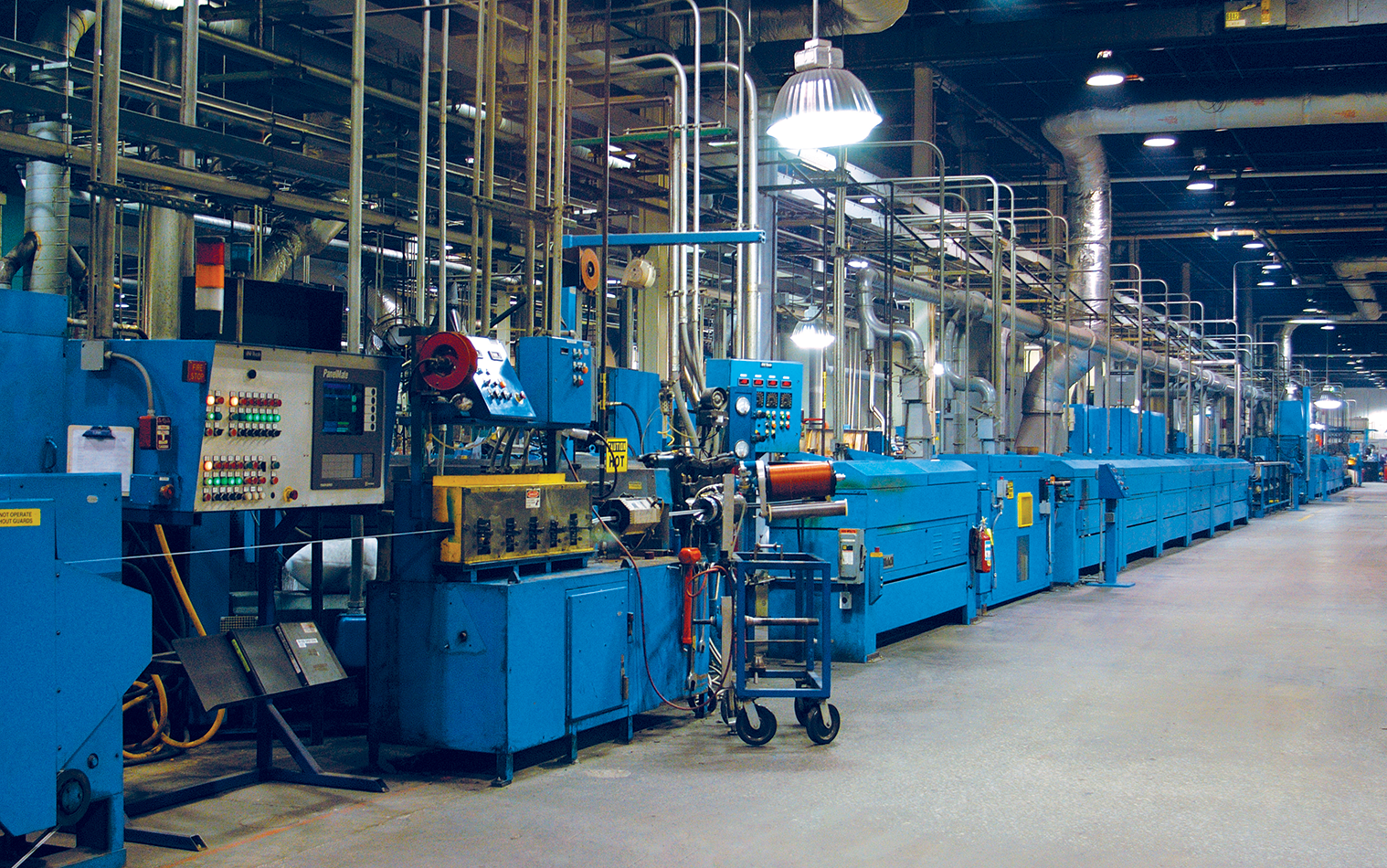
For decades, manufacturers have automated countless production processes, yet continuous extrusion has remained one of manufacturing's most challenging operations to control.
Whether processing EPDM rubber, thermoplastics, reactive plastics or fiber optic cable coatings, extrusion combines multiple materials, complex physical interactions and other constantly changing variables. Even experienced operators can only effectively adjust one variable at a time and legacy advanced process control (APC) systems just can't keep up. This often results in higher scrap, inconsistent quality and lost productivity. But recent advances in artificial intelligence (AI) are changing that.
Rather than relying on fixed programming or manually developed control logic, AI-based autonomous process control software like Liveline Technologies Inc. has been developed to continuously learn from production data, adapt to changing operating conditions and make real-time adjustments while production is running. Unlike traditional APC systems, which often require months to implement and investments in the millions of dollars, Liveline Technologies is typically deployed in four to six weeks and costs thousands rather than millions.
The process: Three steps to autonomous manufacturing
Liveline Technologies layers its intelligent AI-driven process control on top of existing equipment to learn how each production line behaves before safely assuming autonomous control. The deployment follows three distinct phases designed to minimize risk while enhancing process stability and performance.
Phase 1: Learn
A universal edge device connects directly to existing programmable logic controllers, allowing Liveline Technologies to immediately begin learning from the equipment sensors. From there, the platform builds a physics-based model of that plant. Working fast, efficiently and grounded in real time data, Liveline Technologies’ AI uncovers deep interconnections and surfaces features and patterns traditional controls would miss.
Phase 2: Ghost mode
In this phase, Liveline Technologies simulates everything in parallel, predicting outcomes and fine-tuning performance before ever going live. The system optimizes across variables and respects the physical and chemical realities of the specific process.
Phase 3: Closed-loop control
At this stage, a reinforcement learning model adjusts process parameters in real time while keeping operations within the machine’s safe operating limits. It's not just reacting; it's coordinating across dimensions, continuously refining performance as variables shift.
The deployment: Easy installation with existing systems
A key advantage of Liveline Technologies is its simplicity of deployment. Unlike many traditional automation and advanced process control solutions that require significant hardware investments, lengthy integration projects and extensive engineering resources, Liveline Technologies is designed to work with existing production infrastructure.
- Deployment requirements: Liveline Technologies is delivered as a cloud-based SaaS solution, minimizing on-premises infrastructure requirements and reducing deployment complexity. Deployment typically involves configuring secure communication between the customer site and the Liveline Technologies cloud environment.
- What gets installed: In most cases, no significant new hardware is required. A lightweight edge application, connector or gateway may be deployed on the customer network to securely collect and transmit operational data.
- IT/OT integration: Liveline Technologies connects to existing OT systems such as PLCs, historians, MES and SCADA platforms using industry-standard protocols and interfaces. Integration is designed to be non-intrusive and typically does not require modifications to production control systems.
- Cloud connectivity and security: The solution uses secure outbound communications to the Liveline Technologies cloud platform. Deployment generally requires approval to open specific network ports and allow communications through the customer’s firewall. Liveline Technologies follows modern cybersecurity practices, including encrypted data transmission, role-based access controls and secure cloud hosting.
- Engineering support: Implementation typically requires limited engineering effort, with most activities focused on data source configuration, validation and user onboarding.
The results: Measurable business impact
One example comes from Cooper Standard, a global automotive supplier of sealing and fluid handling systems. Cooper Standard manufactures thousands of extrusion profiles across rubber and thermoplastic applications. Variability in incoming materials, changing equipment conditions and the sheer number of product configurations made maintaining consistent process performance increasingly difficult.
Traditional manual process control required experienced operators to continually monitor the line and adjust based on changing conditions. While operational, this approach depended heavily on operator expertise and reaction time.
To address these challenges, Cooper Standard implemented Liveline Technologies' full controls platform in eight global plants on 22 extrusion lines. The implementation quickly demonstrated that autonomous process control can deliver measurable improvements across several complex extrusion processes.
For rubber and thermoplastic extrusion applications, Cooper Standard has already achieved:
- Up to 47% reduction in process variation
- Up to 35% reduction in scrap
- Up to 15% improvement in Overall Equipment Effectiveness
- Typical deployments achieve a ROI within two to nine months
- Fully automated process control with minimal operator intervention
Additional deployments across reactive plastic extrusion demonstrated similar success, including a 98% reduction in process jams, while fiber optic manufacturing applications achieved up to a 75% increase in line capacity through AI-driven optimization of line speed, coating thickness and process stability.
 Figure 1: Liveline Technologies Inc. is a provider of AI-driven process controls solutions that leverage the most recent advancements in artificial intelligence to transform existing production assets into an autonomous system.
The potential: A new era of manufacturing
The success of autonomous process control in extrusion points to something larger than a single application. For the first time, manufacturers can deploy control systems that don't just execute instructions but understand processes. These breakthrough processes are capable of learning the physics of a production line, anticipating how variables interact and continuously improving without human reprogramming. As this capability extends across other complex, high-variability operations, including from mixing and molding to coating and curing, the traditional trade-off between process complexity and automation feasibility begins to disappear. Processes once considered too dynamic or too dependent on operator intuition become candidates for full autonomy.
For manufacturing leaders, the implications reach beyond any one production line. Autonomous process control offers a path to protect institutional knowledge as experienced operators retire, to standardize performance across global plants and to unlock capacity from existing assets without capital-intensive equipment replacement. The plants that adopt this technology first will transform their operations with a fundamentally different model, one where production lines optimize themselves and people are freed to focus on higher-value work. That shift, from automated manufacturing to autonomous manufacturing, is already underway.