This post is an excerpt from the journal ISA Transactions. All ISA Transactions articles are free to ISA members, or can be purchased from Elsevier Press.
Abstract:
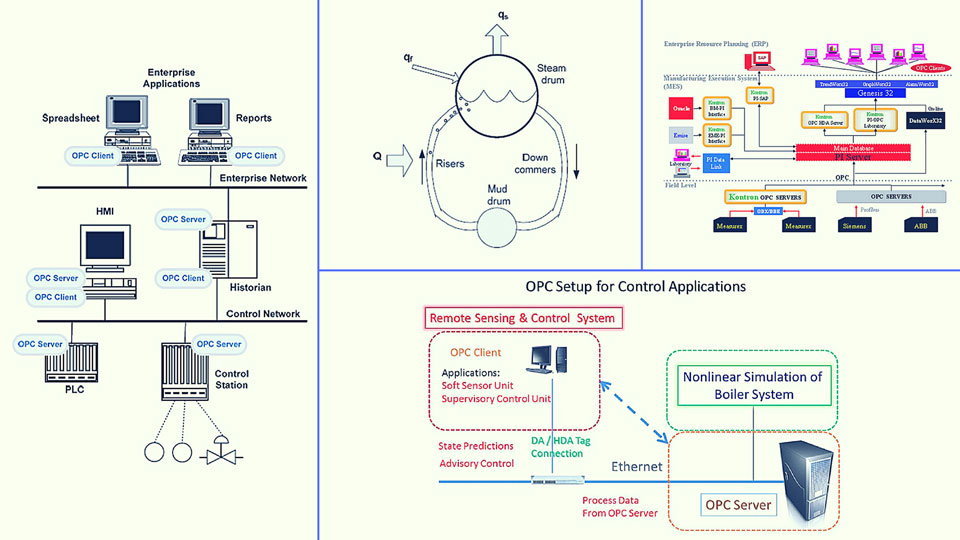
OPC, originally the object linking and embedding (OLE) for process control, brings a broad communication opportunity between different kinds of control systems. This paper investigates the use of OPC technology for the study of distributed control systems (DCS) as a cost effective and flexible research tool for the development and testing of advanced process control (APC) techniques in university research centers. Co-simulation environment based on Matlab, LabVIEW and TCP/IP network is presented here. Several implementation issues and OPC based client/server control application have been addressed for TCP/IP network. A nonlinear boiler model is simulated as OPC server and OPC client is used for closed loop model identification, and to design a model predictive controller (MPC).
The MPC is able to control the NOx emissions in addition to drum water level and steam pressure.
Free Bonus
! To read the full version of this ISA Transactions article, click here .
Enjoy this technical resource article? Join ISA and get free access to all ISA Transactions articles as well as a wealth of other technical content, plus professional networking and discounts on technical training, books, conferences, and professional certification.
Click here to join ... learn, advance, succeed!
2006-2018 Elsevier Science Ltd. All rights reserved.