





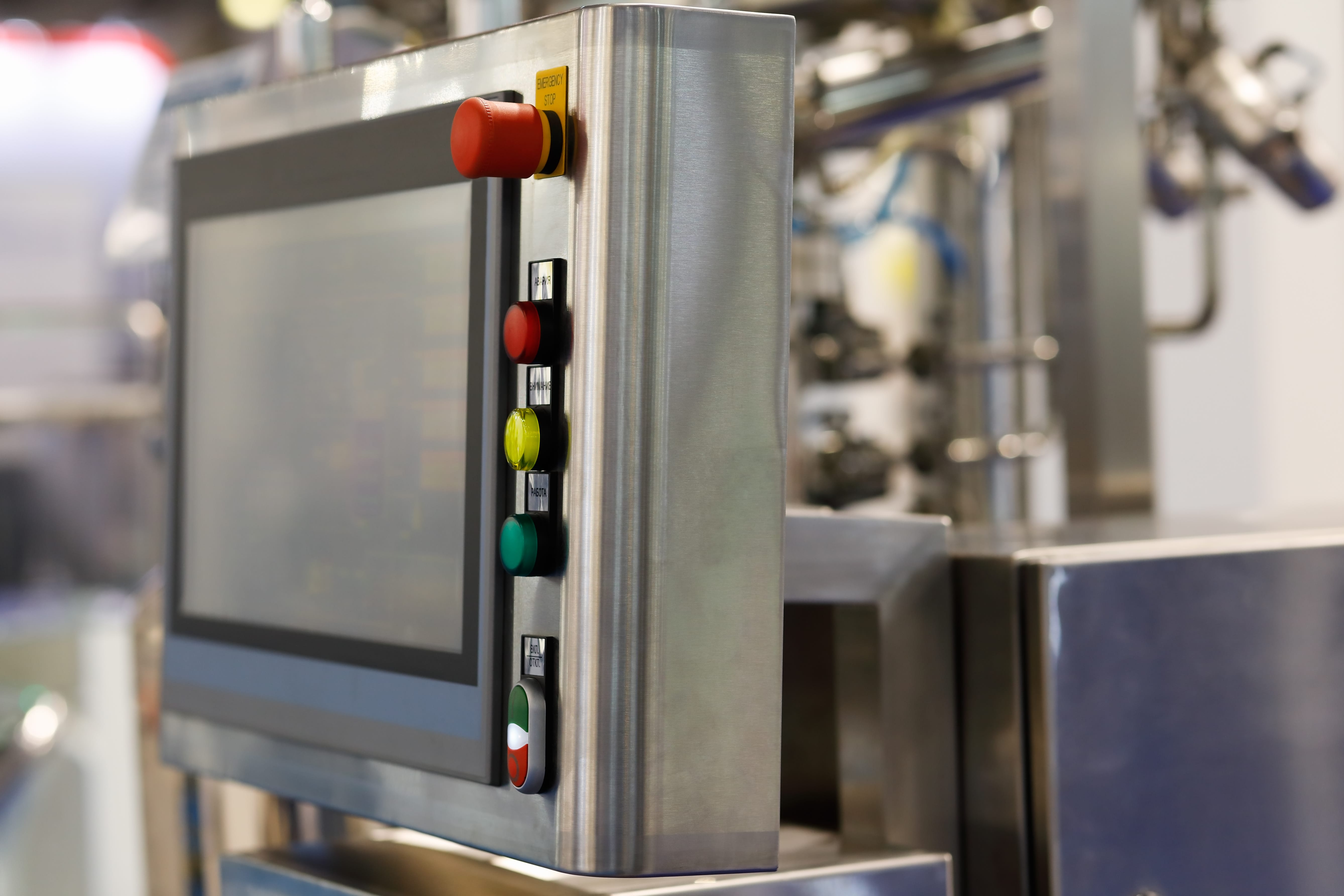
What is an HMI?
Human machine interfaces
, more commonly known as HMIs, have been used since a personal computer arrived on the plant floor. Most people think of them as the screens used in a production environment. In a broader sense, they are a form of user interface (UI) between people and machines. So the better question to ask is, “What does an HMI look like in the age of Industry 4.0?”
In order to answer this question, we should start with a bit of history. The original function of an HMI was to start and stop the equipment that included indicator lights to depict the status. More advanced HMIs have had the ability to adjust process parameters, like speed or temperature, or to include analog indicators to provide feedback of a sensor, like pressure or flow rate. Because all of the control and monitoring was a piece of hardware, HMIs were generally limited to safe operation.
When computers became more common on the factory floor, these enclosures were replaced with a personal computer and CRT monitor using HMI software. All of the mechanical equipment (push buttons, indicator lights, etc.) became a graphic on a screen. This change in user interface
revolutionized manufacturing
in that much more control was available to the operator along with better feedback. As computer and monitor technology evolved, the large CRTs were replaced with touch panels and an embedded PC. As noted earlier, this is the current form for most HMIs.
Because there was the ability to visualize much more of the process, HMI software started to be used for SCADA (supervisory control and data acquisition) systems to control and monitor overall processes. Rather than a standalone panel at a piece of equipment, there was a comprehensive system that linked all of the equipment together. Each HMI became
more of an operator station
with the relevant information displayed. In some ways, the pure HMI function disappeared, as the operator station provided much more capability. This evaluation has resulted in the concepts of HMI and SCADA to largely become used interchangeably.
The current trend in manufacturing returns the HMI to its original application, providing basic
control and monitoring
of equipment. It continues to have network capabilities for connectivity into the SCADA system. Of course, the SCADA system still provides the ability to monitor and control equipment. The system also provides real-time visualization of other process metrics, like downtime, batch status, and quality.
As companies progress with their Industry 4.0 strategies, the physical HMI screens will diminish. The concept of mobile work enables an operator to interface with a machine from a phone or tablet. The same devices also provide access to manufacturing information anywhere in the world. Many of the
augmented reality and virtual reality capabilities
are supported through a mobile device. It is possible the HMI of the future will be through some kind of wearable device.
This article is a product of the International Society of Automation (ISA) Smart Manufacturing & IIoT Division. If you are an ISA member and are interested in joining this division, please email [email protected] .
