As a new era of automated manufacturing dawns, “made in China” will increasingly connote work done solely by robotic hands.
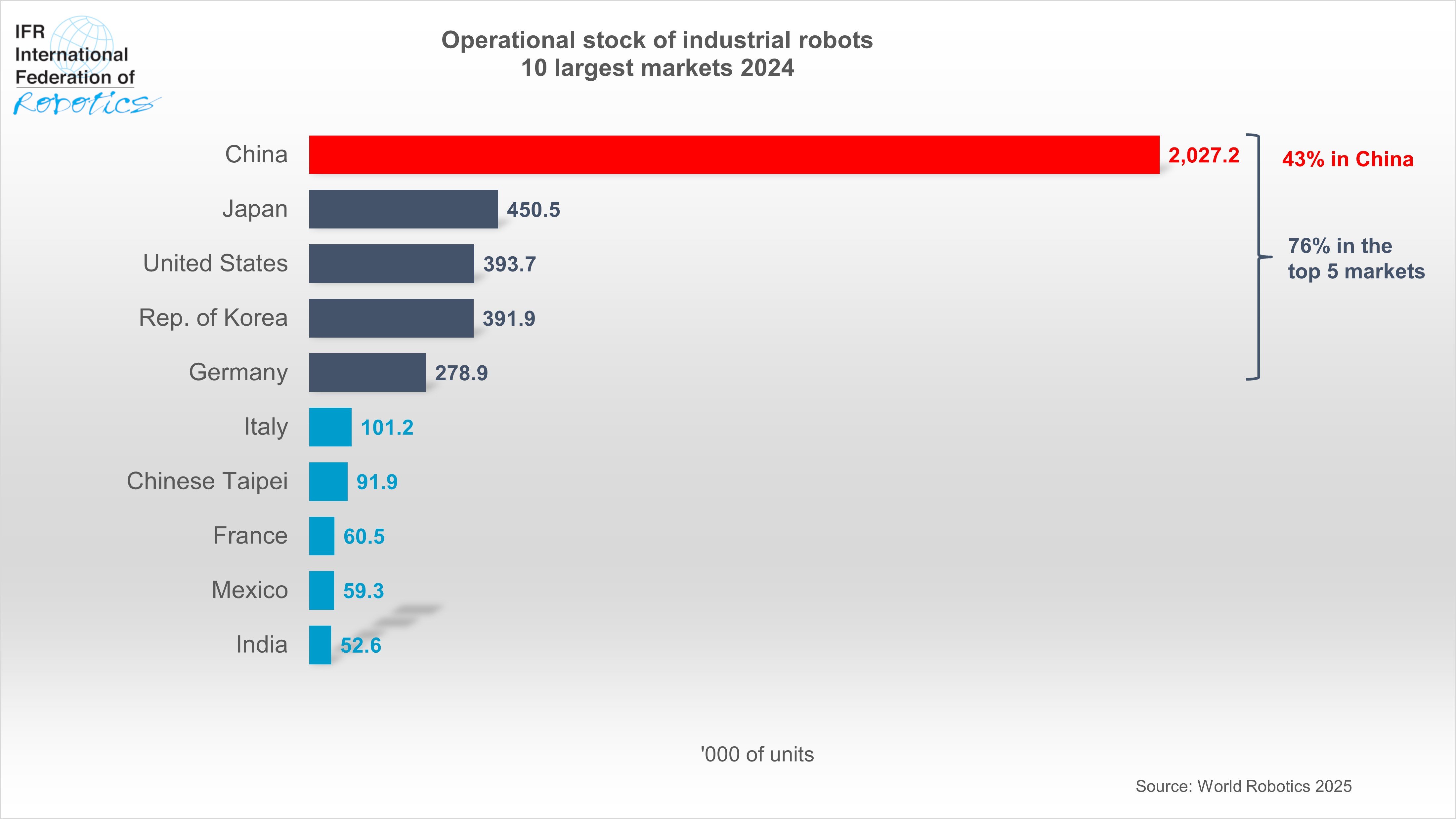
China is by far the world’s largest market for industrial robots, crossing 2 million operational units with 54% of global deployments in 2024. Despite being the third-largest industrial robotics market, the U.S. only had 394 thousand operational units in that same year.
However, Chinese robots are not just aiding human factory workers but taking over entire factory floors by combining AI, IoT and sensing technologies into fully autonomous systems.
Because no human needs to see the work being done in them, these facilities have been given the moniker of “dark factories.” Already, fully automated plants like Xiaomi’s Changping factory can produce one smartphone roughly every three seconds with zero human involvement.
While the U.S. lags behind in industrial robot adoption, it has the opportunity to implement a different strategy to play to its competitive strengths: building “gray factories.” As more funding from the Chips & Science Act supports advanced manufacturing initiatives, human-robot hybrid models could help the U.S. leapfrog China to dominate the next era of manufacturing.
Why build gray factories
Distinguishing themselves from plants with single automation installations in protective cages, gray factories design entire facilities for robots to work collaboratively among humans; and they’re already emerging in the United States.
Agility Robotics’ "RoboFab," for example, is the first factory in the nation making humanoid robots. The facility itself is an example of a gray factory, integrating advanced automated robots with humans who provide real-time oversight to increase efficiency.
Meanwhile, at its Spartanburg plant in South Carolina, BMW has tested humanoid robots to take over ergonomically awkward and exhausting tasks that strain human employees. The robots eliminate human fatigue from the repetitive elements of the fabrication process, while workers can accomplish technical tasks too delicate or variable for robotic hands.
Despite operating at high levels of efficiency, dark factories can lose out to gray factories on sustainability. Humans in the loop can reduce waste by catching defects early before they make their way down the production line, schedule the use of robots at off-peak times, and even identify subtle signs of impending mechanical issues and conduct preventative maintenance.
At the same Spartanburg plant, BMW’s AI-powered corrective lasers flag issues in the placement of metal studs on every vehicle. Humans then correct these errors, cutting production costs while preventing wasted material.
For high-value-added manufacturing that requires continual iteration, gray factories offer the flexibility that fully automated factories cannot. But how can this novel approach to factory automation help the U.S. catch up to China?
Gray factories can supercharge existing U.S. manufacturing
Beyond automotive and robotics manufacturing, the U.S. has the opportunity to use gray factories to accelerate the fabrication of materials and technologies at which it already excels.
Take smart fabrics, for example. These textiles integrate electronic elements directly into woven material and have numerous advanced medical and military uses. According to a recent analysis, the U.S. leads the world in researching smart fabrics but China is on its tail with strong manufacturing capabilities. Since these fabrics can be customized to the wearer and use case, they will benefit from a gray factory model that combines efficient weaving robots with human quality assurance and adaptability.
Another U.S. industry that would most benefit from gray factories is space exploration equipment production, which requires small productions runs of delicate equipment pieces plus precise fine-tuning and multiple rounds of prototyping. For this kind of manufacturing, gray factories beat their fully automated counterparts because they specialize in variability. As both the U.S. and China increase their competition in space, gray factories can help give the former the advantage of flexibility for rapid iteration.
The same logic can apply to rapidly advancing domestic semiconductor manufacturing, which is expected to triple by 2032. Yes, semiconductor fabrication is larger scale than space equipment manufacturing but arguably requires even more precision and human oversight to optimize yield. In the race to make the latest, greatest AI chips, gray factories’ quick reconfiguration abilities will allow for rapid process innovation while dark factories will more slowly adapt.
By building gray factories to enhance production that plays to its strengths, the U.S. will give itself the best chance to compete with China on the fastest-growing, highest margin segments of global manufacturing.
Mastering gray manufacturing
Gray factories are an incredibly viable path to revitalize U.S. manufacturing, but they won’t work unless the nation overcomes its reticence to embrace humanoid robots and solves various system integration challenges.
Essential to gray factories’ success is building and implementing humanoids: robots that can operate safely within environments built for humans. If the U.S. can overcome its deep-seated cultural fears about robot takeover, reduce their upfront cost and cultivate the talent to work in tandem with humanoids, gray factory adoption will be that much easier.
Fully infusing automation technologies into existing factories to make them “gray” will also be a major delaying factor. In this area, dark factories have it easier, since a new autonomous plant can be built like one self-contained machine. Introduce the variables of unpredictable human workers and old factory layouts and equipment and installing a functioning web of IoT and computer vision tech becomes more difficult. The “blank slate” start for full automation does allow the gradual addition of robots, which is a better fit for those unable to stop production for a wholesale upgrade.
Once up and running, however, gray factories will give domestic manufacturing sectors the advantage of continual adaptability in line with the United States’ more piecemeal approach to industrial policy. This flexibility will help the U.S. eventually outpace China’s economics of scale, especially as their overall economic growth falters.
Above all else, gray factories will allow humans to continue to hone their embodied knowledge of how to make things and apply intuition, creativity, and care to the making process. By embracing the gray area between handmade and robot-fabricated, the U.S. can lead a new industrial era where innovation itself is still very much a human craft.