






Mining workers often face unique electrical hazards compared to most industries which require a unique approach to electrical safety. These challenges make the mining industry one of the most dangerous to perform routine electrical maintenance tasks due to the extremely harsh conditions that personnel operate within. Exposed wiring and cables necessary to power mining operations are also hindered by wet and damp climates and require the utmost care for electrical safety precautions. Dust and gases generate a combustible and deadly combination that can quickly turn small electrical accidents into deadly fires or explosions.
When electrical hazards began to present themselves as one of the greatest threats to mining safety, the U.S. National Institute for Occupational Safety and Health (NIOSH), Office of Mine Safety and Health Research (OMSHR) conducted a study between 2000-2009. The study included three tasks:
- A direct review of mining industry occupational injury data compiled by MSHA,
- An interpretation of the narrative descriptions available for the injuries (from MSHA data) and
- A separate examination of fatal electrical injuries.
Eight-hundred sixty-five electrical injuries were reported during the 10-year period, with 39 being fatalities.
The U.S. Bureau of Labor Statistics reported that 1,573 workplace fatalities between 2003 and 2009 had an electrical cause, and an estimated 18,260 nonfatal electrical injuries, resulting in days away from work, occurred over the same period. The NIOSH, OMSHR study concluded that “There were 125,594 mining injuries reported to MSHA for 2000 through 2009, and Electrical was the 10th most frequently listed cause, with 853 injuries.
Of the 853 mining electrical injuries for that period (those with the cause listed as Electrical ), 39 were fatal, making electrical injuries the 6th most prevalent cause of death in mining.” 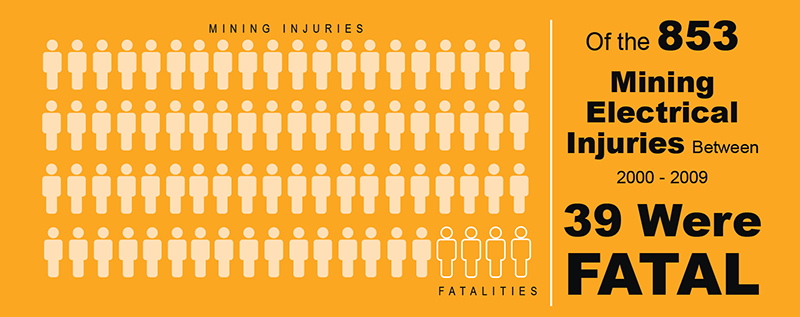 Of these injuries, 42% among them were electricians and mechanics. Contractor employees had a much greater chance of an electrical injury being fatal than did mine operator employees due to their unfamiliarity with the equipment and/or industry. Routine electrical and machine maintenance/repair activities were involved in 69% of electrical injuries. The investigators identified the top three root causes for fatal electrical injuries as:
- No or inadequate lockout and tagging
- Failure of power system components
- Contact of overhead electrical power lines by mobile equipment
In 2019, 3 electrical-related fatalities occurred that prompted Mine Safety and Health Administration (MSHA) to issue an alert on electrical hazards. According to MSHA, these fatalities occurred when:
- An electrician contacted an energized component of an electrical circuit while adjusting the linkage between the disconnect lever and the internal components of the panel that supplied power to the plant feed belt motors.
- A contract electrician contacted an energized conductor while working inside a fire suppression system's electrical panel.
- An electrician contacted an exposed energized connector while troubleshooting a flooded bed scrubber motor circuit onboard a continuous mining machine.
As part of the alert issued by MSHA, the administration offered electrical safety best practices consisting of the following:
- Lockout/Tagout (LOTO) circuits before working on electrical equipment.
- Don't rush.
- Identify and control all hazardous energy sources before conducting any task and follow safe work procedures.
- Train miners on equipment they
- Electricians must know how to de-energize and disconnect electrical systems and equipment.
- Always troubleshoot without power first.
Never work alone.
Talk to coworkers and confirm your plan is safe.
may use.
The MSHA alert’s best practices, while necessary to raise alarm, offered nothing new in terms of an employer’s and a qualified electrician’s responsibility when it comes to The Control of Hazardous Energy (OSHA 29 CFR 1910.147). This faithful reminder is simply a condensed and informal outline of the steps for performing LOTO. When LOTO is performed correctly, electrical hazards that may result in injuries or fatalities should be mitigated.