-

 ISA provides technical resources and standards to help industrial automation professionals advance their careers and the field. We enable automation professionals worldwide to solve problems and enhance their skills by bringing people together to create new technologies and share best practices with future automation professionals.
-
ISA Resources
-
Upcoming Events
-
Industry Insights
-
Consortia
-




Articles and News
26,202 Results Found
-

Redundancy In Automation
In this paper, we discuss different recovery requirements for redundant solutions, as well as approaches to keeping redundant hardware and software architectures running reliably and at peak performance. The technology related to redundant solutions will also be considered. -

Introduction to the Internet Protocol
With the immense interest in the Internet and the potential of attaching control networks to the Internet, the protocol stack of choice is TCP/IP because it provides the foundation for the Internet. This article addresses issues related to the IP portion of the TCP/IP stack as it applies to control networks. -
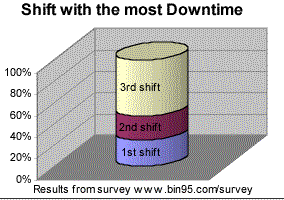
What is the True Downtime Cost (TDC)?
The key to realizing greater savings from more informed management decisions is to predetermine the "True" cost of downtime for each profit center category. TDC is a methodology of analyzing all cost factors associated with downtime, and using this information for cost justification and day to day management decisions. -
Building a Secure Ethernet Environment
The trend toward using Ethernet as the sole communications network for business and industry has raised concerns about security. While proprietary networks for building or factory automation have major drawbacks in terms of limiting information flow and higher cost, their separation from other systems provides a measure of protection against unauthorized access. -

Fully Automated Factories - Futuristic or Today's Reality?
Automated factories and processes are too expensive to be rebuilt for every design change – so they have to be highly configurable and flexible. To successfully reconfigure an entire production line or process requires direct access to most of its control elements—switches, valves, motors and drives—down to a fine level of detail. -
Machinery Vibration and Your PLC
This article explains how to monitor vibration on common plant machinery using accelerometers. It includes a review of the hardware available today and what challenges condition monitoring providers are faced with to meet the requirements of the future. -
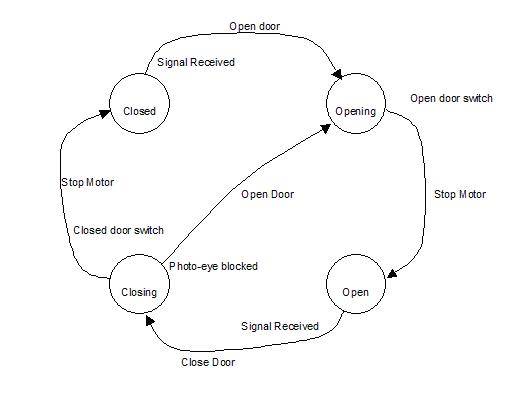
Hierarchical State Machines in the Automation Process
Implementing a HSM solution for the first time involves (naturally) a learning curve. This involves developing an understanding of the class framework, support modules and application structure that would not be present if you were developing from scratch. -
Validation of Automated Systems
Computer technology has changed the framework of business in every industry, transforming the way the businesses operate internally, as well as they interface with customers and external businesses. Many companies today see computer technology as vital to delivering products and services to the marketplace. -
How do Thin Clients run Windows software without a PC?
The answer to this question can be found by exploring something called Terminal Services, a standard feature added to Microsoft Server software starting with Windows 2000. -

Introduction to OPC for Building Automation
In response to the growing need to freely communicate with a wide range of devices, protocols that originated in the BA industry have evolved to deliver straightforward access to a broad range of BA devices. Today, many vendor-specific proprietary protocols have given way to a standardized protocol such as BACnet. -

OPC Tunneling - Know Your Options
Since OPC was introduced over ten years ago, it has seen a steady rise in popularity within the process control industry. Using OPC, automation professionals can now select from a wide range of client applications to connect to their PLCs and hardware devices. -
Strobe Light Applications for Machinery Problem Solving
Strobe lights (or stroboscopes) have been used to study the behavior of rotating machinery, oscillating vibration of components or structures and for balancing for a number of years. Functionally, strobe lights can be very different. -

How to connect a Siemens PLC to USB
The SSW5/USB converter cable is for connection of a Simatic S5 CPU to a PC with a USB interface. For PCs that do not have a serial interface, the SSW5/USB cable can connect to the PLC via a virtual COM port. -
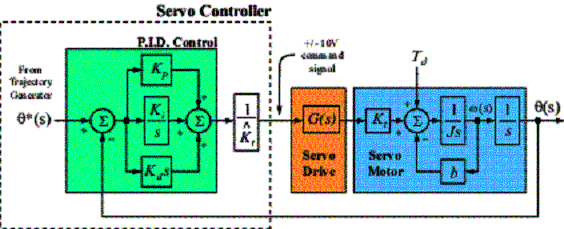
Fundamentals of Servo Motion Control
The fundamental concepts of servo motion control have not changed significantly in the last 50 years. The basic reasons for using servo systems in contrast to open loop systems include the need to improve transient response times, reduce the steady state errors and reduce the sensitivity to load parameters. -
Ziegler-Nichols Tuning Rules And Limitations
The standard reference for PID tuning seems to be the Ziegler-Nichols tuning rules developed in 1942 on a pneumatic controller. -

Introduction to Virtual LANs
A local area network (LAN) is a private network usually confined to one plant. Virtual LANs (VLANs) allow a single physical LAN to be partitioned into several smaller logical LANs. VLANs limit the broadcast domain, improve security and performance and are ideal for separating industrial automation systems from information technology systems. -

IEC 61850 Power Communications Standard - Commercial Ethernet switches need not apply!
The Ethernet-based IEC 61850 international standards for communication in power generation facilities and substations sets a high bar for Ethernet switch reliability. The goal of this standard is to integrate all of the protection, control, measurement, and monitoring functions within a substation. -
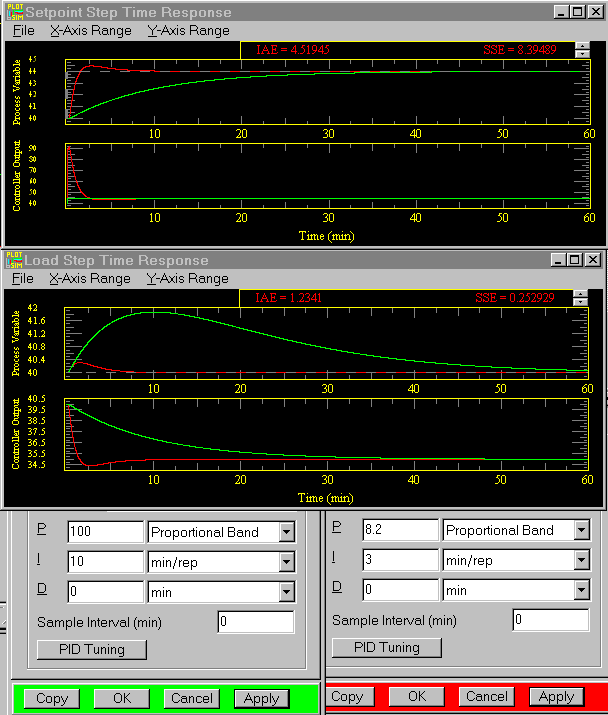
Should You be Using Lambda Tuning?
A tuning method based on achieving smooth set point response is becoming more popular. The method guarantees stability, robustness and no overshoot. Shouldn't you be using it? -
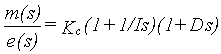
PID Controller Specification
There are no industry-wide standards for PID controllers. However, robust and optimal control of process loops requires PID controllers to have certain abilities and features described here. -
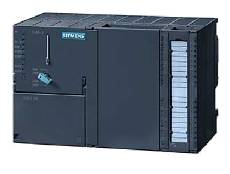
Siemens SIMOTION - Innovative Controller Concept for Production Machines
The more products your machine can produce and the fewer rejects that result, the greater the value of your machine. By value, we are not referring so much to the cost of your machine as to your competitive advantage. To satisfy these demands, it is essential to supply the machine function requirements, while at the same time, ensuring that the speed and quality aspects of production are optimized to the maximum extent possible.


