-

 ISA provides technical resources and standards to help industrial automation professionals advance their careers and the field. We enable automation professionals worldwide to solve problems and enhance their skills by bringing people together to create new technologies and share best practices with future automation professionals.
-
ISA Resources
-
Upcoming Events
-
Industry Insights
-
Consortia
-




Articles and News
252 Results Found
-

How to Improve Motor Performance and Lower Downtime
Out of all the energy consumed by U.S. manufacturers annually, induction motors make up 50 percent of the load. -

Can Variable-Speed Drives Increase Process Efficiency and Reduce Energy Use?
Pumping applications with a variable-flow requirement can lower energy and life-cycle costs with the application of a variable-speed motor to deliver the desired process flow rate -
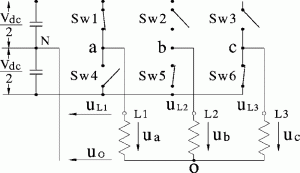
Sliding-Mode Control of Induction Motor Using Space Vector Modulation
A novel sliding-mode control of induction motor using space vector modulation technique -
Is a VFD or Valve Faster?
Is a VFD or Valve Faster? -

What Are the Factors that Affect VFD Rangeability?
What are the factors that affect VFD rangeability? -

VFDs Can Control Multiple Motors
Many applications use one or more motors operating in parallel at the same desired speed. Using one Variable frequency drive (VFD) to control these multiple motors provides a host of advantages -

Multi-Axis Synchronization
The term "multi-axis synchronization" refers to the motion which requires coordination, and the techniques used to achieve control of the motion. With today's increasing automation and machine sophistication, the control applications have become more demanding, and the control techniques have improved. -
Employing an Adjustable Frequency Drive with a Soft Starter Bypass Improves System Reliability
Optimum motor control packages start with a drive to provide the most control, flexibility, and protection. Adding a bypass with an integral soft starter provides a backup system to run the motor should the drive fail. Large drive systems should have soft starters in the bypass, otherwise the application risks negatively affecting the power system, damaged bearings, or bent shafts once the bypass is engaged. -

10 Benefits Adjustable-Speed AC Drives Provide to Industrial Users
Adjustable Speed Drives are used in any application in which there is mechanical equipment powered by motors; the drives provide extremely precise electrical motor control, so that motor speeds can be ramped up and down, and maintained, at speeds required; doing so utilizes only the energy required, rather than having a motor run at constant (fixed) speed and utilizing an excess of energy. -
Advances in Digital Servo Drive Motor Protection
Users are pushing motors closer to their theoretical torque and power limits. In order to protect motors under these rated conditions, accurate thermal models of the motor are needed. -

Factors to Consider in Cabling a Reliable VFD System
A Variable Frequency Drive regulates the speed of a 3-phase AC electric motor by controlling the frequency and voltage of the power it delivers to the motor. Today, these devices are becoming prevalent in a wide range of applications throughout the industry, from motion control applications to ventilation systems and many others. -
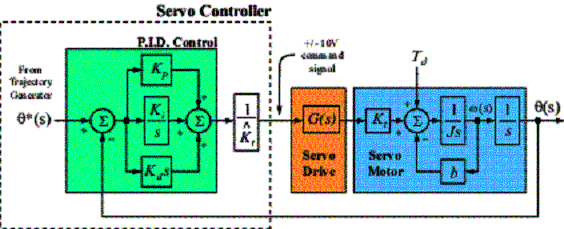
Fundamentals of Servo Motion Control
The fundamental concepts of servo motion control have not changed significantly in the last 50 years. The basic reasons for using servo systems in contrast to open loop systems include the need to improve transient response times, reduce the steady state errors and reduce the sensitivity to load parameters.


