






While large manufacturing companies may have the most prominent presence, a network of small businesses including machine shops and systems integrators (SIs) form a vital part of the manufacturing support ecosystem within the local economies where they operate. In fact, with many sizable manufacturing companies running lean operations and increasingly burdened with resource constraints, it is not uncommon for them to look to suppliers for support, especially in specialized disciplines such as industrial automation. For example, when a metal casting manufacturer needed to develop an automated test system, they turned to a local machine shop for assistance. Undetected flaws can lead to future failures of castings, entailing expensive repairs for both the manufacturer and the end user.
To avoid this undesirable scenario and ensure product quality, manufacturers typically test each casting before releasing it for assembly. Although machine shops are well-equipped to design and construct test equipment, incorporating automation is not often an in-house specialty. With a complex series of testing steps involving the opening and closing of multiple valves in specific patterns, this test process was ideal for automation. Thus, a collaboration was established between Stephens Machine, Inc. and Par Electric & Engineering, LLC .
Stephens Machine, a precision machine shop specializing in steel fabrication, would leverage their expertise to design and build the test stand, while Par Electric, a SI specializing in industrial control systems design and maintenance, would take the lead on the electrical design, programming and pipefitting work.
Operating under pressure
The automated hydraulic test system consists of a control panel, motor, pump and valve/manifold system. A casting to be tested is connected to various manifold valves using high-pressure hoses, and unused ports are plugged. A typical testing process involves first filling the casting with a fluid, such as water or oil, delivered through the manifold via a series of directional valves (photo above). Any air is purged from the system, and then the assembly is pressurized to a target value and the valves are closed. If any leaks in the casting are present, a bleed-down in pressure will be observed in the minutes that follow.
For this application, the test process consists of three phases. Initially the system is filled and pressure tested at 50% of the final value, for a duration of five minutes. The system is then pressurized a second time at 75% for a similar interval. If both previous steps are successful, the final test is conducted at 100% of the desired pressure value. For each phase, only a very small decay in pressure is permissible, and this is monitored by five pressure sensors.
To accomplish the filling, pressure testing and draining, it is necessary to operate thirteen directional control valves associated with the manifold. With multiple valves and a motor starter to control, the team decided to use an electro-mechanical interposing relay with indicator light for each, to protect the PLC outputs from shorted loads, make it easy to identify which valves are operating and facilitate easy replacement if needed.
Drumroll please…
Programming the manifold and valves to step through the patterns required by the test routine is an ideal use case for a classic drum instruction. Drum instructions, or drum sequencers, feature time-based and event-based step transitions, suitable for repetitive processes that consist of a finite number of steps, and each step produces a uniquely configurable output pattern. A common example of a purely physical/mechanical drum sequencer would those found in music boxes or self-playing pianos, where a series of pins rotating on a cylindrical surface drive the output notes. Decades ago, automation systems first used electromechanical drum sequencers to operate outputs for valves and motors as part of a functional sequence.
Because modern programmable logic controllers (PLCs) evolved from and mimicked electromechanical systems, they can include a software drum instruction that performs the function of an electromechanical drum sequencer, but with other advantages such as easy configuration and monitoring. This feature saves significant programming and debugging time by simplifying what would take a multitude of rungs in ladder logic to drive the opening and closing of each valve. Based on prior positive experiences, and with the knowledge that a built-in drum instruction was available, the Par design team selected an AutomationDirect Productivity2000 programmable logic controller for this work.
Utilizing approximately 50 input/outputs (I/O), the controller also would be required to perform analog math computations to calculate if the pressure decay during a testing sequence remained within acceptable threshold limits or deviated. As an added benefit, the PLC programming software is provided free of charge and features a logic simulator. The simulation tool allows code to be tested and debugged remotely by using a laptop or PC without the need for access to the PLC hardware.
Seeing results
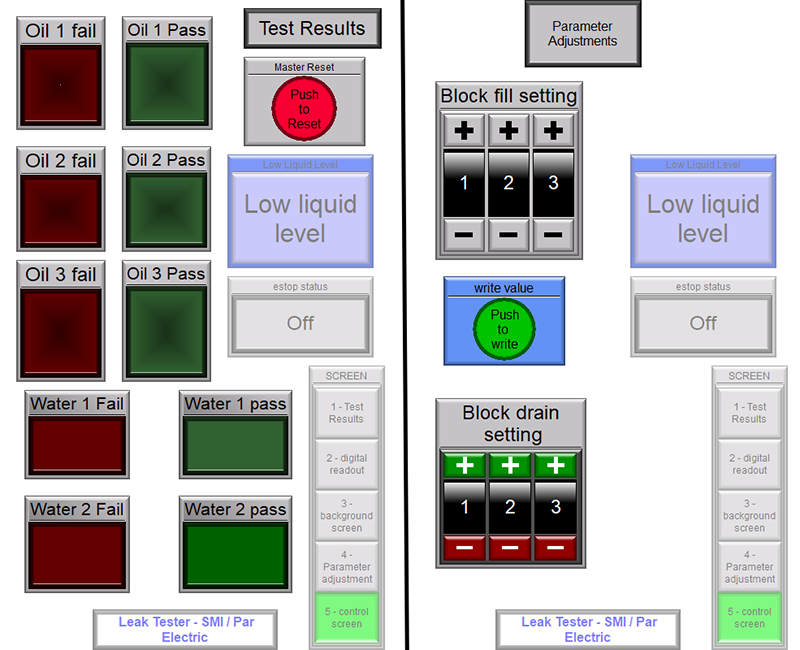
The operator controls the test sequence from the interface located on the control panel. Due to the challenging environmental nature of the industry, some test functionality is initiated using robust 30-mm pushbuttons. Should the test need to be stopped before the procedure is complete an emergency-stop button is available to safely shut down the process. Operating status and test results are displayed on an AutomationDirect 7” C-more touch panel.
The color touchscreen interface offers crisp resolution, and for this application it is mounted in a portrait configuration—as opposed to a typical landscape orientation—on the side of the electrical control panel for optimal operator access and visibility (Figure 1).  In addition to displaying the operational step and test pass/fail results, thresholds for each parameter can be accessed via the touchscreen. For an added level of protection, a security code is required to adjust any parameters such as maximum or minimum pressure levels (Figure 2).
  Although the test system as developed does not currently feature remote connectivity or cloud access, this is a capability that can easily be added in the future.
With test equipment in particular, documentation for engineering and warranty purposes is often essential. Test system data for these purposes can easily be captured and logged when the manufacturer is ready.
Simplifying the supply chain
With supply chain shortages and availability issues an increasing concern for many in the automation industry, when and how parts are purchased can significantly impact a project timeline. Finding a trusted supplier that can deliver cost-effective, quality parts without unnecessary complexity in the purchasing process is essential for small businesses.
For this project, the bulk of the components and installation hardware including the PLC, HMI, circuit breakers, motor starter, control relays, control power transformer, safety relay, fan, emergency-stop and pushbuttons, enclosure, wire management, terminal blocks and more could be obtained with a single purchase from AutomationDirect (Figure 3). 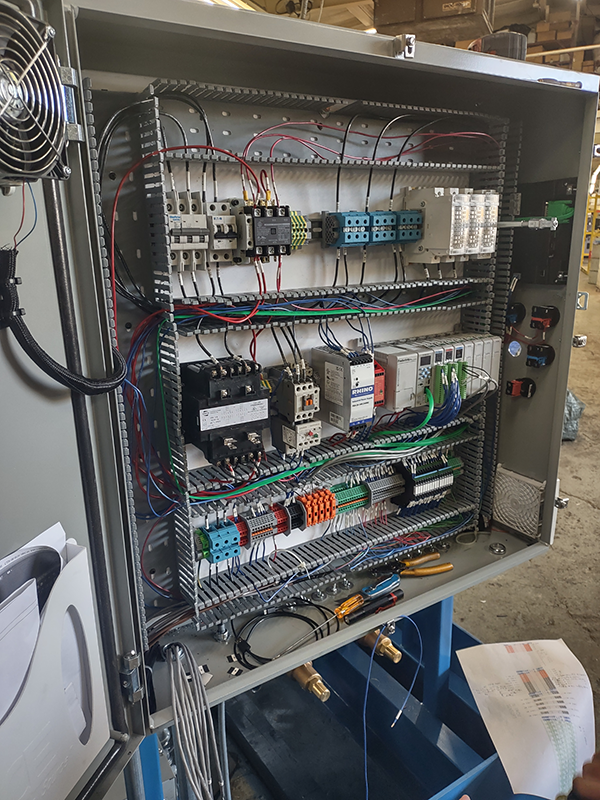 Orders are securely placed via the user-friendly website using a credit card, bypassing the need for coordination with a purchasing department or invoicing system. This streamlined procurement, tracking and order management process can lead to significant savings in both schedule and cost, especially for small businesses.
Throughout the entire product selection, design and development phases, the team appreciated the availability of comprehensive support. In addition to extensive online product resources available 24/7, there is also live phone support for more detailed issues. Outstanding support is a quality that the lead design engineers at both the SI and machine shop appreciate and value when selecting their automation suppliers.
New roads to revenue
There are many routes to success and partnerships are often a cornerstone for growth, especially for small businesses. In this case, working with a SI enabled a machine shop to enhance their product offering and better support their customer. Adding automation to their machined and assembled test stand was a great project for collaboration and all parties involved were thrilled with the results. All figures courtesy of Par Electric & Engineering, LLC
