
Brian Wolf, director, Operations Excellence at LSB Industries , described the rapid application of analytics getting results in a short time at the 27th Annual ARC Industry Forum. He has several years of manufacturing experience setting up data analytics for digital transformation for multiple companies across hundreds of facilities. LSB Industries is a leading North American producer of industrial and agricultural chemicals including ammonia, Urea Ammonium Nitrate (UAN), ammonium nitrate (AN), and nitric & sulfuric acid. The company has production facilities in El Dorado, Arkansas; Cherokee, Alabama; Prior, Oklahoma; and Baytown, Texas.
Digital transformation goals
Wolf explained looking at the classic P (Predicted Failure) to F (Failure) curve the goal is to predict future failures in a timely manner to take action before this impacts production with the application of analytics. He emphasized, “If we do all this work but don't stop the failure, what's the point?" “Getting the right information to the right person at the right time is absolutely key," he said. LSB Industries has partnered with Atonix to capture information and make plant data smart to alert people that can mitigate potential problems early benefiting from predictive maintenance with higher production efficiency. 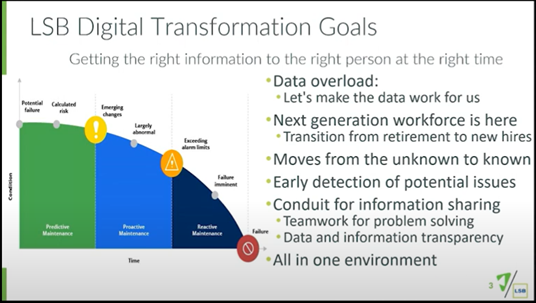 Each of their plants has 5,000 to 6,000 thousand data points coming in real time, and the data is used improve operations with predictive analytics.
“What could potentially take down a facility, and where do you go look in data to find that needle in the haystack?" Wolf asked. This process also requires getting data out of their silos and collaborative teamwork for problem solving between departments.
Use existing data first
The company is first using data from installed systems at the site without adding new instruments. Wolf made an important point: “If you have enough data to run your plant you likely have enough data to do analytics and monitor processes.” Part of this was adding a company historian to aggregate data and to get it in one place including what Wolf terms “stranded data” into a Pi Historian that was stuck in PLCs, logbooks, file cabinets, and tribal knowledge. He added, “this includes data stuck in people’s heads.” Making use of the existing process data first and foremost yielded results with a rapid deployment that required little effort.
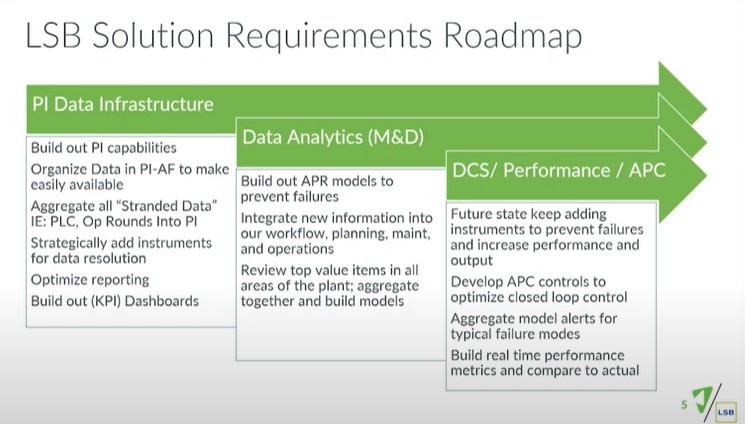 Using methods including advanced pattern recognition and neural net math to predict failures, the system reports specific information so the appropriate people can take action on it. Wolf summarized the process:
- Make use of existing process data
- Rapid Deployment with minimal effort and expertise
- Software that drives the process, not just analytics.
Thousands of measured data points near real time come in filtering all the noise out of data to take action on a couple things a week. LSB applied ATONIX to build algorithms in the models in order to drive that success with just existing data at each one of the company’s facilities.
No-code algorithm development
The ATONIX no code model configuration makes complex math simple for asset experts. The ATONIX tool has thousands of templates that are built for real world industry applications. Process engineers go to that information and using Atonix build a template without hiring data scientists. The tool utilizes the intelligence from engineers coupled with existing model templates and machine learning functions to create applications with significant ROI.
Workflow
The ATONIX tool drives the process of resolving, prioritizing and managing issues through their life cycle. Working on the right issues at the right time, “just because you discover something doesn't mean the process needs to be shut down right now but mediation needs to be added to the planned workflow.”
Getting results
Wolf describe various examples based on implementation throughout the company. “We were able to roll this out across our entire facility Fleet wide in three months across everything. Each site took about a month get online and the big part of that that takes longer than even the deployment is the change of management philosophy at the facilities, “what do we do with the information now changes and improved the way we work.” Also, Wolf described the importance of engaging site people and integrating with software that drives the process as opposed to just doing analytics.