-

 ISA provides technical resources and standards to help industrial automation professionals advance their careers and the field. We enable automation professionals worldwide to solve problems and enhance their skills by bringing people together to create new technologies and share best practices with future automation professionals.
-
ISA Resources
-
Upcoming Events
-
Industry Insights
-
Consortia
-




Search
5,292 Results Found
-
 Feature
ISA Process Industry Virtual Conference Highlights Open Process Automation and More
“In the past few years, open process automation and industry initiatives have focused on open modular, interoperable and portable solutions,” Bridget Fitzpatrick, Process Automation Authority for Wood Applied Intelligence, said during her keynote speech at the International Society of Automation (ISA) Process Industry Virtual Conference (PIC). -
 Feature
China: Manufacturing Under Pressure After Stunning Post-COVID Rebound
Chinese manufacturing is under pressure from both ends: raw material and energy prices are rising sharply; while consumer demand is weak. However, despite considerable supply chain problems during the latter part of the year, the 4th quarterly update of our Manufacturing Industry Output (MIO) tracker, shows that Chinese manufacturing is on track to achieve 5.9% growth. -
 Feature
Trying to Secure Critical infrastructure? You Can’t Take Your Foot Off the Gas.
Now that bad actors have witnessed the impact an attack can have on critical infrastructure OT systems, they’re emboldened to try and expand cyber campaigns to illustrate supremacy and increase public distrust and anxiety. So, we’ll dive into some of the most significant concerns that OT leaders need to be aware of in the coming year–and what can be done to strengthen your security posture. -
 Feature
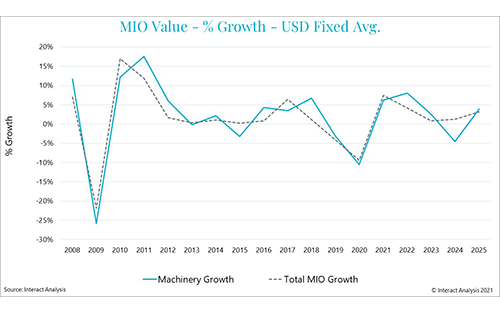
Interact Analysis: German Manufacturing on the Mend
In this insight, we take a look at German manufacturing, where COVID-19 recently forced the cancellation of the leading global show for advanced manufacturing and industrial technologies: Smart Production Solutions (SPS) in Nuremberg. -
 Feature
How to Select the Best Machine Controller for Your Application
With the growing number of controller choices available to automation engineers, separating the chaff to find the best device for their particular application can be difficult when evaluating multiple platform types. -
 Feature
Security for IoT Networks Needs to Reflect an OT Mindset
As defenders and engineers who need to keep systems running securely and safely, it’s important to understand how the adoption of IoT impacts visibility and security for OT systems. -
 Feature
OT, Meet ICT
To realize the potential of smart factories and Industry 4.0, the coming together of Information and Communications Technology (ICT) and Operational Technology (OT) is essential. Achieving a working relationship is, however, going to take work, says Tom Richter. -
 Feature
Closed-Loop Digital Twins Keep Holiday Shipping on Schedule
By calibrating closed-loop digital twins in the intralogistics industry, warehouse managers are running operations at peak levels, unleashing orders to fly off the shelf. -
 Feature
Predictive Maintenance: How a Sensor-to-Cloud Retrofit Drives Benefits
If you're a machine builder or user maintaining hundreds of machines, then failures are the things you dread most. You know you need Predictive Maintenance, but the cost is often prohibitive. This article discusses a retrofit approach that uses an edge device to continuously measure a machine's critical parameters and send the sensor data to the cloud. -
 Feature
The Importance of Automation Integration in Manufacturing
From raw materials for plastics and semiconductor chips to household products such as toilet paper and hand sanitizer, one thing is abundantly clear: automated manufacturing is needed now. -
 Feature
Efficiency, Safety and Predictive Maintenance: Trends in the LV Drives Market
The variable speed drive market is back on track, with 7.7% growth predicted for 2021. Interact Analysis' latest market research offers insight into three important trends influencing the drives market: functional safety, predictive maintenance and efficiency regulations. -
 Feature
Industrial Ethernet and TSN Shape the Future of Industrial Automation
Moxa Global Technology Partner Manager and member of the CC-Link Partner Association (CLPA) Chih-Hong Lin talks about the role of Time-Sensitive Networking (TSN) and industrial Ethernet in shaping the future of industrial automation. -
 Feature
Rockwell Automation's OEE Approach to Achieve Industry 4.0
In a conversation with Rockwell Automation’s Matthew Giordano (pictured above), IS Solutions, partner manager, he described the companies scalable OEE (Overall Equipment Effectiveness) solutions to achieve Industry 4.0 to understand “what is happening on the shop floor." -
 Feature
Ethernet-APL Brings Real-time Communication to the Field in Process Systems
With the new Ethernet-APL communication technology, users in the process industries have gained a strong partner at their side in their quest for higher efficiency and increasing quality. This new form of data transmission will give digitalization a boost in process engineering production environments. Data from all areas of a process system will be connected in a secure and practical manner and made available from a central point. This helps users derive valuable information from vast amounts of data points. -
 Feature
Ethernet-APL Unlocks the Benefits of Digital Communication for the Process Industry
Companies like BASF face the challenge of keeping countless production systems and plants around the world up to date with the latest technologies. To make sure that powerful technologies are employed without any surprises occuring, new instruments and technologies are first put through their paces–and the introduction of Ethernet-APL is no different. -
 Feature
APM 4.0: Transforming Decision Making about Plants and Assets with Role-Based Applications
Reliability and process engineers need solutions that fit their needs for operational insight and asset management. The valuable skillset of data scientists must be complemented with engineering wisdom and AI applied within the business processes to create role-based applications that will eventually lead to the self-optimizing plant (SOP). -
 Feature
Designing an Intelligent System for High Reliability Production Line
Fears of perfection, narrow focus and regulatory compliance are major hurdles faced in improving reliability through predictive analytics. Here’s how to overcome them. -
 Feature
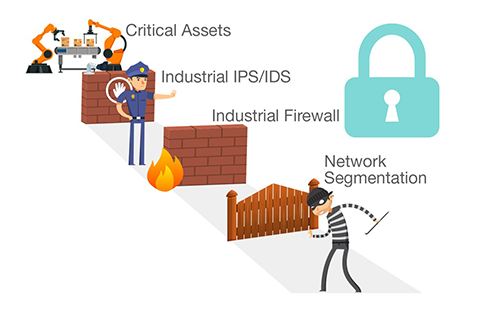
Building a Strong OT Cybersecurity Foundation: First Ask the Right Questions
Inevitably, IT/OT integration has become one of the key indicators of a company's potential future growth. However, despite its importance, IT/OT integration remains inconceivable to many companies due to one main obstacle: cybersecurity. -
 Feature
Why the Industrial Sector Needs to Rethink Displacing Data Beyond the Edge
The five core challenges process engineering businesses face–and how an Intelligent Edge approach is key to more successful edge deployments. -
 Feature
PLC and Operator Interface Advantages Stack Up for a Large Container Automatic Stacking Crane Project
Scalability and connectivity of PLCs and operator interfaces played a key role as TMEIC integrated 86 new container automatic stacking cranes for the Port of Virginia.


