Manufacturers that rushed into cloud-only manufacturing execution systems (MES) are discovering latency, lock-in and outages that stop lines. This article explains how an edge-native reference architecture keeps deterministic control local while using the cloud for analytics, plus a decision matrix and phased migration playbook to escape vendor lock-in without disruption.
Consider a shift from centralized, cloud-based processing to distributed, local execution at the edge of the network. By processing data and executing control logic locally, an edge-native MES eliminates the latency and variability inherent in cloud-only architectures. Deterministic control allows critical processes to respond to events in real time without the delays associated with cloud communication.
Disadvantages of cloud-only MES
Cloud MES promised fast rollouts and zero capital expenditures (CapEx), but physics still matters. A 200 ms round-trip from press to cloud and back is invisible to finance software, but fatal to a 20 ms stamping cycle. Gartner pegs the average cost of information technology (IT) downtime at $2.3 million per hour when just-in-time sequences freeze. Multi-tenant clouds also exhibit jitter: the same application programming interface (API) call can take 40 ms or 400 ms depending on neighbor load. Over a year, that variability shows up as missed cycles, phantom rejects and excess rework.
Real-world events prove the risk is not theoretical. In early 2025, a targeted cyber-attack severed Jaguar Land Rover’s cloud-based supplier portal. JIT call-offs halted within minutes and took three days to restore. A June 2025 ransomware hit on food distributor UNFI forced manual order entry across 30,000 stores — an estimated $350 to $400 million sales impact. Major software as a system (SaaS) outages still occur. Service level agreements (SLAs) reimburse credits, not lost overall equipment effectiveness (OEE).
Cloud-based MES contracts typically escalate 7% to 10% annually and charge egress fees that can exceed compute cost. Once recipes, work instructions and historian data reside in a proprietary data model, migration becomes a re-implementation project—classic “Hotel California” economics.
Edge-native defined and proven
An edge-native MES keeps the time-critical path, sequence control, quality gates, and safety interlocks inside the plant local-area network. Containers (K3s, MicroK8s) and WebAssembly (Wasm) modules run on ruggedized PCs or DIN-rail gateways, joined by a lightweight message bus. Deterministic latency (< 10 ms) is guaranteed because traffic never leaves the site. Cloud resources are invoked selectively: long-term analytics, cross-fleet key performance indicator (KPI) dashboards and artificial intelligence (AI) model training. The result is a hybrid architecture that marries real-time autonomy with cloud-scale intelligence.
Evidence of success for this hybrid model can be found on the factory floor. Foxconn’s new “edge-cloud platform” deploys local K8s clusters at each site; if the wide-area network fails, lines keep running and data buffers upstream. BMW Group’s pilot plant in Regensburg, Germany uses edge nodes equipped with graphics processing units (GPUs) to run vision AI; weld-seam inspection dropped from 120 ms (cloud) to 8 ms, raising first-pass yield by 1.8%. Electronics surface-mount technology (SMT) lines running Siemens’ edge-native quality agent report 90% fewer solder defects versus previous cloud-only vision systems.
Edge-native MES offers tangible paybacks in terms of OEE, quality and security.
- OEE: predictive-maintenance models hosted onsite eliminate the “upload-wait-download” lag, which can cut unplanned downtime from 15% to 25%.
- Quality: less than 10 ms vision feedback removes bad parts before the next placement, which saves rework and recall exposure.
- Security: data stays on-prem, which shrinks the external attack surface and simplifies GDPR/ITAR audits.
Choosing a path using a four-question matrix
The following (Figure 1) is a forced-choice questionnaire that maps answers directly onto an MES architecture choice—cloud-only, hybrid or edge-native—and puts out a one-page rationale users can put in front of management.
1. Is there a real-time (<100 ms) need? Choice is edge mandatory.
2. Are there data-sovereignty constraints (defense, pharma, food)? Choice is on-prem storage.
3. Is there a financial bias (OpEx comfort versus CapEx control) factor? Choice is a five-year total cost of ownership (TCO) including egress.
4. What is the personnel skill set? Edge-native requires DevOps/OT competence; cloud-only offloads that burden.
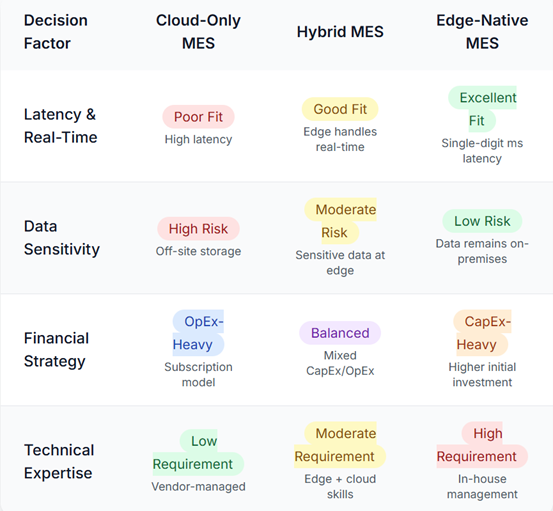 Figure 1: MES architecture decision matrix.
Additional tools
Once you determine your MES architecture, additional tools can help you move forward. A latency-budget worksheet is a very practical one-sheet resource. Use it to:
- List every control loop with its hard deadline (e.g., robotic weld 50 ms).
- Map the data path (e.g., sensor to network to compute to actuator).
- Allocate the time-requirement budget (e.g., network 5 ms, inference 3 ms, input/output [I/O] 2 ms). If the cloud leg already consumes 60 ms, the loop fails; move it to the edge.
Another useful step is to create a four-phase migration playbook. The associated figures for each (shown at the bottom of the article) are examples that provide a roadmap for migrating from cloud-only MES to edge-native without production stops.
- Phase 1: Catalog MES functions. Tag by criticality, latency class, data sensitivity. (Phase 1 below)
- Phase 2: Establish a pilot K3s cluster on an unused line. Containerize a non-critical module (OEE dashboard, andon app). (Phase 2 below)
- Phase 3: Migrate real-time loops, first packaging, then safety, using a parallel-run cutover. (Phase 3 below)
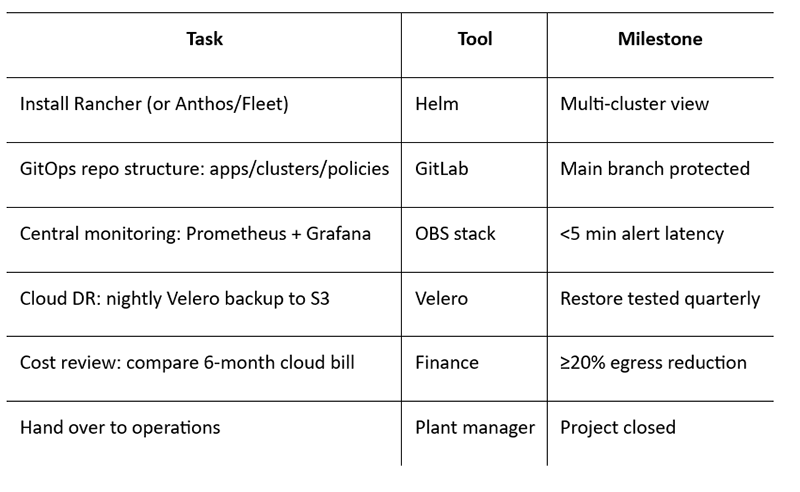
- Phase 4: Federate clusters under a single GitOps pipeline. (Phase 4 below) The cloud now receives only aggregated, non-time-critical data. The entire sequence can be executed during planned shutdowns, avoiding production hits.
Final thoughts
The cloud is ideal for many enterprise workloads, but manufacturing execution is a time-sensitive system where milliseconds matter and autonomy is non-negotiable. An edge-native MES delivers the resilience modern plants need while preserving cloud benefits for analytics and multi-site coordination. Architects who adopt this hybrid stance escape lock-in, cut downtime cost and future-proof their digital operations.
Phase 1: Discover and prioritize (weeks 1 and 2)
The Phase 1 objective is to produce a data-driven backlog that ranks every MES function by latency class, data sensitivity and business criticality.
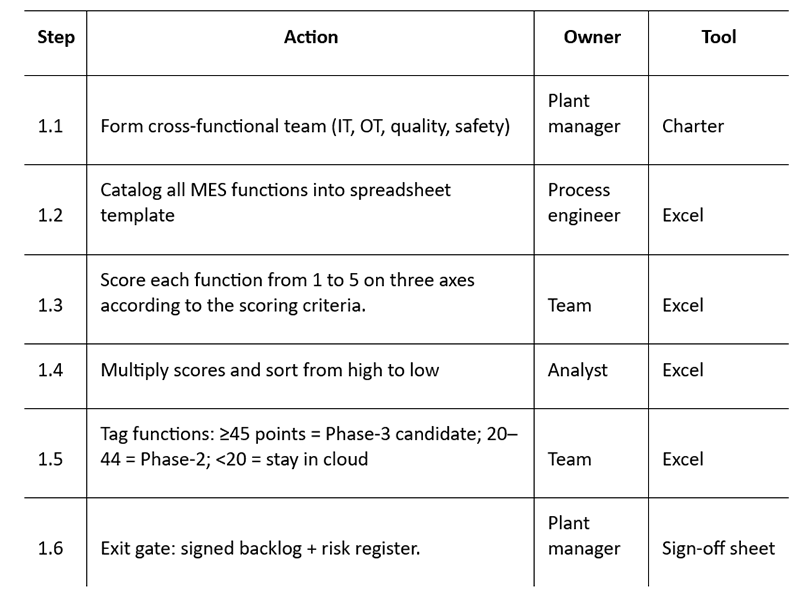 Scoring criteria (1 = low, 5 = high)
- Latency class: 1 = >500 ms, 5 = <20 ms
- Data sensitivity: 1 = public, 5 = regulated/export-controlled
- Business criticality: 1 = nice-to-have report, 5 = line-stop
Phase 2: Pilot on a non-production line (weeks 3 - 6)
Phase 2 goal is to prove the technology stack and staff competence before touching real production. 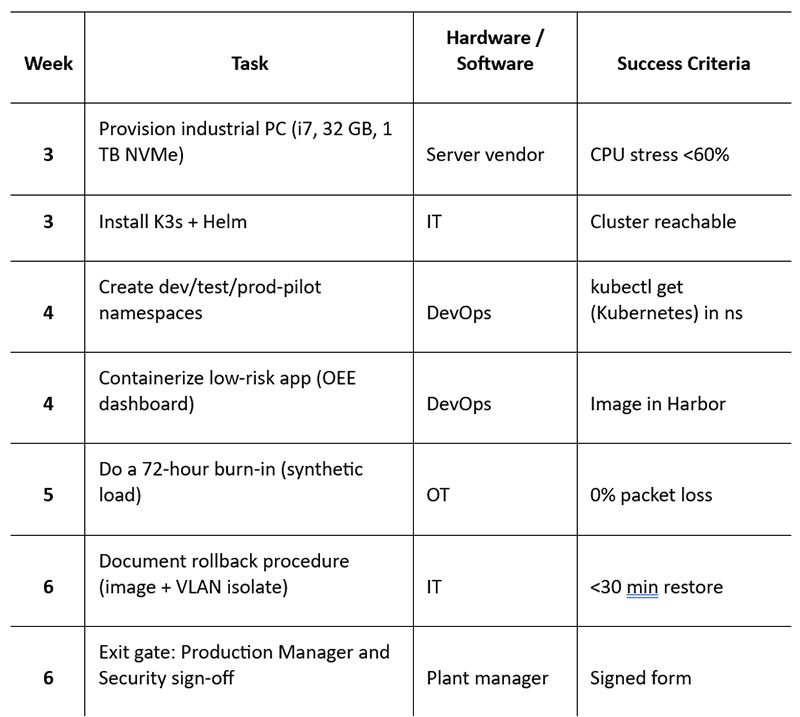
Phase 3: Cutover real-time loops (months 2 - 4 in 2-week sprints)
Phase 3 principle: shadow, compare, switch, decommission.
Sprint template (14 days):
- Days 1 through 3: Deploy edge service in read-only shadow mode; log the outputs.
- Days 4 through 6: Parallel run; metric mismatch must be <0.1%.
- Day 7: Security scan and performance baseline.
- Days 8 through 10: Change traffic (DNS/OPC redirect); observe for 24 hours.
- Day 11–14: if no alarms, retire cloud function; update DR book.
Migration order (highest risk last)
- Andon boards
- OEE calculation
- Vision-based quality
- Safety interlocks.
Phase 3 exit gate
- All functions scoring ≥45 points now on edge
- Cloud MES still active for non-time-critical modules
- Downtime recorded = 0 minutes (parallel cut-over).
Phase 4: Federate and optimize (months 5 and 6)
Turn isolated clusters into a managed hybrid platform.