AutoQuiz is edited by Joel Don, ISA's social media community manager.
This automation industry quiz question comes from the ISA Certified Control Systems Technician (CCST) program . Certified Control System Technicians calibrate, document, troubleshoot, and repair/replace instrumentation for systems that measure and control level, temperature, pressure, flow, and other process variables. Click this link for more information about the CCST program.
Instrument technicians often use piping and instrumentation diagrams (P&ID) as a reference to identify what type of instrumentation is installed and how this instrumentation is installed in the process. Referencing the process line depicted in the post image from a typical P&ID, which of following statements is true:
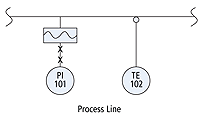
a) TE-102 is shown as a surface-mounted temperature sensor, and pressure sensor PI-101 is "directly-connected" to the process b) temperature sensor TE-102 is inserted into a thermowell, and pressure indicator PI-101 uses a filled capillary system and diaphragm seal to isolate it from the process fluid c) PI-101 and TE-102 are wired directly to a DCS controller d) temperature sensor TE-102 is a bulb-type sensor, and pressure sensor PI-101 is electrically-connected to an electromagnetic isolator e) none of the above
Answer A cannot be correct because a directly-connected pressure sensor would not use a diaphragm seal or capillary system. Surface-mounted temperature sensors do not use wells and would be shown without the circle touching the process line.
Answer C is incorrect because no information is given about wiring connections. In fact, the lack of this information and the absence of a transmitter for each sensor would indicate the instruments shown are local indication only.
Answer D is incorrect because, although the P&ID symbol for TE-102 somewhat looks like a bulb thermometer, it is not. The wavy line inside the symbol for the diaphragm seal for PI-101 should not be confused with the P&ID interconnection symbols for electromagnetic signals.
The correct answer is B, temperature sensor TE-102 is inserted into a thermowell, and pressure indicator PI-101 uses a filled capillary system and diaphragm seal to isolate it from the process fluid. A diaphragm seal is shown on a P&ID as a box with a "wavy line" inside. This represents the isolation that a diaphragm seal provides between the process fluid and the instrument. A capillary (filled) system is identified easily by the "X's" in the connection line between the PI and the diaphragm seal. For the temperature sensor, we do not know what type of sensor is installed (RTD or thermocouple), but the circle touching the process line indicates that the sensor is installed in a thermowell.
Reference
: ANSI/ISA-5.1-2009 - Instrumentation Symbols and Identification
About the Editor
Joel Don is the community manager for ISA and is an independent content marketing, social media and public relations consultant. Prior to his work in marketing and PR, Joel served as an editor for regional newspapers and national magazines throughout the U.S. He earned a master's degree from the Medill School at Northwestern University with a focus on science, engineering and biomedical marketing communications, and a bachelor of science degree from UC San Diego .
Connect with Joel