






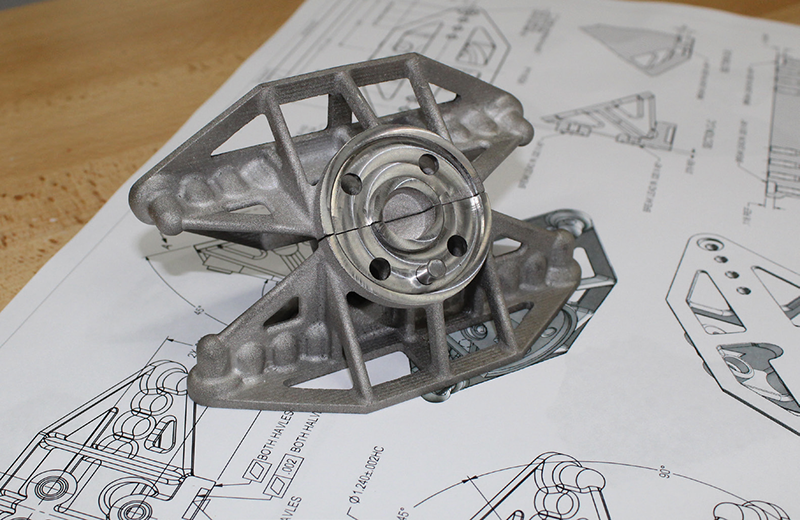
Industry application: Automotive Parts Manufacturing Robotics–End of Arm Tooling Location: Saint Marys, Penn. Challenge: Develop a strong, lightweight end-of-arm tooling attachment for a high-volume precision inspection application with varying weight requirements. The complex part enables two tools to sit at a 90-degree angle to each other on one arm.
Solution 3d Printer: ExOne Innovent+® Material: 17-4PH Stainless Steel (D90 of 22 μm) Part size: 4.5 x 2 x 2 in. (12 x 5 x 5 cm) Weight: 95 grams Cost: $150 prior to fi nishing (compared to $672 for DMLS) Benefits: Generative software produced a lightweight design that could not be manufactured outside of 3D printing. Binder jet 3D printing the part was one-fourth the price of laser powder bed fusion. Final materials met MPIF standard 35 and customer requirements.
The challenge
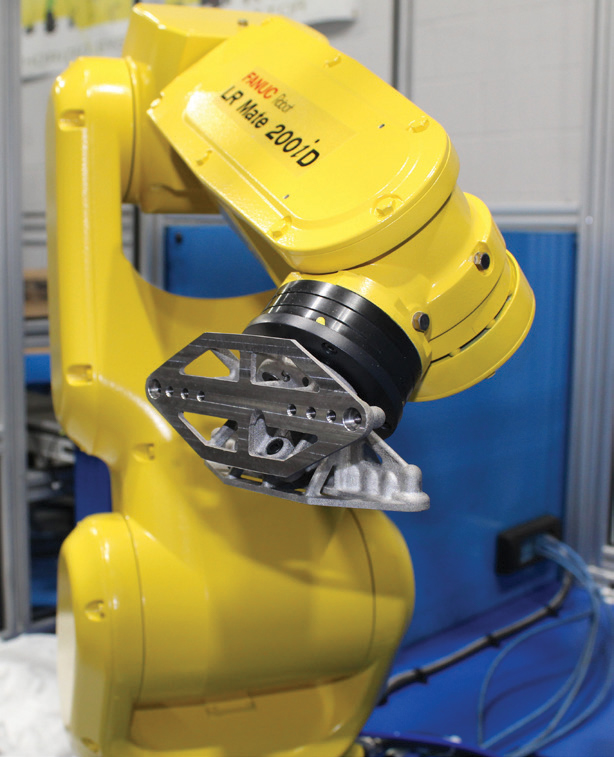
Allegheny Electric needed durable and lightweight end-of-arm tooling for a robotic inspection process. A six-axis FANUC robot needed to pick up and place six different parts, of varying weights up to 2.5 pounds, for serial inspection running nonstop across three shifts. The number of parts being inspected in this factory environment ranges from 50,000 annually for the lowest-volume piece to 500,000 parts annually for the highest volume.
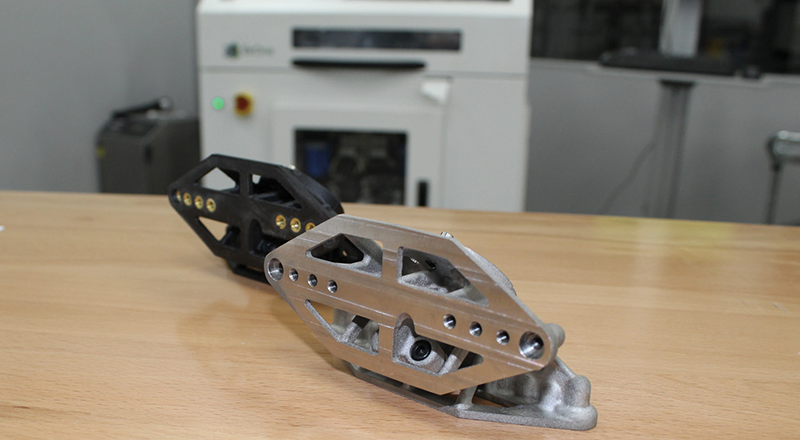
The 3D printed piece was part of an assembly that needed to attach to two other end-of-arm tooling (EOAT) pieces that needed, in turn, to sit 90 degrees to one another for a variety of different inspection techniques Oftentimes, an EOAT solution developed by Allegheny Electric would be 3D printed in plastic, carbon fiber-reinforced plastic, or machined in a strong, lightweight material such as aluminum. Although an initial prototype was originally 3D printed in a carbon-reinforced plastic, the weight requirements and processing volumes for this project eliminated this material from consideration for the final production application for lack of durability.
“It would have had less life, and they couldn’t afford the risk of dropping the part into the inspection station, which costs several thousands of dollars,” explained Chris Aiello, VP of Business Development at FreeFORM. “The rigidity and strength just wasn’t there for the biggest parts.” Additionally, machining the desired functionality, even in lightweight aluminum, would have produced an EOAT part that would have been at the upper edge of weight for the FANUC robot arm being used, which was also not viewed as desirable. Being an automation solution provider, Allegheny Electric wanted to explore whether metal 3D printing could offer weight and cost savings through new designs that could help them offer an innovative new solution to customers.
The customer looked to both laser powder bed fusion, specifically DMLS, and binder jet 3D printing for a possible solution.
The solution
Jake Shannon, Design Engineer at Allegheny Electric, approached Aiello to explore the options. Using generative software from Solid Edge, a CAD design and analysis software from Siemens, the two companies collaborated on a new lightweight design for the project that could only be produced with 3D printing. The design was quoted for both DMLS and binder jetting on an ExOne Innovent+, which is owned by FreeFORM Technologies. The part was quoted at $672 for DMLS, prior to any final finishing, and a comparable $150 on the Innovent+.
|
|
|
The complex part designed in Solid Edge and 3D printed with binder jetting technology enables two tools to sit on the end of a robot arm at a 90-degree angle to each other. They must hold a variety of weights for a highvolume precision inspection application. |
In binder jet 3D printing, the printer uses a digital fi le to quickly inkjet a binder into a thin layer of powder particles—metal, sand or ceramic—creating a solid part one layer at a time. When printing metals, the fi nal part must be sintered in order to fuse the particles together into a solid object. 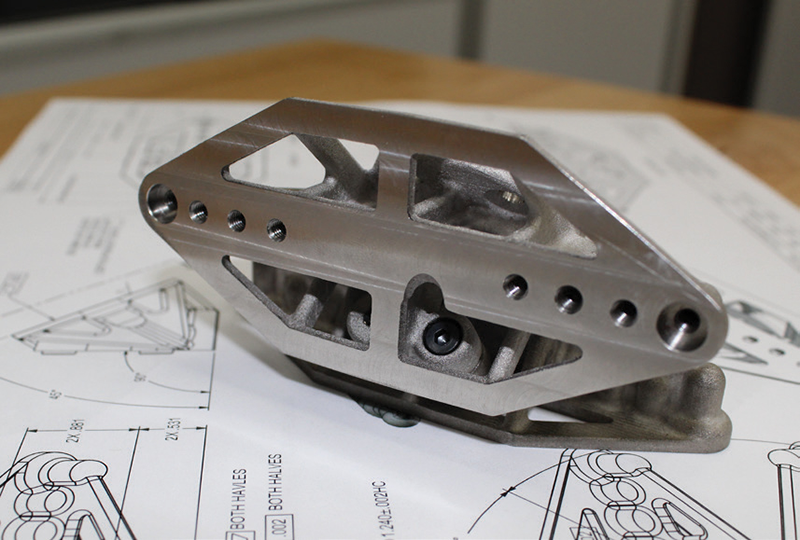 Because binder jetting is so much faster than other metal 3D printing methods, such as laser powder bed fusion, it off ers much lower costs that are more competitive with traditional manufacturing processes.
Binder jetting is also a sustainable method of manufacturing that reduces material waste to less than 5%, saves energy by consolidating many assembled parts and processes into one, and can deliver end-use designs that are 30-40% lighter—for more effi cient cars, planes, military equipment, and other applications. In fact, Aiello said that the unique lightweight design generated in this case could not have been produced outside of a 3D printing technology. The company was also able to print a traditional stainless steel MIM powder, 17-4PH, with a D90 of 22 μm. This material was also desirable because of its durability and corrosion resistance, an important feature for the fi nal part, which would be used in a factory with frequent temperature fluctuation.
 Printed on an entry-level Innovent+, the final part exceeded MPIF standard 35, delivering a hardness of HRC 27 and fi nal density of 98%. Because the hardness met the customer’s requirements, additional heat treatment wasn’t required. “They could have gone with a simpler design in aluminum, but the part would have actually been heavier to get the same strength as 17-4PH,” Aiello said. “By going with this kind of organic generative design, they were also able to reduce the overall payload on the machine, so it’s likely going to extend the life of the robot for the customer.” In this case, it was decided to machine three critical features, including a few holes and one surface for fi nal fl atness, to further dial in accuracy.
Aiello noted that binder jetted parts take to machining just like standard metal materials. “It’s very similar to machining wrought material,” Aiello said. “It looks no diff erent than a machined metal flat stock part.”
In all, the initial printing on the Innovent+ entry level system, with a build volume of 160 x 65 x 65 mm (6.3 x 2.5 x 2.5 in), took less than a day of printing in 50 micron layers of standard MIM powders. Using the Innovent+, a printer that has been on the market since 2016, also delivered reliable parts.
“The surface quality is superior to any of the other printers,” Aiello said. “It’s an easy machine to run. It was great for this kind of application. ...
The Innovent+ is defi nitely meeting plus or minus 2.5 to 3% accuracy (for fi rst runs), which is the kind of out-of-the-box performance that the engineering team expects.” The Innovent+ can dial in even better accuracy below 1% with 2-3 iterations.
The future
While this project didn’t have a high-volume part requirement for the final EOAT–only four parts were initially needed–Allegheny Electric Service was eager to do the project to explore whether binder jet 3D printing was ready to produce affordable parts in unique designs that could deliver higher performance in its automation applications. Now, it has a new solution option to offer customers that can deliver durable, lightweight parts in metal at affordable prices. “We are always working within the design constraints of traditional manufacturing. Now we can focus on design intent and process optimization to meet or exceed our customers expectations,” said Jake Shannon, design engineer, Allegheny Electric Service.
“We will definitely continue to off er our customers end of arm tooling produced with binder jet 3D printing. An important feature for us to off er our customers is how this technology reduced the payload on the robot.” For Aiello and the FreeFORM team, this project was an inspiration in how it showed the new design possibilities they can now off er in standard and durable metal materials at aff ordable prices. The FreeFORM team has deep experience in powder metallurgy and MIM, and they say the parts they are now producing with binder jet 3D printing are equivalent to the type of product they were producing with those traditional processes. However, now they can deliver them without tooling and with more geometric freedom than ever before.
“This project shows exactly why we started the company, to help customers solve challenging problems,” Aiello said. “Binder jetting was really the only way to go for this project. It was one-fourth the cost of DMLS, and we did it in a strong material that reduced the payload on the robot. As AES rolls this technology out, it’s going to be a bigger savings for their customers.” 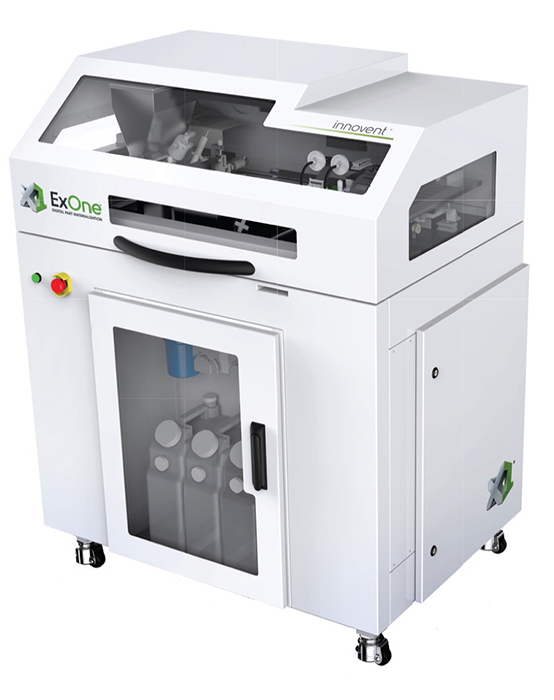
About Allegheny Electric Service
Since 1985, Allegheny Electric has been synonymous with excellent service, quality, workmanship and versatility, through control systems design and industrial automation for the powder metal, lumber, and metal stamping industries. Allegheny Electric, a FANUC integrator, is committed to increase and improve their products using the latest technology available to provide practical solutions that will satisfy their customers’ needs now and in the future.
About FreeFORM Technologies
FreeFORM is a fi rst-of-its-kind metal binder jet 3D printing contract manufacturer. Founded in 2020 by a group of engineers, FreeFORM aims to bring binder jet technology to the masses through technology adoption. FreeFORM’s co-founders bring a diverse outlook into metals manufacturing and are committed to providing world-class services to the customer while providing low cost of ownership and speed to market. Their vision is to be the benchmark for additive manufacturing.
About ExOne
ExOne is the pioneer and global leader in binder jet 3D printing technology. Since 1995, we’ve been on a mission to deliver powerful 3D printers that solve the toughest problems and enable world-changing innovations. Our 3D printing systems quickly transform powder materials—including metals, ceramics, composites and sand—into precision parts, metal casting molds and cores, and innovative tooling solutions. Industrial customers use our technology to save time and money, reduce waste, improve their manufacturing fl exibility, and deliver designs and products that were once impossible.