“Manufacturing has reached an inflection point. We have enormous ambitions for smart manufacturing and industrial AI as a nation, but those ambitions will not be realized at scale if our data remains trapped in proprietary systems,” declared John Dyck, CEO of CESMII, the Smart Manufacturing Institute, at the start of the webinar CESMII cohosted with the Manufacturing Leadership Council.
Titled “Scaling Smart Manufacturing & Industrial AI,” the Aug. 4, 2026 webinar detailed the importance of interoperability and introduced the Industrial Information Interoperability eXchange (i3x), , an open interoperability standard supported by more than 40 manufacturing technology providers.
The interoperability imperative
The webinar brought together nearly 800 industrial manufacturing leaders to watch manufacturers, strategy consultants and more than 30 competing automation vendors demonstrate interoperability under one shared architecture.
“US manufacturing will not escape productivity stagnation by scaling the same, fragmented, plant- by-plant pattern of innovation. Renewed growth requires a new pattern, one that combines enterprise standards with plant-level freedom and makes every successful solution easier to scale with AI,” Dyck explained.
A series of funded projects showed that smart manufacturing can solve real operational problems, but scaling the solutions was difficult. The problem wasn’t a lack of technology, talent or innovation. The missing ingredient was interoperability.
“The problem wasn’t a lack of technology, talent or innovation. The missing ingredient was interoperability.”
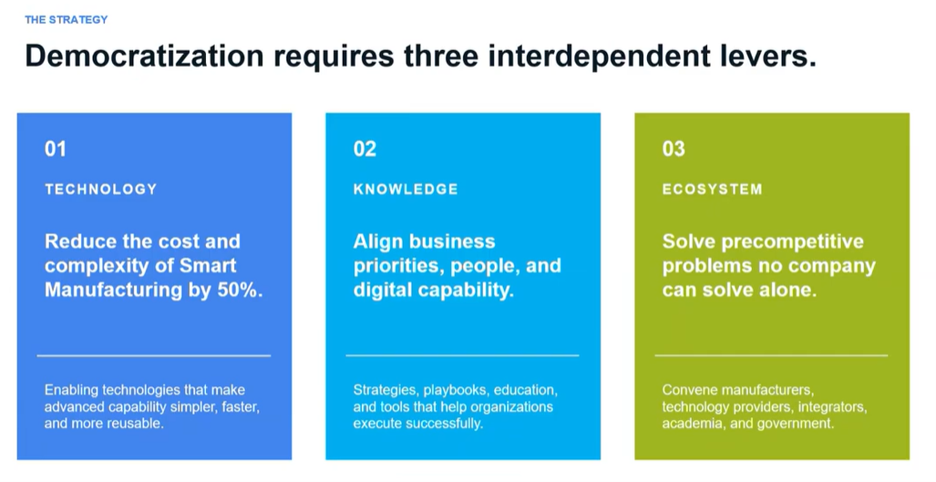
The speakers emphasized that interoperability, the mechanism that converts invention into a reusable ecosystem, offers a new pattern of industrial innovation. The interoperability movement is not about technology for its own sake but about strengthening U.S. competitiveness through smart manufacturing, they said. Smart manufacturing needs to be democratized by lowering cost, reducing complexity and lowering the barriers for participation. That doesn’t mean using fewer standards; rather, it means using standards effectively to make it easy for plants to get started.
“Democratization will require technology, knowledge and ecosystem, and they must advance together,” said Dyck. He outlined three smart manufacturing imperatives:
- Open, standards-based information modeling: Define shared meaning.
- Smart manufacturing interoperability platforms: Operationalize shared context.
- Industrial information interoperability eXchange: CESMII’s i3X application
 i3x: A Global Open API Initiative
“For years, hardware and software vendors have largely dictated manufacturing standards,” said Brian Perlstein, Digital Manufacturing Innovation Leader, at Owens Corning. “CESMII and i3X represent a fundamental shift. It's the manufacturing community defining the requirements, with technology providers enabling the vision, not driving it. It looks like they’re finally solving manufacturing’s biggest challenge: forced interoperability of alignment.”
The June release of i3X 1.0 marks “one of the industry’s largest collaborative efforts to simplify manufacturing integration and accelerate Industrial AI adoption,” according to a CESMII press release. i3X provides an implementation guide, OpenAI specifications, a conformance test suite, updated i3X explorer and more.
“i3X provides a structure for surfacing data in a consistent way, helping teams begin to unify their systems, and enabling organizations to scale from isolated pilots to enterprise-wide deployment of AI-driven solutions,” said Jonathan Wise, chief technology architect at CESMII.