Conventional wisdom often implies that more equipment data is inherently better, with each device promising to measure and transmit increasingly expansive quantities of it. Digital networks are then used to funnel this often overwhelming data into the collective laps of maintenance and plant operations personnel.
Unfortunately, a mountain of data is worth about as much as no data if there is no way to sort through it to glean the informative nuggets that have true value. More data is only beneficial if it can be analyzed and converted into a valuable or profitable response.
Let's discuss how to utilize the data and information provided by smart digital valve controllers (DVCs). These devices have certainly delivered on their promise of increased data visibility, but the investment remains largely unrealized if most of that information is ignored or never evaluated.
The rise of digital controllers
Valve controllers have evolved significantly since the inception of pneumatic devices in 1949 (Figure 1). The original versions were purely mechanical, but the introduction of microprocessors in 1994 transitioned valve positioners to true DVCs.
 Figure 1: The Fisher™ 3500 Positrol Valve Positioner debuted in 1949. Decades later, the arrival of microprocessors in 1994 led to significant breakthroughs in digital valve control and diagnostic technology.
Since then, DVCs have evolved rapidly, incorporating a broad array of sensors and advanced diagnostics that measure a host of valve-related characteristics, including valve position, inlet air pressure, air flow, packing friction, shaft movement and velocity, and more.
While controllers still function to accurately position valves despite variations in process conditions, data acquisition has become increasingly important because a DVC’s sensors and diagnostic software can detect and flag degrading valve performance before valve failure occurs. DVCs can detect deterioration in packing, air pressure and actuator problems that can be investigated and resolved. In short, plant upsets and control valve-related outages can be averted by analyzing a continuous stream of valve data and acting on it quickly.
Who has time for that?
When asked about their work order backlog, nearly every maintenance technician will respond with frustration. With many technicians facing delays of weeks or even months, they frequently have no choice but to focus on the most urgent and important breakdowns.
Ironically, many of the preventative maintenance items are usually deferred, ultimately leading to the reactive mode of maintenance they are trying to avoid. Their situation would improve significantly if they could somehow know which valves required no maintenance, and which needed eventual or immediate investigation.
The path to proactive maintenance
It turns out there is a way to flag valves in need of attention, and much of what is required to take advantage of that has already been paid for and installed in many plants. Higher tier DVCs have the sensors and internal diagnostics needed to detect and predict impending failures in real time. In fact, many sites already have the software and field hardware required to access that data, but this is only useful if they have the time to review it and know what to look for.
Many maintenance staff lack time, but they can use external support to compensate. By utilizing existing plant devices, control system networks and establishing a secure one-way data communication path, external service providers can use both AI-driven algorithms and expert personnel to monitor problems using continuous diagnostic data from DVCs. By doing this, they can document minor issues in biweekly, monthly, or quarterly reports (Figure 2), and flag significant issues immediately for quick investigation.
In addition to advanced digital tools, the expertise and collaboration of dedicated services teams play a critical role in maximizing the value of valve diagnostics. For example, facilities can utilize remote valve analysts who evaluate real-time valve health data and provide insight on time-based degradation, helping prioritize urgent maintenance and reduce unplanned downtime.
By partnering with expert service providers, maintenance departments receive actionable summaries that highlight monitored valves, emerging issues, and prioritized maintenance needs. This focus allows maintenance teams to address equipment that needs work and trust that the other valves are in good working order.
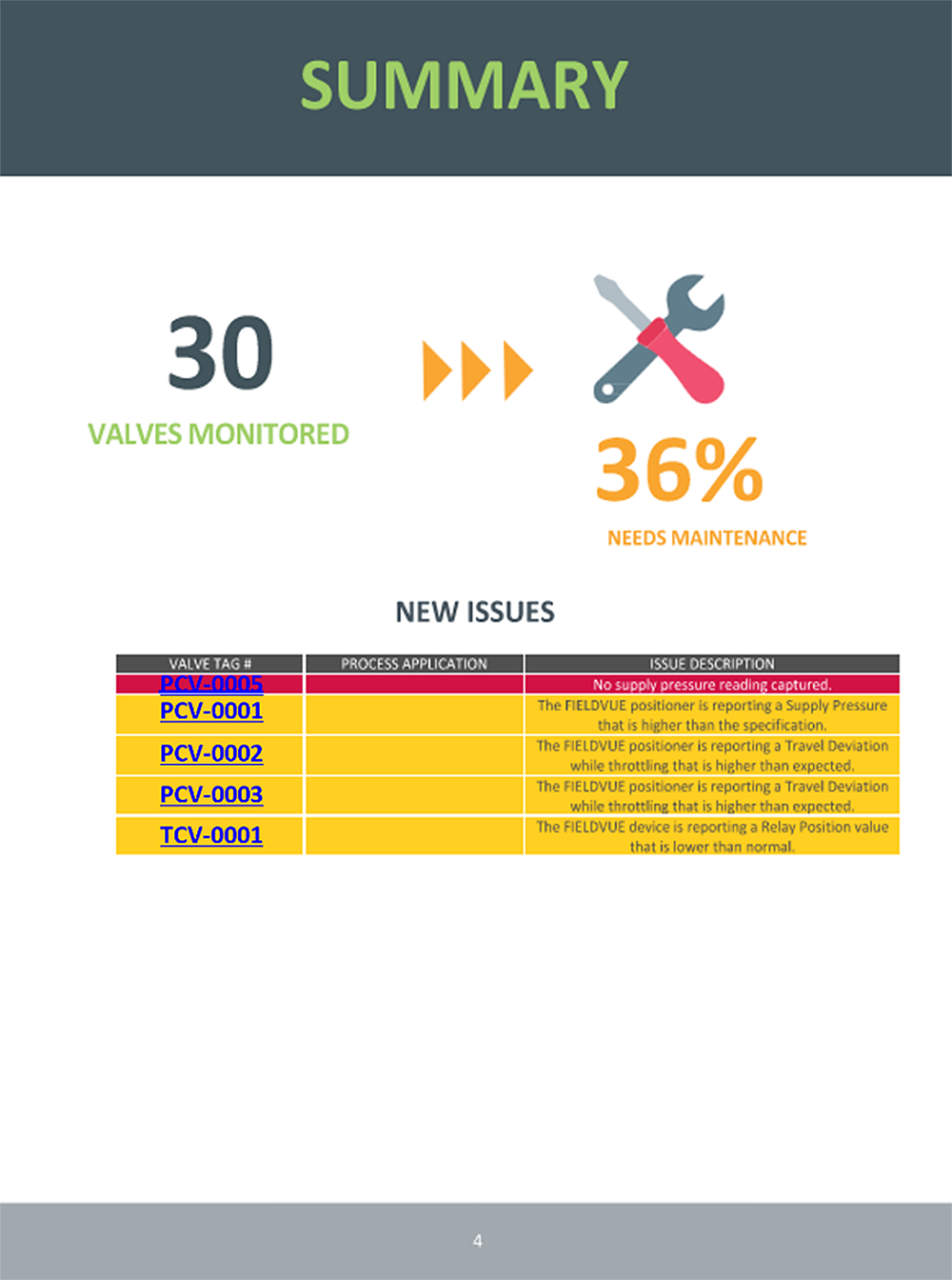
 Figure 2: Remote control valve monitoring services provide a list of problem valves on a bi-weekly, monthly, or quarterly basis, indicating details of the problem and potential solutions. Significant issues are immediately transmitted to the end user’s maintenance personnel so they can be quickly addressed.
In many cases, DVC sensors can spot and flag developing issues before they directly affect production. Changes in packing friction, slower than normal movement, failing to make full travel and other issues are all signs of worsening conditions that will ultimately lead to valve failure if not addressed.
Achieving real-world savings
A combined cycle power plant had numerous combustion and steam turbines with 200 control valves, all of which were maintained by a small, overworked staff of technicians. The site had standardized on Emerson’s Fisher™ Fieldvue™ DVC6200 DVCs for all their valves, and it had an Emerson Ovation control system and an existing digital network, with data from the valves sent to an AMS Device Manager ValveLink™ SNAP-ON Application, also from Emerson. As a result, plant personnel had access to a veritable mountain of data and information, but they lacked the time and expertise to leverage it. They engaged their local automation provider, and it offered the possibility of Emerson’s remote Valve Condition Monitoring service. Most of the infrastructure was already in place, so the service offering only required the installation of a secure network connection to allow the remote monitoring team to access continuous performance data for the site’s critical valves.
The results quickly justified the cost, revealing high temperatures on two valves that risked damaging them (Figure 3). The root cause was a room heater which had been placed in the room to avoid freezing. Unfortunately, it was located very close to two valves and had been subjecting them to elevated temperatures. Fortunately, the condition was detected and resolved before any valve damage occurred.
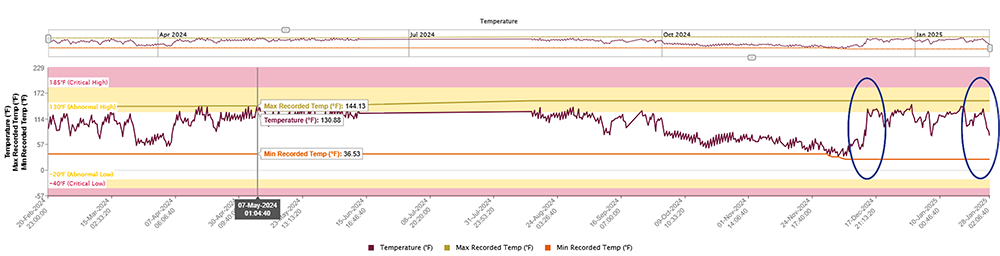 Figure 3: Abnormally high actuator temperatures were noted on two valves during winter months. These were flagged by the monthly valve report, and a field investigation found that a space heater was stuck on in the equipment room.
Shortly thereafter, several valves in identical applications but on different units indicated travel and friction anomalies. The valves were pulled and found to have severely eroded plugs that would have ultimately caused an outage. About $500,000 in lost production was averted in the first year due to the remote valve monitoring program, more than justifying the cost of the service. Most of the required equipment was already in place, typically the case, reducing initial costs and implementation time.
Take advantage of your investments
Advanced DVCs certainly offer significant improvements in process control. However, the data they provide can easily double that benefit if it is fully leveraged. Most plants have advanced DVCs already installed, as well as the communication networks and control systems required to gather the data, so a remote valve condition monitoring program can often be easily and inexpensively implemented. Even if the program is limited to critical valves, the savings from reduced and timely maintenance can avert costly process downtime and interruptions.
If your maintenance staff find themselves overwhelmed, and if unexpected control valve failures are costing the plant money and production, it may be time to take full advantage of the smart DVCs and communication networks that likely already exist in your facility. Third-party service providers are ready to provide your team with the required assistance, with any costs quickly and continuously recovered, and more, due to increased uptime.
Figures courtesy of Emerson