
On the surface, it’s difficult to know where to begin. The best place to start is analyzing your energy data. But unfortunately, you can’t find that data on your electric bill—it’s barely a summary. To manage your energy, start by measuring it. Once you determine where, when and how that energy is consumed, areas for improvement become obvious.
How energy monitoring can help you
Unstable pricing:
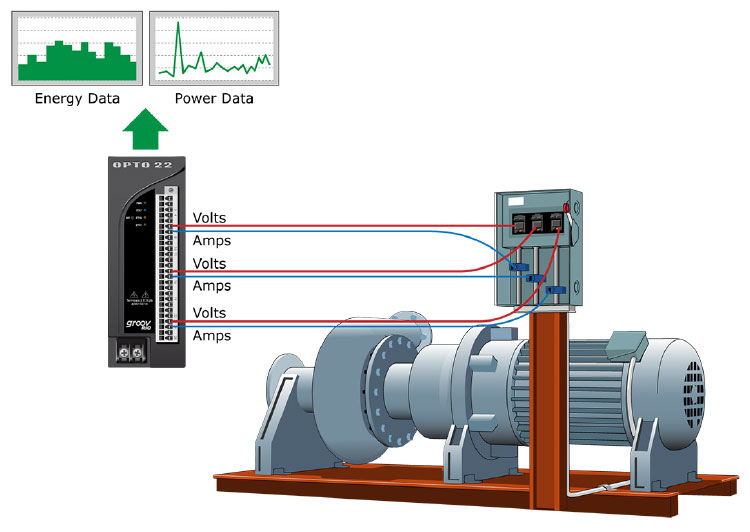
Did you know that in many districts, the price of power changes during the day? It spikes during peak hours and drops during off-peak hours. Don’t blame the utility companies. They are just trying to manage the grid to avoid overload. But variable energy pricing created an opportunity for Opto 22, a manufacturing company that uses more than 500 kWh daily. Adding a few groov RIO Energy Monitoring units (EMUs) (Figure 1) gave the company the data to see easy ways to save tens of thousands of dollars each month.
Powerful predictions:
Unlocking machine health insights. Energy is used in every industrial process and is usually fairly predictable. But add energy monitoring to a process, or even just a single motor, and new insight emerges. At some point, that motor’s electric current consumption will change because of a bad motor winding, inadequately lubricated bearings, a clogged cooling fan, fluctuating incoming voltage and so on. One thing is certain: a sudden change to the baseline operating current indicates a problem that could cost time and money.
That’s why industrial original equipment manufacturer (OEM) Alta Refrigeration includes a groov RIO EMU in every system they build and install at customer cold storage sites. Cataloging energy usage in 10-minute intervals provides insight to help keep refrigeration running at peak performance. As Peter Santoro, controls engineer at ALTA, explained, “Often, we know what the problem is before the customer calls.” Pricing per part. Most organizations consider energy costs part of overhead—ongoing expenses of running a business that aren’t directly tied to a specific product or service.
The bill gets paid by accounting, and most production environments never see a detailed breakdown of where their kilowatts are going. That makes it easy to pass blame onto other departments and hide energy inefficiencies. But Mercer Technologies , an OEM of heat treatment furnaces, took a new approach. “In our most recent design, we’ve used the groov RIO EMU to monitor energy consumption of a particular furnace,” said Cody Young, Mercer’s controls and automation engineer.
“With energy monitoring, we can calculate in real time how much it costs to heat treat parts, and we can now accurately assign the cost of energy to the production of a particular component.” Environmental, social and governance: Businesses now have to balance profitability with environmental impact. Products and brands that uphold environmental, social and governance (ESG) principles tend to experience stronger growth compared to those that don't, and government regulations and incentives for reducing carbon footprint are on the rise. The State of Indiana recently launched its Energy INsights Program.
Sponsored by the Indiana Economic Development Corporation (IEDC), the program offers smart manufacturing starter kits to small and medium manufacturers with the goal of reducing energy costs by 5-15%. Each kit contains the energy monitoring equipment a company needs to get started: an Opto 22 groov EPIC processor preloaded and licensed for use with Inductive Automation’s Ignition SCADA and a few groov RIO EMUs equipped with I/O points and current transformers to measure power consumption in real time (Figure 2). 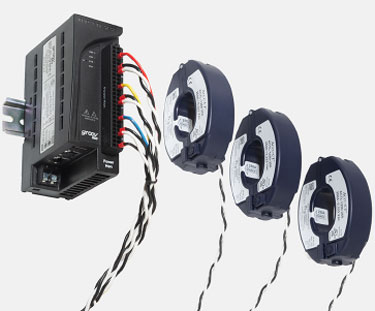
Plug into power awareness
Are you ready to get started? Watch the IntegrateLive! Webinar to see how easy it is to wire up a groov RIO EMU to a field device, commission it with your web browser, and immediately start monitoring the data flow with the SCADA software of your choice. You may be surprised how quickly you can start reducing energy expense, tracking machine health, allocating costs and meeting ESG goals. This feature originally appeared in the May Sustainability issue of AUTOMATION 2024.