ISA provides technical resources and standards to help industrial automation professionals advance their careers and the field. We enable automation professionals worldwide to solve problems and enhance their skills by bringing people together to create new technologies and share best practices with future automation professionals.
We attract over 140,000 unique automation professionals monthly, making us the premier online content provider and the only dedicated electronic magazine in the automation industry.
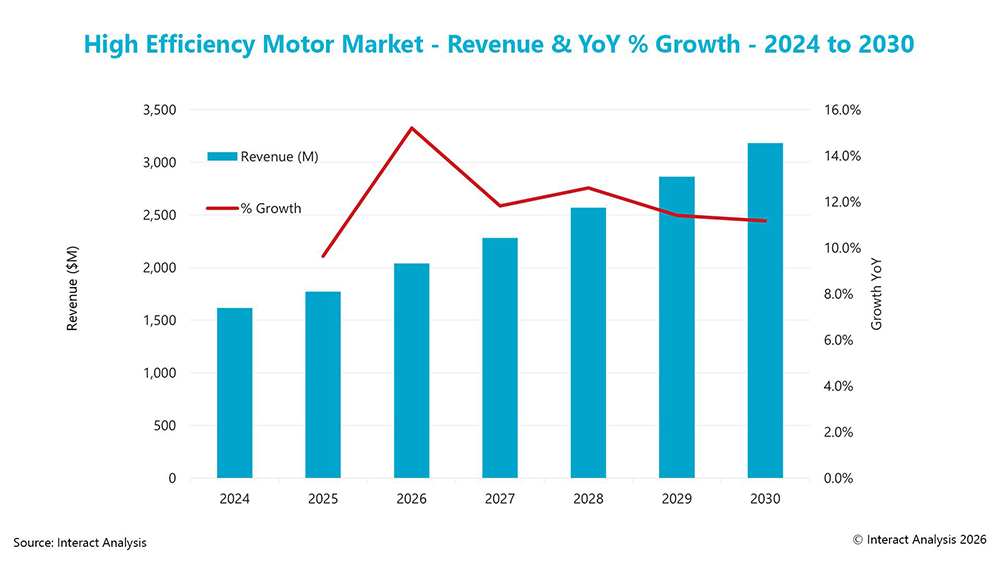
The market for high-efficiency motors is forecast to soar from $1.6 billion in 2024 to $3.1 billion in 2030.
LONDON, Feb. 24, 2026 — Continued growth is anticipated in the high-efficiency motor market between 2026 and 2030, according to the latest research report from Interact Analysis. The market intelligence specialist is cautiously optimistic about the outlook for the sector and forecasts a strong year in 2026, with revenues expected to climb by 15%. This follows a market slowdown in 2025 when poor global macroeconomic conditions hindered demand. Rising demand for high-efficiency motors in certain industry sub-sectors, such as data centers, and mandatory legislation, particularly in Europe, is driving growth. An average annual growth rate of 12% is predicted between 2024-2030, with the market rising from $1.6 billion in 2024 to $3.1 billion in 2030.
EMEA continues to lead the way in high-efficiency motors
In 2024, Europe, the Middle East and Africa (EMEA) region accounted for approximately 48.5% of global market revenues in the high-efficiency motor sector. Europe was the first region to pass major legislation mandating the usage of motors meeting IE4 levels of efficiency. Meanwhile, rising energy costs across the continent have also contributed to a surge in demand for high-efficiency motors since 2022. High-efficiency motors market revenues reached $782.8 million in 2024 and this is expected to rise to $1.6 billion by 2030. The second-largest region for high-efficiency motors is currently APAC, accounting for $519.9 million of revenue in 2024, projected to rise to $942.6 million by 2030. There is no current major IE4 legislation in the region, with demand driven by the sheer scale of the manufacturing sector. Finally, The Americas accounted for 19.4% of total market revenues in 2024 ($312.9 million, rising to $600.5 million by 2030). Although there is strong growth in the sector, a lack of legislation has hindered the pace of adoption.
What to expect for high-efficiency motors in 2026
In Q3 and Q4 of 2025, many motor vendors reported market conditions improving and Interact Analysis expects this to continue into 2026.
Blake Griffin, Interact Analysis research manager, said, “Many capital projects were paused during 2025 as uncertainty loomed and interest rates remained high. As the year continued, the new economic reality surrounding US tariff policy normalized, while at the same time, borrowing conditions improved.
“2026 is expected to be a peak year during our forecast as the remaining motors in Europe legislated to be IE4 are substituted away from IE3 (75kw to 200kw). We expect the market will maintain high levels of growth through our forecast, with market values in nearly every major region expected to double by 2030.”
About the report: High efficiency motors
This report provides an analysis of high efficiency (IE4+) low voltage AC motors. The movement towards high efficiency motors is inevitable. Legislation in the EU going into effect mid-2023 will mandate that motors between 75kw –200kw meet a minimum IE4 efficiency standard. This will mark the first legislative action within the motor market which includes IE4. The expectation is more legislation is due to follow both in Europe as well as other regions. As such, it has become increasingly important to understand the market for high-efficiency motors, and the likely direction the market will head with regard to motor topology.
About Interact Analysis
With more than 200 years of combined experience, Interact Analysis is the market intelligence authority for global supply chain automation. Our research covers the entire automation value chain – from the technology used to automate factory production, through inventory storage and distribution channels, to the transportation of the finished goods. The world’s leading companies trust us to surface robust insights and opportunities for technology-driven growth.