This post is an excerpt from the journal ISA Transactions. All ISA Transactions articles are free to ISA members, or can be purchased from Elsevier Press .
Abstract:
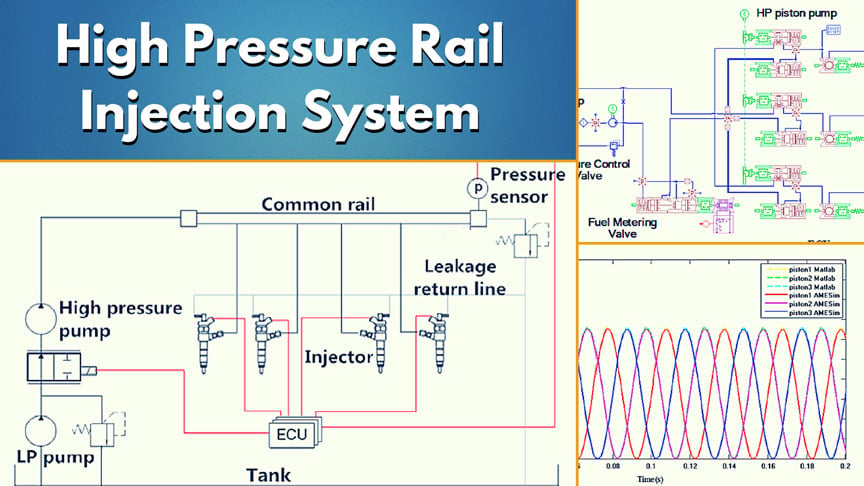
In this paper, modeling and common-rail pressure control of high-pressure common rail injection system (HPCRIS) is presented. The proposed mathematical model of high pressure common rail injection system which contains three sub-systems: high pressure pump sub-model, common rail sub-model and injector sub-model is a relative complicated nonlinear system. The mathematical model is validated by the software Matlab and a virtual detailed simulation environment. For the considered HPCRIS, an effective model free controller which is called extended state observer–based intelligent proportional integral (ESO-based iPI) controller is designed. And this proposed method is composed mainly of the referred ESO observer, and a time delay estimation based iPI controller.
Finally, to demonstrate the performances of the proposed controller, the proposed ESO-based iPI controller is compared with a conventional PID controller and ADRC.
Free Bonus! To read the full version of this ISA Transactions article, click here .
Join ISA and get free access to all ISA Transactions articles as well as a wealth of other technical content, plus discounts on events, webinars, training & education courses, and professional certification.
Click here to join ... learn, advance, succeed!
2006-2017 Elsevier Science Ltd. All rights reserved.