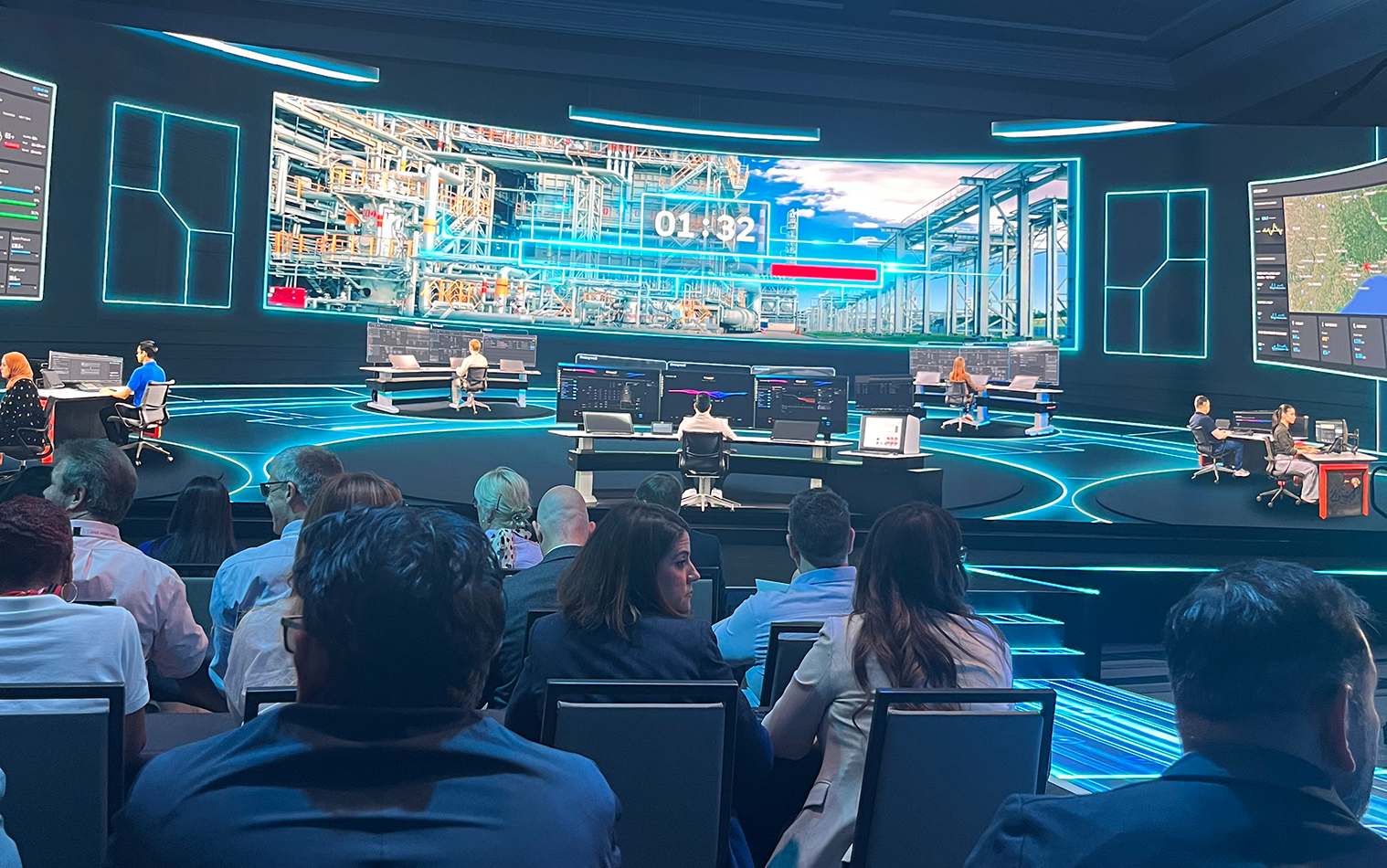
Honeywell Process Automation celebrated its 50th annual Honeywell Users Group (HUG) event in Phoenix from June 7-11, where industry professionals gathered to learn how AI is impacting both manufacturing optimization and the cybersecurity threat environment.
“The cybersecurity landscape for industrial organizations continues to evolve rapidly, with increasingly advanced threats targeting critical operations,” said Jim Masso, president and CEO of Honeywell Process Automation.
In addition to showcasing all its latest solutions in the HUG Demo Center, Honeywell brought together a range of expert speakers. In Tuesday’s keynote session, OT/ITS cybersecurity professional Mike Holcomb spoke about how cyber attacks have changed in the recent past.
“We’re seeing the first documented cases of AI being used to target OT,” Holcomb said.
In 2021, when a ransomware group hacked into the IT network of Colonial Pipeline, which operates the largest gasoline pipeline in the United States, it ended up causing 10 days of downtime. Hackers started to realize they don’t have to attack the OT directly; instead, they can get into something the OT relies on to operate, like IT. They can also access a wealth of information via Chat GPT about specific companies that haven’t protected their data well enough, he said.
In Monterey, New Mexico, earlier this year, threat actors used Claude and OpenAI’s GPT models to try hacking into the IT network at a municipal water and drainage facility, Holcomb said. Claude wrote and managed a 17,000-line Python framework that included publicly available offensive security techniques and credential harvesting.
“While the toolset was not particularly sophisticated or novel, the speed at which Claude assembled, tested and iterated on it was operationally significant, compressing what would have taken days or weeks of development into hours,” according to SecurityWeek.
Claude suggested that the attackers target the operational technology (OT) system and attempted to help the hackers gain access to it using a password-spray attack. Even though the attack was ultimately unsuccessful, it serves as an important warning.: Threat actors can use generative AI (like Claude) to quickly access information and write code intended to attack OT systems.
“Though these environments are complex, protecting them doesn’t have to be,” Holcomb said. “If we took five minutes a week to say, ‘Hey, what other cybersecurity incidents are out there happening in the OT world? Can this impact us and, if so, what can we do about it?’ Our environments would be a million times more secure than they are today.”
When Wi-Fi came out, everyone wanted it, Holcomb continued. But unfortunately, it wasn’t secure. Attackers could get onto Wi-Fi and steal data. Holcomb explained that his boss at the time pulled him aside and told him that he didn’t have a choice about using Wi-Fi. More and more businesses were going to use Wi-Fi. Cybersecurity professionals were forced to rise to the challenge. It’s the same with AI. It’s here to stay, whether we like it or not, and its abilities are only going to get more extensive, he said.
Holcomb recommended five “BASIC” recommendations for securing OT systems in today’s cybersecurity landscape:
- Back up and recovery. It’s not a question of if we will get hit but a question of when.
- Asset inventory: Inventory hardware, software and firmware and implement asset registers.
- Secure network architecture.
- Incident response planning: We needed to pay attention to what else is going on in the world and what hackers are targeting.
- Continuous vulnerability management: Constantly monitor systems for weak points.
Honeywell is responding to the changing needs of the cybersecurity landscape with the expansion of its cybersecurity suite designed to protect against the next generation of cyber threats. The suite now offers five new capabilities. The new features include a portable USB-scanning device, an OT and endpoint monitoring service, a data diode that protects sensitive data flow and more.
“Organizations with a unified cybersecurity strategy across both digital and physical environments are setting a solid foundation for operational resilience while also avoiding potentially dangerous and costly attacks,” Masso said.
The June event marked the 50th annual HUG Americas, welcoming a global audience. There will be no EMEA HUG in 2026. Instead, Honeywell is hosting Process Automation Customer Days across Europe, the Middle East and Asia Pacific.