AutoQuiz is edited by Joel Don, ISA's community manager.
Today's automation industry quiz question comes from the ISA Certified Control Systems Technician (CCST) program . Certified Control System Technicians calibrate, document, troubleshoot, and repair/replace instrumentation for systems that measure and control level, temperature, pressure, flow, and other process variables. Click this link for more information about the CCST program.
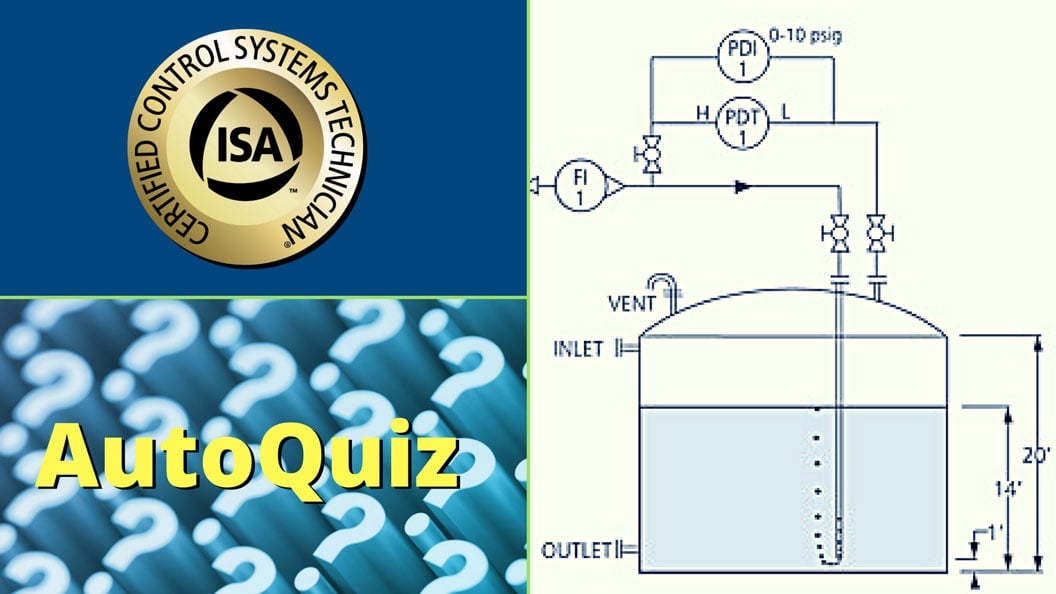
A tank level is measured using a differential pressure transmitter (DPT-1) and a bubbler tube. The tank is vented to atmosphere. The bubbler tube is 1 foot from the bottom of the tank, and the tank wall is 20 feet high. A 0-10 psig differential pressure gauge (DPI-1), accurate to .25 per cent of full scale, is connected to the bubbler tube connection at the high side of the transmitter. The low pressure side is connected to the tank top. With the tank containing liquid with a specific gravity of 1.2 and the level in the tank at 14 feet, the reading on DPI-1 in pounds per square inch (psi) is most nearly equal to:
a) 5.6 psi b) 6.1 psi c) 6.8 psi d) 7.3 psi e) none of the above
Fluid at a specific gravity of 1.0 exerts .43 psi per foot of level.
The fluid in this tank, at a specific gravity of 1.2, will exert .52 psi per foot of level.
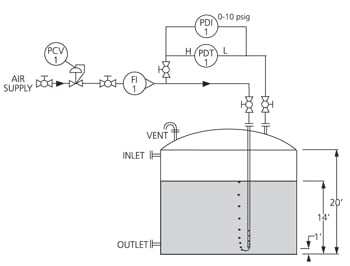
The bubbler tube has been offset 1 foot off of the bottom of the tank, therefore, it is only measuring 13 of the overall 14 feet. 13 ft × .52 psi/ft = 6.8 psi
The correct answer is C, 6.8 psi.