The International Society of Automation’s (ISA) Virtual Events Program debuted its IIoT & Smart Manufacturing Conference on Oct. 27, 2020. Speakers at this eight-session virtual event presented advances in connectivity, automation and security in the context of hybrid manufacturing. You can access the video recordings here for the next 30 days. The keynote speeches focused on the significance of 5G in the manufacturing and automation sectors.
Speakers included Adrian Scrase, CTO for the European Telecommunications Standard Institute (ETSI); Andrew Alleman, chief architect for network solutions, next generations, and standards at Intel Corporation; and Dr. Andreas Mueller, head of communication and network technology for Bosch Corporate Research. Other sessions during the day touched on industrial wireless systems and advancements in automation cyberphysical security, practical machine learning and artificial intelligence applications, smartly connecting manufacturing systems, how smart manufacturing is safe manufacturing, and more.
Keynote: 5G's growing importance
Adrian Scrase built a case for the increasing importance of 5G in manufacturing and automation, highlighting the spread of 5G, some of its best features, and its cybersecurity specificities.
“Many industry sectors demand high availability, high reliability, low latency, and secure communications, which 5G inherently supports,” Scrase explained. “5G . . . will revolutionize many industrial sectors.”
Scrase said 5G is being deployed faster than what was first predicted. In fact, the Global mobile Suppliers Association (GSA) has identified 392 operators and (operators to be) investing in tests, trials, pilots and more around 5G mobile and 5G fixed wireless access (FWA) networks. Though previous generations have either offered no satellite component or only a non-integrated add-on solution, Scrase said, 3GPP (the mobile broadband standard group) has studied enhancement of 5G to include non-terrestrial networks. That implies:
- Extending the reach to areas that can’t be optimally covered by terrestrial 5G networks.
- Providing 5G service reliability and resiliency for public safety systems.
- Providing connectivity on board airborne vehicles, (such as air flight passengers, UASs/drones, etc.), vessels, and trains.
“Security is not something where you check the box and you’re done," Scrase said. “There’s always be work to be done to make sure we stay ahead and stay state- of- the- art. [When it comes to] 5G, this becomes even more important.”
Enabling manufacturing distributed computing
Andrew Alleman discussed how 5G can engender business value across a variety of use cases, such as automated guided vehicles (AGVs), virtual reality and vision-based quality checks. For example, Intel & Bosch successfully demonstrated time-sensitive networking (TSN) over 5G. Intel “actively participates in standards bodies like 3GPP to develop specifications to support TSN-over-5G , such as Release-16, and work with the ecosystem to create a proofs of concept (PoC) based on the early specifications using next-generation wireless technologies like 5G and Wi-Fi 6,” according to a recently blog post. 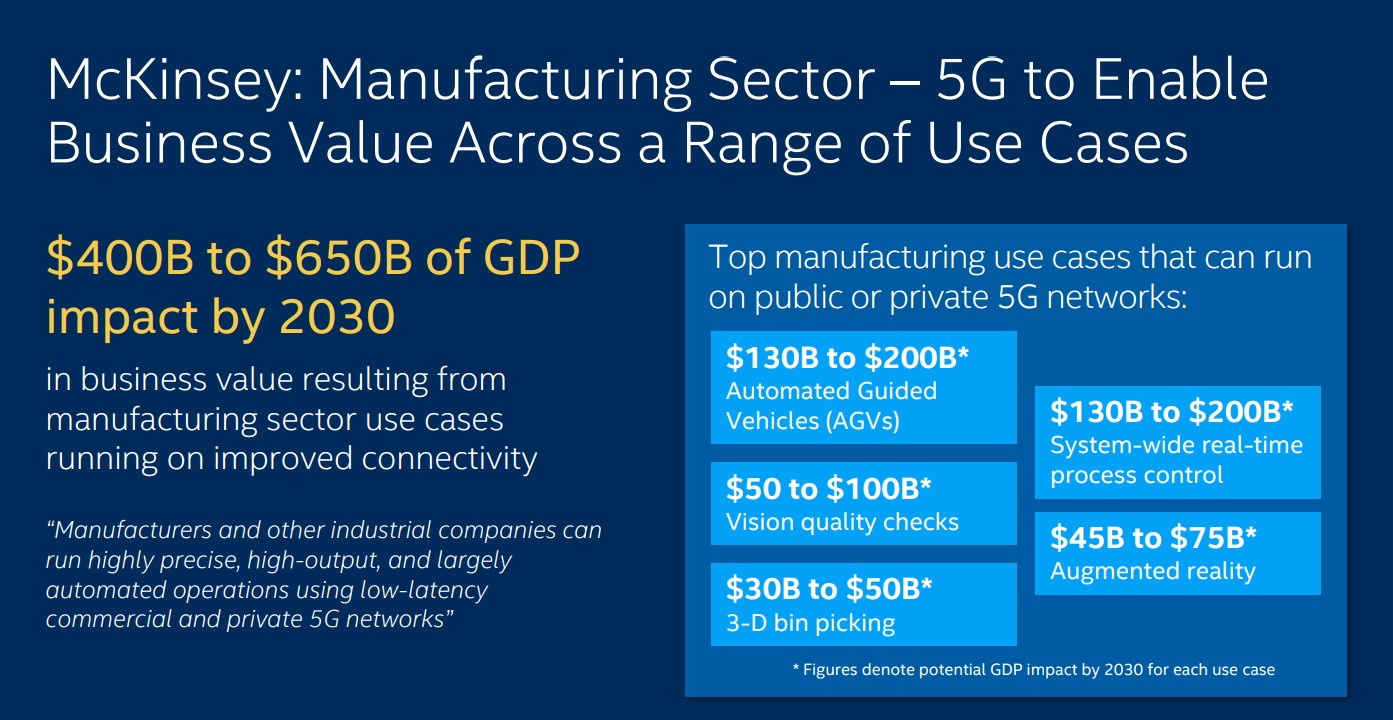 “5G will be an enabler for many types of applications, certainly in the manufacturing space and will drive the digital transformation of that space," Alleman said.
"It's part of an overall larger shift toward network-based and distributed computing architectures."
5G for the industrial IoT: Lifting Industry 3.0 to the next level
Dr. Andreas Mueller took a deep dive into the reasoning behind 5G’s significant impact on Industrial IoT. “5G is the backbone of the vision for the factory of the future,” he said.
Mueller outlined the five overarching reasons for 5G in manufacturing:
- Industrial-grade performance, including high reliability, low latency and good coverage.
- Use case disruption, enabling completely new system architectures.
- Higher flexibility & versatility for quickly reacting to market needs & easy retrofitting.
- Key to convergence – on the way to a one-size fits all solution.
- Future-proof platform for easy upgrades in the future.
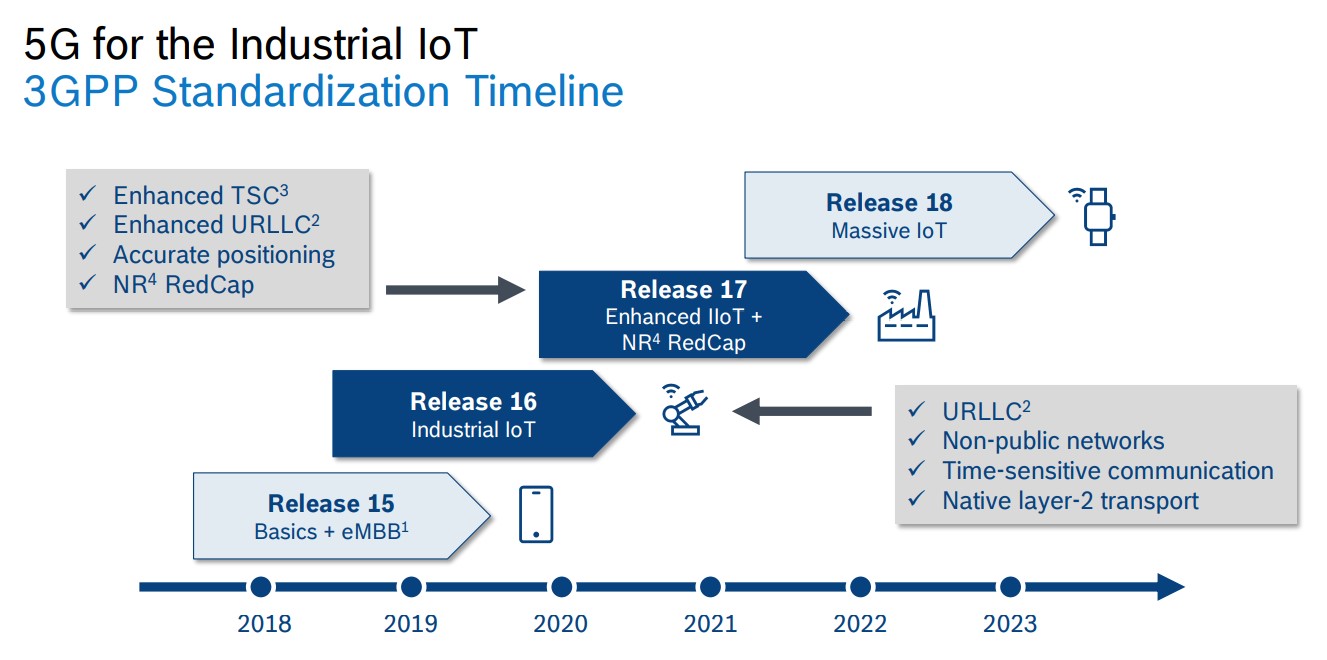
Mueller also gave an overview of the 3 GPP standardization timeline so listeners could see how 5G for the industrial IoT has been standardized over the past few years.